
惯性聚合 高效追踪和阅读你感兴趣的博客、新闻、科技资讯
阅读原文 在惯性聚合中打开

推荐订阅源

WordPress大学
WordPress大学
Cyberwarzone
Cyberwarzone
The GitHub Blog
The GitHub Blog
云风的 BLOG
云风的 BLOG
P
Proofpoint News Feed
小众软件
小众软件
Recent Announcements
博客园 - 三生石上(FineUI控件)
Security Archives - TechRepublic
W
WeLiveSecurity
Cloudbric
Cloudbric
博客园 - 司徒正美
美团技术团队
N
News and Events Feed by Topic
Exploit-DB.com RSS Feed
PCI Perspectives
PCI Perspectives
宝玉的分享
宝玉的分享
H
Help Net Security
H
Hackread – Cybersecurity News, Data Breaches, AI and More
Google DeepMind News
Help Net Security
Help Net Security
Last Week in AI
Last Week in AI
S
Schneier on Security
N
News | PayPal Newsroom
B
Blog RSS Feed
L
LINUX DO - 最新话题
T
Troy Hunt's Blog
S
Secure Thoughts
雷峰网
雷峰网
aimingoo的专栏
aimingoo的专栏
L
Lohrmann on Cybersecurity
G
Google Developers Blog
Microsoft Azure Blog
Hacker News - Newest:
Hacker News - Newest: "LLM"
T
Tenable Blog
S
Securelist
L
LangChain Blog
Recent Commits to openclaw:main
I
InfoQ
H
Heimdal Security Blog
Cisco Talos Blog
Cisco Talos Blog
F
Full Disclosure
Y
Y Combinator Blog
酷 壳 – CoolShell
酷 壳 – CoolShell
K
Kaspersky official blog
T
Tailwind CSS Blog
奇客Solidot–传递最新科技情报
奇客Solidot–传递最新科技情报
钛媒体:引领未来商业与生活新知
钛媒体:引领未来商业与生活新知
阮一峰的网络日志
阮一峰的网络日志
C
Cisco Blogs

MIT Technology Review

Want to get a data center online quickly? Give it some flex. Why do South Koreans love AI so much? This man with ALS is “the first power user” of a brain implant that lets him speak The Download: cutting AC emissions, and nature’s drug designer These new solid-state ACs promise a cool future. Scientists aren’t so sure. The Download: “reprogramming” aging, and the hidden sense of interoception You do your own time Why “reprogramming” is the buzziest approach to reversing aging right now Inside interoception: The hidden sense of how you feel inside The Download: soccer’s data renaissance and China’s big nuclear plans Google DeepMind is worried about what happens when millions of agents start to interact Job titles of the future: Nature’s drug designer Inside soccer’s data renaissance Why China is betting on big nuclear reactors The Download: the “steroid olympics” and a safer Mythos The “steroid olympics” were a circus—and a window into our culture The Download: whole-body rejuvenation drugs and five things to know about AI Learning to lead in a hybrid human-AI enterprise David Sinclair plans to test whole-body rejuvenation drugs in the XPrize competition Five things you need to know about AI The Download: how the World Cup ball will fly and OpenAI’s “super app” Why this year’s World Cup ball may not fly as far The Download: AI hacking beyond Mythos, and chatbots’ impact on our brains Are AI chatbots making us lose control of our brains? The Meta hack shows there’s more to AI security than Mythos The Download: AI-generated lawsuits and virtual power plants for data centers How courts are coping with a flood of AI-generated lawsuits How virtual power plants could provide energy for data centers The Download: Trump’s new AI order, and smart glasses for warfare The Download: AI can run your admin department now Rehumanizing global health care with agentic AI How small businesses can leverage AI The Download: China’s brain implant ambitions China has approved the world’s first invasive brain-computer chip—here’s what’s next The Download: unlocking lithium and controlling Ebola The deadly Ebola outbreak is proving difficult to control How the Pope’s Magnifica Humanitas offers a template for individuals to meet the AI moment How a new extraction process could unlock the world’s lithium The Download: climate tech goes public and the AI Hype Index returns Climate tech companies are going public. What’s next? The AI Hype Index: AI gets booed in graduation season The Download: keeping up with AI, and the future of IVF Green steel startup Boston Metal is doubling down on critical metals How Chinese short dramas became AI content machines The shock of seeing your body used in deepfake porn Three things in AI to watch, according to a Nobel-winning economist The Download: seafloor science and military chatbots The Download: inside the Musk v. Altman trial, and AI for democracy A blueprint for using AI to strengthen democracy Week one of the Musk v. Altman trial: What it was like in the room Trump’s mass firing just dealt another blow to American science A new US phone network for Christians aims to block porn and gender-related content This startup’s new mechanistic interpretability tool lets you debug LLMs Rebuilding the data stack for AI The Download: DeepSeek’s latest AI breakthrough, and the race to build world models The Download: introducing the 10 Things That Matter in AI Right Now Roundtables: Unveiling The 10 Things That Matter in AI Right Now The new word in home construction could be “plastics” A natural protein may protect the GI tract from infection This tool could show how consciousness works Early life may have breathed oxygen earlier than believed Analog computing from waste heat Get ready for hotter, muggier, stormier summers Recent books from the MIT community AI at MIT Inventor recalls eye imaging breakthrough Pie Day 2026 The Download: bad news for inner Neanderthals, and AI warfare’s human illusion The case for fixing everything How robots learn: A brief, contemporary history Making AI operational in constrained public sector environments Treating enterprise AI as an operating layer The Download: cyberscammers’ banking bypasses, and carbon removal troubles Why having “humans in the loop” in an AI war is an illusion The noise we make is hurting animals. Can we learn to shut up? The quest to measure our relationship with nature Is carbon removal in trouble? The Download: NASA’s nuclear spacecraft and unveiling our AI 10 Cyberscammers are bypassing banks’ security with illicit tools sold on Telegram No one’s sure if synthetic mirror life will kill us all Redefining the future of software engineering The Download: the state of AI, and protecting bears with drones NASA is building the first nuclear reactor-powered interplanetary spacecraft. How will it work? Coming soon: 10 Things That Matter in AI Right Now The problem with thinking you’re part Neanderthal Why opinion on AI is so divided Want to understand the current state of AI? Check out these charts. The Download: how humans make decisions, and Moderna’s “vaccine” word games Job titles of the future: Wildlife first responder You have no choice in reading this article—maybe What’s in a name? Moderna’s “vaccine” vs. “therapy” dilemma The Download: an exclusive Jeff VanderMeer story and AI models too scary to release Constellations The Download: AstroTurf wars and exponential AI growth Desalination technology, by the numbers Is fake grass a bad idea? The AstroTurf wars are far from over. Mustafa Suleyman: AI development won’t hit a wall anytime soon—here’s why The Download: water threats in Iran and AI’s impact on what entrepreneurs make Desalination plants in the Middle East are increasingly vulnerable Enabling agent-first process redesign
Building trust in the AI era with privacy-led UX
2026-04-15 · via MIT Technology Review

Skip to Content

Sponsored

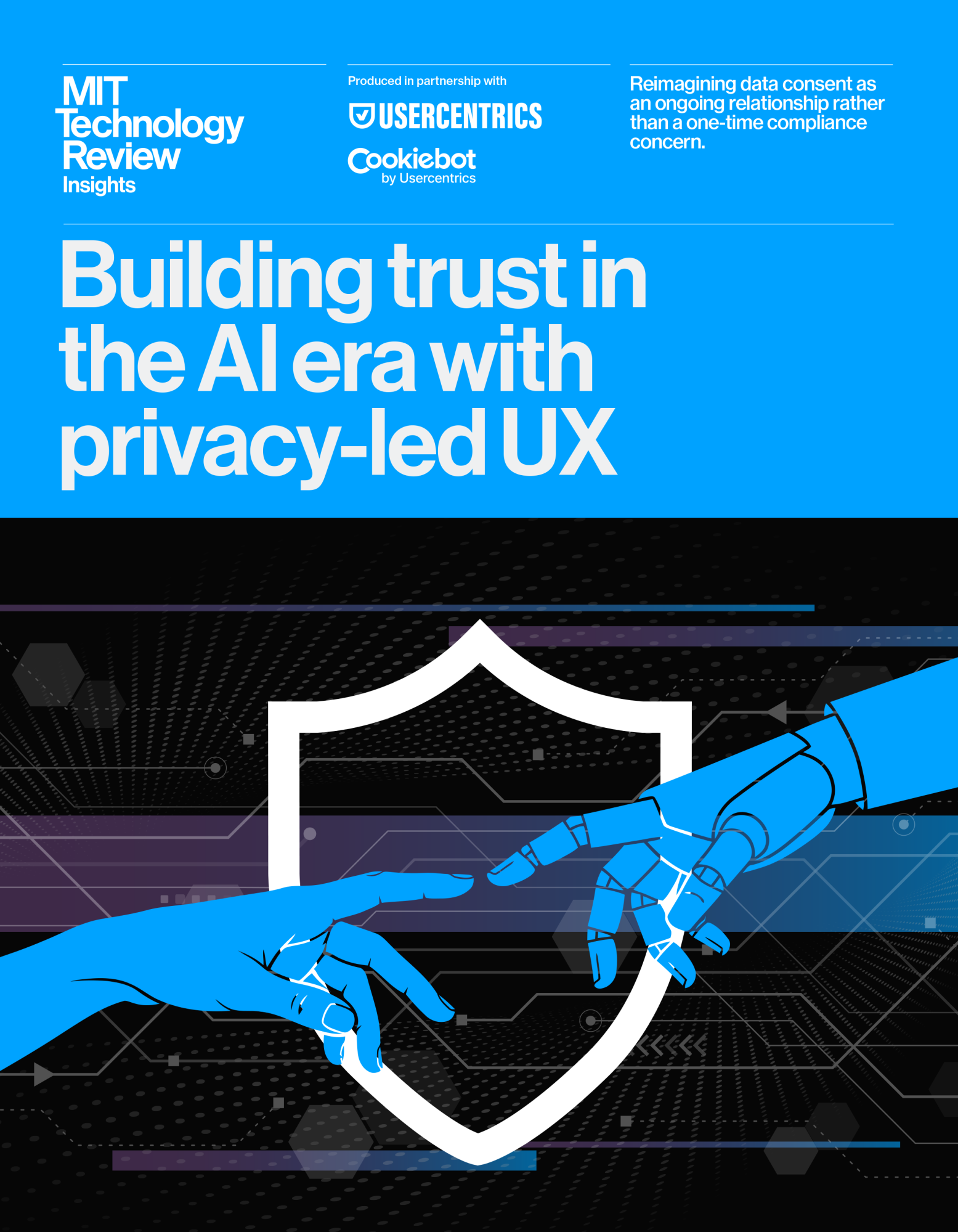
Reimagining data consent as an ongoing relationship rather than a one-time compliance concern.

April 15, 2026

The practice of privacy-led user experience (UX) is a design philosophy that treats transparency around data collection and usage as an integral part of the customer relationship. An undertapped opportunity in digital marketing, privacy-led UX treats user consent not as a tick-box compliance exercise, but rather as the first overture in an ongoing customer relationship. For the companies that get it right, the payoff can bring something more intangible, valuable, and durable than simple consent rates: consumer trust.
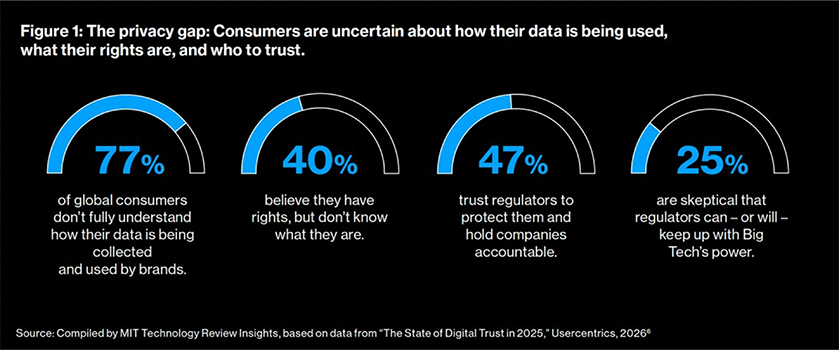
The opportunities of privacy-led UX have only recently come into focus. Adelina Peltea, the chief marketing officer at Usercentrics, has seen enterprise sentiment shift: “Even just a few years ago, this space was viewed more as a trade-off between growth and compliance,” she says. “But as the market has matured, there’s been a greater focus on how to tie well-designed privacy experiences to business growth.”

And it turns out that well-designed, value-forward consent experiences routinely outperform initial estimates.
Touchpoints for privacy-led UX often include consent management platforms, terms and conditions, privacy policies, data subject access request (DSAR) tools, and, increasingly, AI data use disclosures.

This report examines how data transparency builds trust with customers; how this, in turn, can support business performance; and how organizations can maintain this trust even as AI systems add complexity to consent processes.
Key findings include the following:

  • Privacy is evolving from a one-time consent transaction into an ongoing data relationship. Rather than asking users for broad permissions up front, leading organizations are introducing data-sharing decisions gradually, matching the depth of the ask to the stage of the customer relationship. Companies that take this tack tend to gather both a larger quantity and higher quality of consumer data, the value of which often compounds over time.
  • Privacy-led UX is a prerequisite for AI growth. The consumer data that organizations gather is rapidly becoming a core foundation upon which AI-powered personalization is built. Organizations that establish clear, enforceable privacy and data transparency policies now are better positioned to deploy AI responsibly and at scale in the future. This starts with correctly configured consent mode across ad platforms.
  • Agentic AI introduces new levels of both complexity and opportunity. As AI systems begin acting on users’ behalf, the traditional consent moment may never occur. Governing agent-generated data flows requires privacy infrastructure that goes well beyond the cookie banner.
  • Realizing the advantages of privacy-led UX requires cross-functional collaboration and clear leadership. Privacy-led UX touches marketing, product, legal, and data teams—but someone must own the strategy and weave the threads together. Chief marketing officers
  • (CMOs) are often best positioned for that role, given their visibility across brand, data, and customer experience.
  • A practical framework can support businesses in getting it right. Organizations must define their data collection and usage strategies and ensure their UX incorporates data consent, including a focus on banner design. Following a blueprint for evaluating and improving privacy-led UX supports consistency at every consent touchpoint.

Download the report.

This content was produced by Insights, the custom content arm of MIT Technology Review. It was not written by MIT Technology Review’s editorial staff. It was researched, designed, and written by human writers, editors, analysts, and illustrators. This includes the writing of surveys and collection of data for surveys. AI tools that may have been used were limited to secondary production processes that passed thorough human review.

Deep Dive

Stay connected

Illustration by Rose Wong

Get the latest updates from
MIT Technology Review

Discover special offers, top stories, upcoming events, and more.