
惯性聚合 高效追踪和阅读你感兴趣的博客、新闻、科技资讯
阅读原文 在惯性聚合中打开

推荐订阅源

Threat Intelligence Blog | Flashpoint
爱范儿
爱范儿
H
Help Net Security
Last Week in AI
Last Week in AI
The Cloudflare Blog
博客园 - 三生石上(FineUI控件)
小众软件
小众软件
IT之家
IT之家
aimingoo的专栏
aimingoo的专栏
大猫的无限游戏
大猫的无限游戏
Jina AI
Jina AI
Google DeepMind News
B
Blog
C
Check Point Blog
T
Tailwind CSS Blog
云风的 BLOG
云风的 BLOG
D
Docker
Recent Announcements
Vercel News
Vercel News
博客园 - 聂微东
阮一峰的网络日志
阮一峰的网络日志
MyScale Blog
MyScale Blog
The GitHub Blog
The GitHub Blog
Stack Overflow Blog
Stack Overflow Blog
雷峰网
雷峰网
人人都是产品经理
人人都是产品经理
月光博客
月光博客
F
Fortinet All Blogs
Blog — PlanetScale
Blog — PlanetScale
B
Blog RSS Feed
The Register - Security
V
Visual Studio Blog
F
Full Disclosure
Hugging Face - Blog
Hugging Face - Blog
T
Threat Research - Cisco Blogs
Latest news
Latest news
PCI Perspectives
PCI Perspectives
Cisco Talos Blog
Cisco Talos Blog
博客园 - Franky
D
DataBreaches.Net
A
Arctic Wolf
OSCHINA 社区最新新闻
OSCHINA 社区最新新闻
奇客Solidot–传递最新科技情报
奇客Solidot–传递最新科技情报
G
Google Developers Blog
P
Palo Alto Networks Blog
Engineering at Meta
Engineering at Meta
Microsoft Azure Blog
T
Tenable Blog
L
LINUX DO - 热门话题
Spread Privacy
Spread Privacy

MIT Technology Review

Want to get a data center online quickly? Give it some flex. Why do South Koreans love AI so much? This man with ALS is “the first power user” of a brain implant that lets him speak The Download: cutting AC emissions, and nature’s drug designer These new solid-state ACs promise a cool future. Scientists aren’t so sure. The Download: “reprogramming” aging, and the hidden sense of interoception You do your own time Why “reprogramming” is the buzziest approach to reversing aging right now Inside interoception: The hidden sense of how you feel inside The Download: soccer’s data renaissance and China’s big nuclear plans Google DeepMind is worried about what happens when millions of agents start to interact Job titles of the future: Nature’s drug designer Inside soccer’s data renaissance Why China is betting on big nuclear reactors The Download: the “steroid olympics” and a safer Mythos The “steroid olympics” were a circus—and a window into our culture The Download: whole-body rejuvenation drugs and five things to know about AI Learning to lead in a hybrid human-AI enterprise David Sinclair plans to test whole-body rejuvenation drugs in the XPrize competition Five things you need to know about AI The Download: how the World Cup ball will fly and OpenAI’s “super app” Why this year’s World Cup ball may not fly as far The Download: AI hacking beyond Mythos, and chatbots’ impact on our brains Are AI chatbots making us lose control of our brains? The Meta hack shows there’s more to AI security than Mythos The Download: AI-generated lawsuits and virtual power plants for data centers How courts are coping with a flood of AI-generated lawsuits How virtual power plants could provide energy for data centers The Download: Trump’s new AI order, and smart glasses for warfare The Download: AI can run your admin department now Rehumanizing global health care with agentic AI How small businesses can leverage AI The Download: China’s brain implant ambitions China has approved the world’s first invasive brain-computer chip—here’s what’s next The Download: unlocking lithium and controlling Ebola The deadly Ebola outbreak is proving difficult to control How the Pope’s Magnifica Humanitas offers a template for individuals to meet the AI moment How a new extraction process could unlock the world’s lithium The Download: climate tech goes public and the AI Hype Index returns Climate tech companies are going public. What’s next? The AI Hype Index: AI gets booed in graduation season The Download: keeping up with AI, and the future of IVF Green steel startup Boston Metal is doubling down on critical metals How Chinese short dramas became AI content machines The shock of seeing your body used in deepfake porn Three things in AI to watch, according to a Nobel-winning economist The Download: seafloor science and military chatbots The Download: inside the Musk v. Altman trial, and AI for democracy A blueprint for using AI to strengthen democracy Week one of the Musk v. Altman trial: What it was like in the room Trump’s mass firing just dealt another blow to American science A new US phone network for Christians aims to block porn and gender-related content This startup’s new mechanistic interpretability tool lets you debug LLMs Rebuilding the data stack for AI The Download: DeepSeek’s latest AI breakthrough, and the race to build world models The Download: introducing the 10 Things That Matter in AI Right Now Roundtables: Unveiling The 10 Things That Matter in AI Right Now The new word in home construction could be “plastics” A natural protein may protect the GI tract from infection This tool could show how consciousness works Early life may have breathed oxygen earlier than believed Analog computing from waste heat Get ready for hotter, muggier, stormier summers Recent books from the MIT community AI at MIT Inventor recalls eye imaging breakthrough Pie Day 2026 The Download: bad news for inner Neanderthals, and AI warfare’s human illusion The case for fixing everything How robots learn: A brief, contemporary history Making AI operational in constrained public sector environments Treating enterprise AI as an operating layer The Download: cyberscammers’ banking bypasses, and carbon removal troubles Why having “humans in the loop” in an AI war is an illusion The noise we make is hurting animals. Can we learn to shut up? The quest to measure our relationship with nature Is carbon removal in trouble? The Download: NASA’s nuclear spacecraft and unveiling our AI 10 Cyberscammers are bypassing banks’ security with illicit tools sold on Telegram No one’s sure if synthetic mirror life will kill us all Building trust in the AI era with privacy-led UX Redefining the future of software engineering The Download: the state of AI, and protecting bears with drones NASA is building the first nuclear reactor-powered interplanetary spacecraft. How will it work? Coming soon: 10 Things That Matter in AI Right Now The problem with thinking you’re part Neanderthal Why opinion on AI is so divided The Download: how humans make decisions, and Moderna’s “vaccine” word games Job titles of the future: Wildlife first responder You have no choice in reading this article—maybe What’s in a name? Moderna’s “vaccine” vs. “therapy” dilemma The Download: an exclusive Jeff VanderMeer story and AI models too scary to release Constellations The Download: AstroTurf wars and exponential AI growth Desalination technology, by the numbers Is fake grass a bad idea? The AstroTurf wars are far from over. Mustafa Suleyman: AI development won’t hit a wall anytime soon—here’s why The Download: water threats in Iran and AI’s impact on what entrepreneurs make Desalination plants in the Middle East are increasingly vulnerable Enabling agent-first process redesign
Want to understand the current state of AI? Check out these charts.
2026-04-13 · via MIT Technology Review

If you’re following AI news, you’re probably getting whiplash. AI is a gold rush. AI is a bubble. AI is taking your job. AI can’t even read a clock. The 2026 AI Index from Stanford University’s Institute for Human-Centered Artificial Intelligence, AI’s annual report card, comes out today and cuts through some of that noise. 

Despite predictions that AI development may hit a wall, the report says that the top models just keep getting better. People are adopting AI faster than they picked up the personal computer or the internet. AI companies are generating revenue faster than companies in any previous technology boom, but they’re also spending hundreds of billions of dollars on data centers and chips. The benchmarks designed to measure AI, the policies meant to govern it, and the job market are struggling to keep up. AI is sprinting, and the rest of us are trying to find our shoes.

All that speed comes at a cost. AI data centers around the world can now draw 29.6 gigawatts of power, enough to run the entire state of New York at peak demand. Annual water use from running OpenAI’s GPT-4o alone may exceed the drinking water needs of 1.2 million people. At the same time, the supply chain for chips is alarmingly fragile. The US hosts most of the world’s AI data centers, and one company in Taiwan, TSMC, fabricates almost every leading AI chip. 

The data reveals a technology evolving faster than we can manage. Here’s a look at some of the key points from this year’s report. 

The US and China are nearly tied

In a long, heated race with immense geopolitical stakes, the US and China are almost neck and neck on AI model performance, according to Arena, a community-driven ranking platform that allows users to compare the outputs of large language models on identical prompts. In early 2023, OpenAI had a lead with ChatGPT, but this gap narrowed in 2024 as Google and Anthropic released their own models. In February 2025, R1, an AI model built by the Chinese lab DeepSeek, briefly matched the top US model, ChatGPT. As of March 2026, Anthropic leads, trailed closely by xAI, Google, and OpenAI. Chinese models like DeepSeek and Alibaba lag only modestly. With the best AI models separated in the rankings by razor-thin margins, they’re now competing on cost, reliability, and real-world usefulness. 
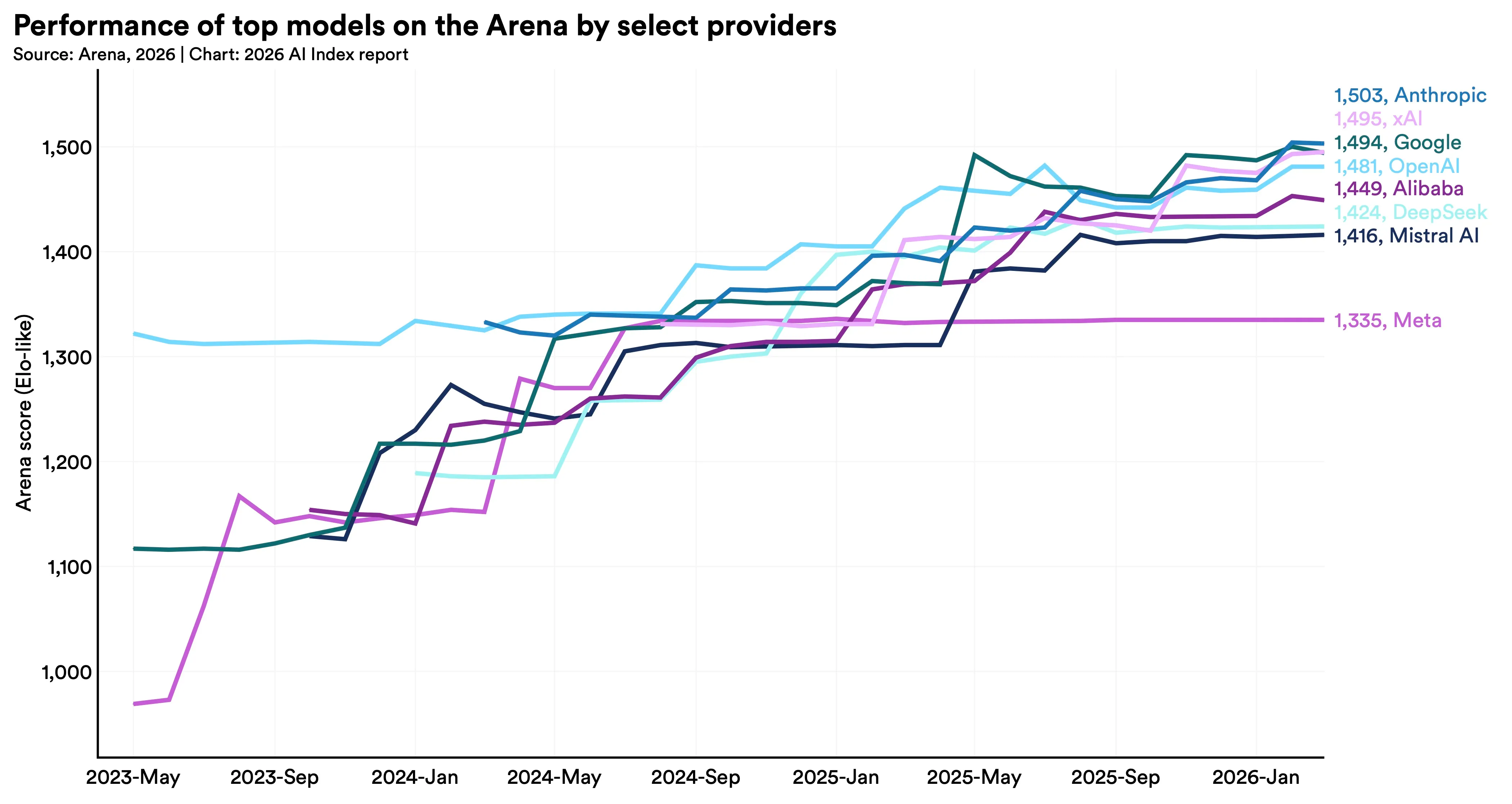
Chart of the performance of top models on the Arena by select providers, showing the Arena score from May 2023 to Jan 2026 with the models all trending upward.  The scores are tightly packed by US based Anthropic, xAI, Google and OpenAI lead Alibaba, DeepSeek and Mistral (in that order.) Meta trails the pack.

The index notes that the US and China have different AI advantages. While the US has more powerful AI models, more capital, and an estimated 5,427 data centers (more than 10 times as many as any other country), China leads in AI research publications, patents, and robotics. 

As competition intensifies, companies like OpenAI, Anthropic, and Google no longer disclose their training code, parameter counts, or data-set sizes. “We don’t know a lot of things about predicting model behaviors,” says Yolanda Gil, a computer scientist at the University of Southern California who coauthored the report. This lack of transparency makes it difficult for independent researchers to study how to make AI models safer, she says.

AI models are advancing super fast

Despite predictions that development will plateau, AI models keep getting better and better. By some measures, they now meet or exceed the performance of human experts on tests that aim to measure PhD-level science, math, and language understanding. SWE-bench Verified, a software engineering benchmark for AI models, saw top scores jump from around 60% in 2024 to almost 100% in 2025. In 2025, an AI system produced a weather forecast on its own.  

“I am stunned that this technology continues to improve, and it’s just not plateauing in any way,” says Gil.
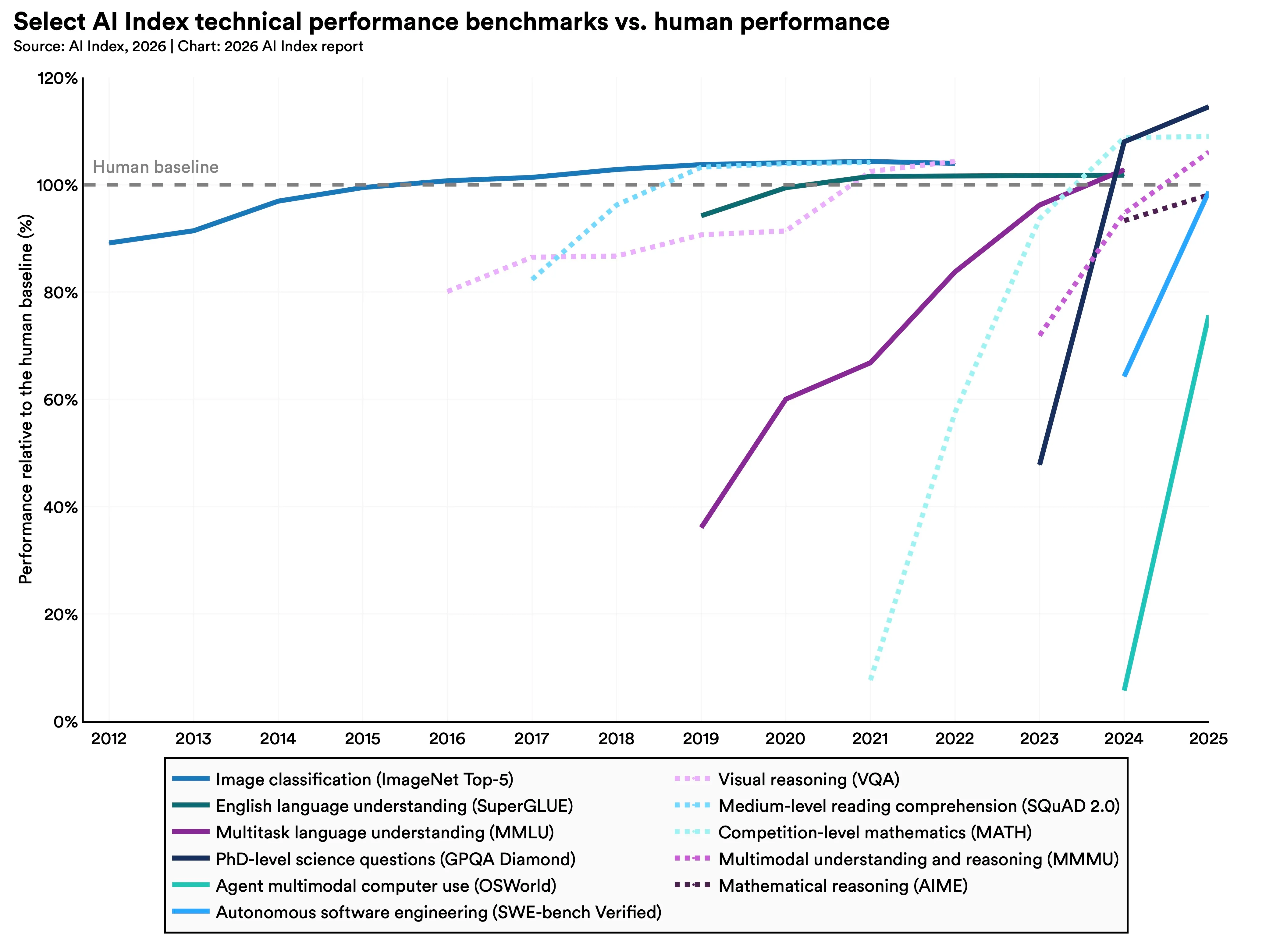
line chart of Select AI Index technical performance benchmarks vs human performance, showing that skills such as image classification, English language understanding, multitask language understanding, visual reasoning, medium level reading comprehension, multimodal understanding and reasoning have surpassed the human baseline at or before 2025, with autonomous software engineering, mathmatical reasoning and agent multimodal computer use trending towards meeting the human baseline by 2026.

However, AI still struggles in plenty of other areas. Because the models learn by processing enormous amounts of text and images rather than by experiencing the physical world, AI exhibits “jagged intelligence.” Robots are still in their early days and succeed in only 12% of household tasks. Self-driving cars are farther along: Waymos are now roaming across five US cities, and Baidu’s Apollo Go vehicles are shuttling riders around in China. AI is also expanding into professional domains like law and finance, but no model dominates the field yet. 

But the way we test AI is broken

These reports of progress should be taken with a grain of salt. The benchmarks designed to track AI progress are struggling to keep up as models quickly blow past their ceilings, the Stanford report says. Some are poorly constructed—a popular benchmark that tests a model’s math abilities has a 42% error rate. Others can be gamed: when models are trained on benchmark test data, for example, they can learn to score well without getting smarter. 

Because AI is rarely used the same way it’s tested, strong benchmark performance doesn’t always translate to real-world performance. And for complex, interactive technologies such as AI agents and robots, benchmarks barely exist yet. 

AI companies are also sharing less about how their models are trained, and independent testing sometimes tells a different story from what they report. “A lot of companies are not releasing how their models do in certain benchmarks, particularly the responsible-AI benchmarks,” says Gil. “The absence of how your model is doing on a benchmark maybe says something.” 

AI is starting to affect jobs

Within three years of going mainstream, AI is now used by more than half of people around the world, a rate of adoption faster than the personal computer or the internet. An estimated 88% of organizations now use AI, and four in five university students use it. 

It’s early days for deployment, and AI’s impact on jobs is hard to measure. Still, some studies suggest AI is beginning to affect young workers in certain professions. According to a 2025 study by economists at Stanford, employment for software developers aged 22 to 25 has fallen nearly 20% since 2022. The decline might not be pinned on AI alone, as broader macroeconomic conditions could be to blame, but AI appears to be playing a part.
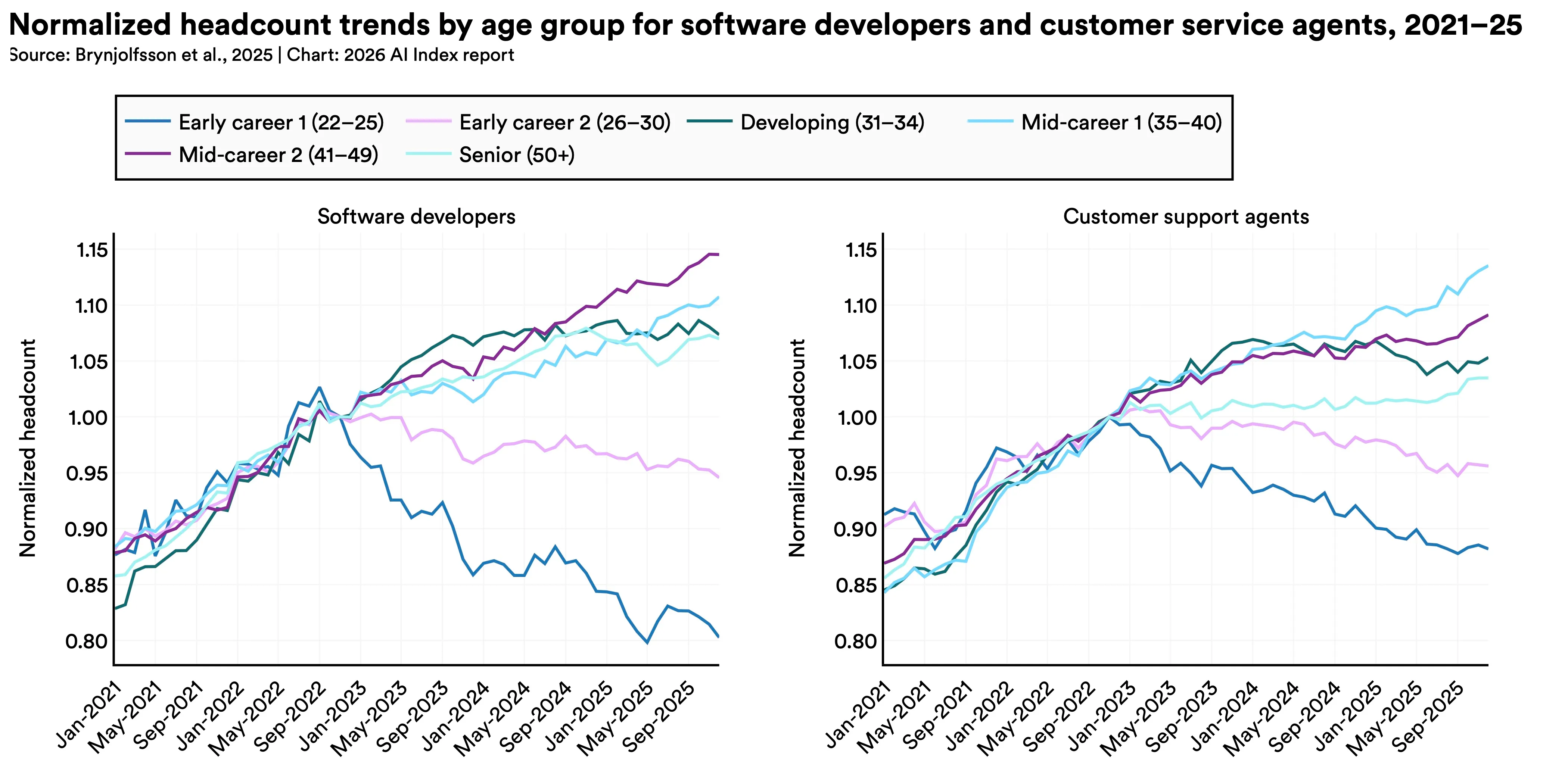
two line charts showing the normalized headcount trends by age group from 2021 through 2025. On the left for software developers the early career (age 22-25) cohort drops rapidly after a peak in September 2022, with other ages still rising albeit less steeply.  On the right, customer support agents see a similar trend, although the decline for the early career group is less steep than for software developers.

Employers say that hiring may continue to tighten. According to a 2025 survey conducted by McKinsey & Company, a third of organizations expect AI to shrink their workforce in the coming year, particularly in service and supply chain operations and software engineering. AI is boosting productivity by 14% in customer service and 26% in software development, according to research cited by the index, but such gains are not seen in tasks requiring more judgment. Overall, it’s still too early to understand the bigger economic impact of AI. 

People have complicated feelings about AI 

Around the world, people feel both optimistic and anxious about AI: 59% of people think that it will provide more benefits than drawbacks, while 52% say that it makes them nervous, according to an Ipsos survey cited in the index. 

Notably, experts and the public see the future of AI very differently, according to a Pew survey. The biggest gap is around the future of work: While 73% of experts think that AI will have a positive impact on how people do their jobs, only 23% of the American public thinks so. Experts are also more optimistic than the public about AI’s impact on education and medical care, but they agree that AI will hurt elections and personal relationships.
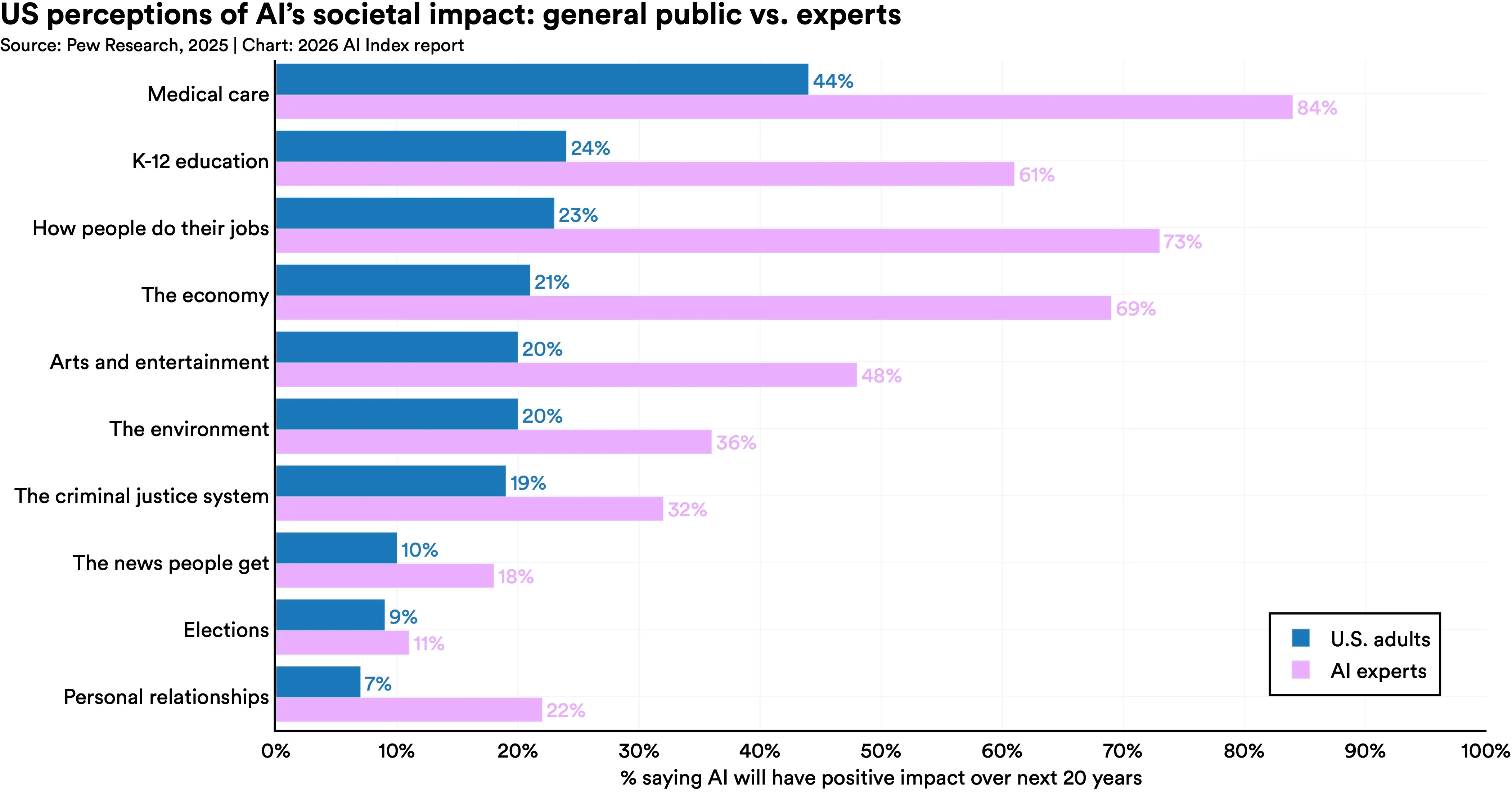
Bar chart of US perceptions of AI's societal impact contrasting US adults with AI experts, with the percentage of AI experts saying that AI will have a positive impact in the next 20 years is 2-3 times higher than the US adults.  The most optimistic AI experts are in the field of medical care with 84% predicting a positive outcome (versus 44% of US adults.) The greatest difference is for jobs with experts polling at 73% and US adults  polling at 23%.  Both groups have a similar (11% for experts and 9% of adults.) expectation for a positive outcome for AI in elections.

Among all countries surveyed, Americans trust their government least to regulate AI appropriately, according to another Ipsos survey. More Americans worry federal AI regulation won’t go far enough than worry it will go too far. 

Governments are struggling to regulate AI

Governments around the world are struggling to regulate AI, but there were some minor successes last year. The EU AI Act’s first prohibitions, which ban the use of AI in predictive policing and emotion recognition, took effect. Japan, South Korea, and Italy also passed national AI laws. Meanwhile, the US federal government moved toward deregulation, with President Trump issuing an executive order seeking to handcuff states from regulating AI. 

Despite this federal action, state legislatures in the US passed a record 150 AI-related bills. California enacted landmark legislation, including SB 53, which mandates safety disclosures and whistleblower protections for developers of AI models. New York passed the RAISE Act, requiring AI companies to publish safety protocols and report critical safety incidents.
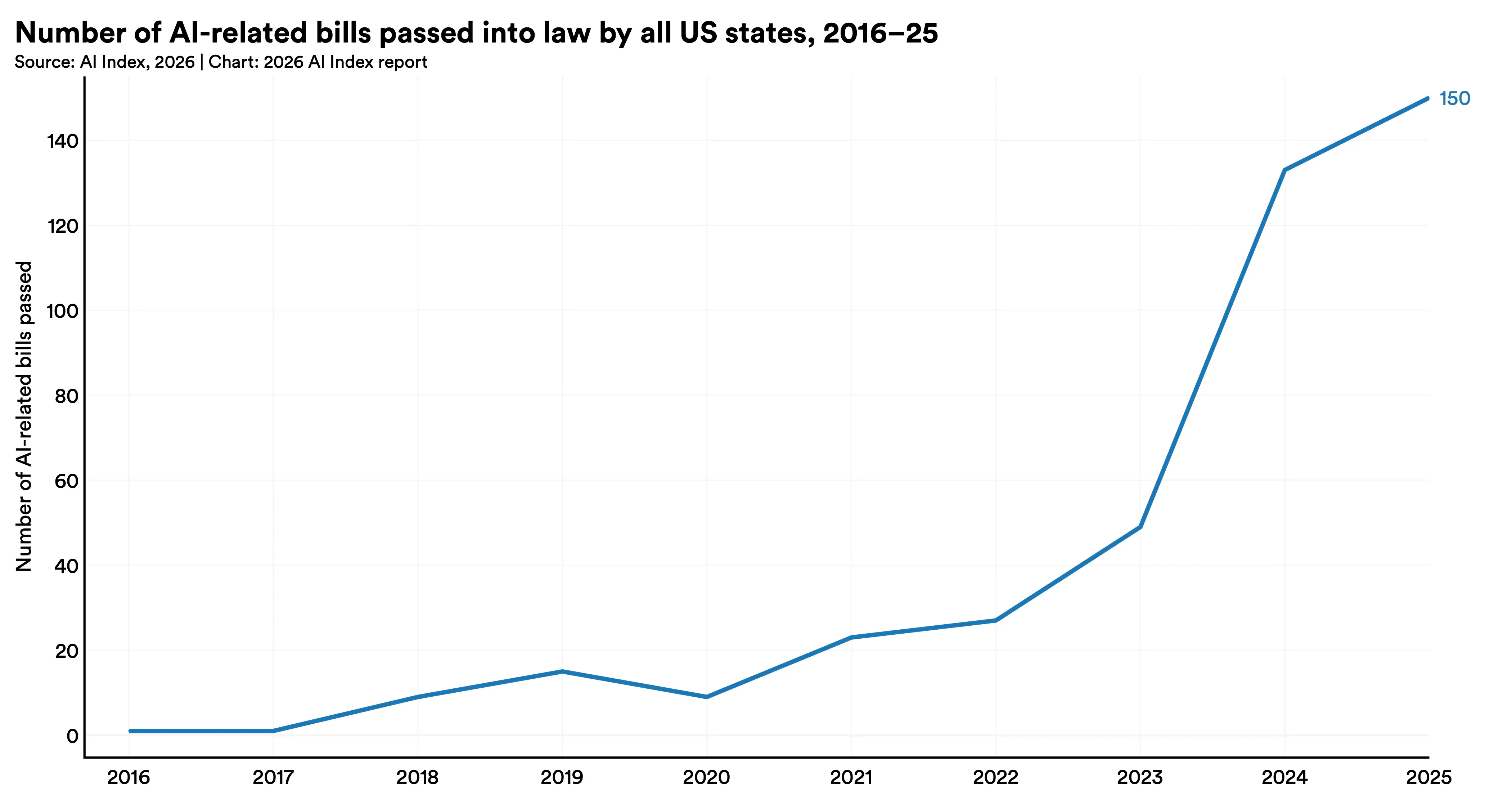
line chart showing the number of AI-related bills passed into law by all US states from 2016-2025, which increases sharply in 2023 and peaks with 150 bills in 2025.

But for all the legislative activity, Gil says, regulation is running behind the technology because we don’t really understand how it works. “Governments are cautious to regulate AI because … we don’t understand many things very well,” she says. “We don’t have a good handle on those systems.”

Correction (April 16): The Stanford AI Index incorrectly stated that the estimated annual water use from running OpenAI's GPT-4o may exceed the drinking water needs of 12 million people. The correct figure is 1.2 million, and the article has been updated to reflect this."