



Conflict and extreme weather could threaten large desalination plants that supply water to the region.
April 7, 2026
MIT Technology Review Explains: Let our writers untangle the complex, messy world of technology to help you understand what’s coming next. You can read more from the series here.
As the conflict in Iran has escalated, a crucial resource is under fire: the desalination technology that supplies water across much of the region.
In early March, Iran’s foreign minister accused the US of attacking a desalination plant on Qeshm Island in the Strait of Hormuz and disrupting the water supply to nearly 30 villages. (The US denied responsibility.) In the weeks since, both Bahrain and Kuwait have reported damage to desalination plants and blamed Iran, though Iran also denied responsibility.
In late March, President Donald Trump threatened the destruction of “possibly all desalinization plants” in Iran if the Strait of Hormuz was not reopened. Since then, he’s escalated his threats against Iran, warning of plans to attack other crucial civilian infrastructure like power plants and bridges.
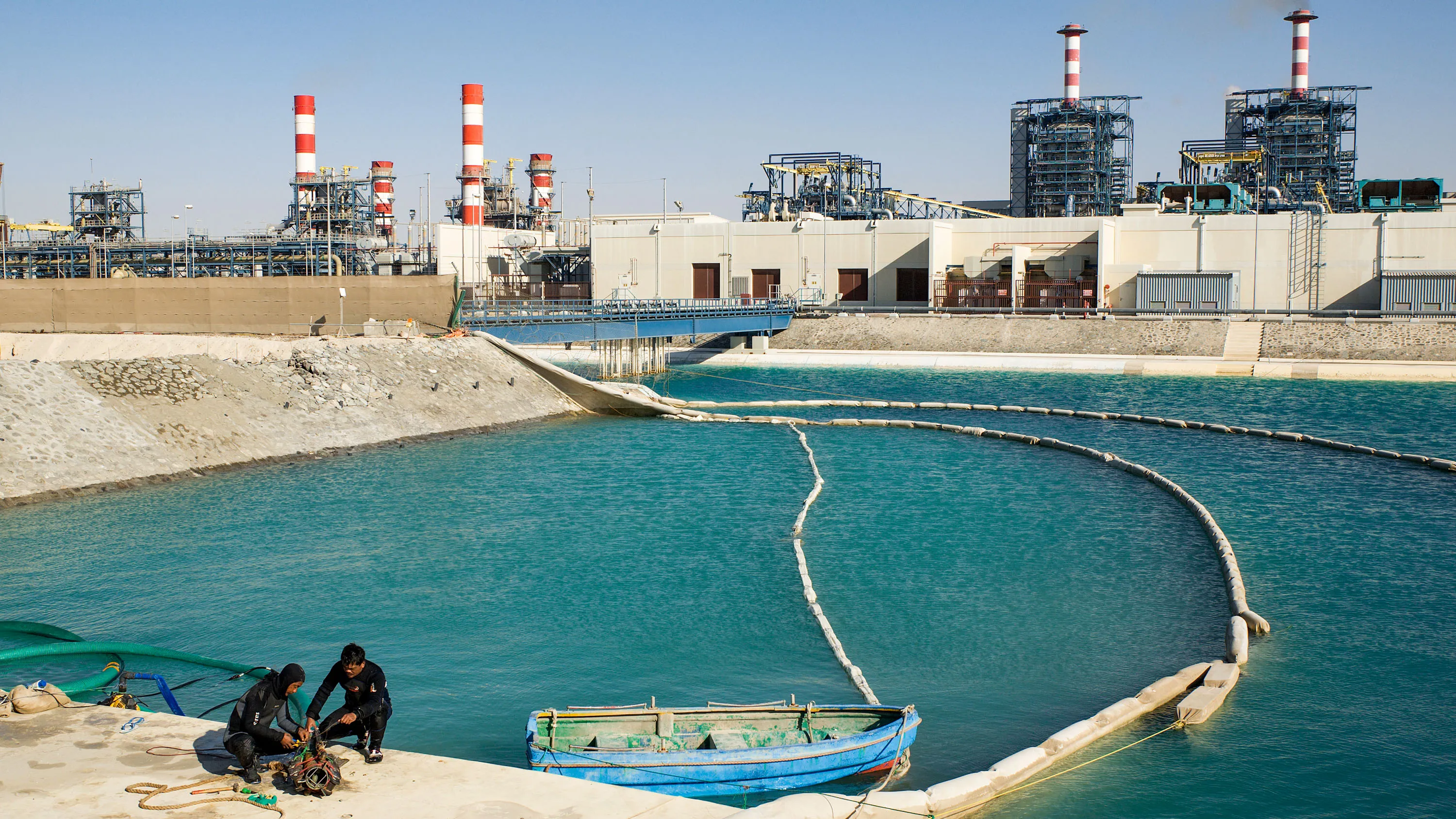
Countries in the Middle East, particularly the Gulf states, rely on the technology to turn salt water into fresh water for farming, industry, and—crucially—drinking. The mounting attacks and threats to date highlight just how vital the industry is to the region—a situation made even more precarious by rising temperatures and extreme weather driven by climate change.
Right now, 83% of the Middle East is under extremely high water stress, says Liz Saccoccia, a water security associate at the World Resources Institute. Future projections suggest that’s going to increase to about 100% by 2050, she adds: “This is a continuing trend, and it’s getting worse, not better.”
Here’s a look at desalination technology in the Middle East and what wartime threats to the critical infrastructure could mean for people in the region.
A vital resource
Desalination technology has helped provide water supplies in the Middle East since the early 20th century and became widespread in the 1960s and 1970s.
There are two major categories of desalination plants. Thermal plants use heat to evaporate water, leaving salt and other impurities behind. The vapor can then be condensed into usable fresh water. The alternative is membrane-based technology like reverse osmosis, which pushes water through membranes that have tiny pores—so small that salt can’t get through.
Early desalination plants in the Middle East were the first type, burning fossil fuels to evaporate water, leaving the salt behind. This technique is incredibly energy-intensive, and over time, processes that rely on filters became the dominant choice.
Membrane technologies have made up essentially all new desalination capacity in recent years; the last major thermal plant built in the Gulf came online in 2018. Many reverse osmosis plants still rely on fossil fuels, but they’re more efficient. Since then, membrane technologies have added more than 15 million cubic meters of daily capacity—enough to supply water to millions of people.
Capacity has expanded quickly in recent years; between 2006 and 2024, countries across the Middle East collectively spent over $50 billion building and upgrading desalination facilities, and nearly that much operating them.
Today, there are nearly 5,000 desalination plants operational across the Middle East.
And looking ahead, growth is continuing. Between 2024 and 2028, daily capacity is expected to grow from about 29 million cubic meters to 41 million cubic meters.
Uneven vulnerabilities
Some countries rely on the technology more than others. Iran, for example, uses desalination for about 3% of its municipal fresh water. The country has access to groundwater and some surface water, including rivers, though these resources are being stretched thin by agriculture and extreme drought.
Other nations in the region, particularly the Gulf countries (Bahrain, Qatar, Kuwait, the United Arab Emirates, Saudi Arabia, and Oman), have much more limited water resources and rely heavily on desalination. Across these six nations, all but the UAE get more than half their drinking water from desalination, and for Bahrain, Qatar, and Kuwait the figure is more than 90%.
“The Gulf countries are much, much more vulnerable to attacks on their desalination plants than Iran is,” says David Michel, a senior associate in the global food and water security program at the Center for Strategic and International Studies.
There are thousands of desalination facilities across the region, so the system wouldn’t collapse if a small number were taken offline, Michel says. However, in recent years there’s been a trend toward larger, more centralized plants.
The average desalination plant is about 10 times larger than it was 15 years ago, according to data from the International Energy Agency. The largest desalination plants today can produce 1 million cubic meters of water daily, enough for hundreds of thousands of people. Taking one or more of these massive facilities offline could have a significant effect on the system, Michel says.
Escalating threats
Desalination facilities are quite linear, meaning there are multiple steps and pieces of equipment that work in sequence—and the failure of a component in that chain can take an entire facility down. Attacks on water inlets, transportation networks, and power supplies can also disrupt the system, Michel says.
During the Gulf War in 1991, Iraqi forces pumped oil into the gulf, contaminating the water and shutting down desalination plants in Kuwait.
The facilities are also generally located close to other targets in this conflict. Desalination is incredibly energy intensive, so about three-quarters of facilities in the region are next to power plants. Trump has repeatedly threatened power plants in Iran. In response, Iran’s military has said that if civilian targets are hit, the country will respond with strikes that are “much more devastating and widespread.” Other governments and organizations, including the United Nations, the European Union, and the Red Cross, have broadly condemned threats to infrastructure as illegal.
But war isn’t the only danger facing these plants, even if it is the most immediate. Some studies have suggested that global warming could strengthen cyclones in the region, and these extreme weather events could force shutdowns or damage equipment.
Water pollution could also cause shutdowns. Oil spills, whether accidental or intentional, as in the case of the Gulf War, can wreak havoc. And in 2009, a red algae bloom closed desalination plants in Oman and the United Arab Emirates for weeks. The algae fouled membranes and blocked the plants from being able to take water in from the Persian Gulf and the Gulf of Oman.
Desalination facilities could become more resilient to threats in the future, and they may need to as their importance continues to grow.
There’s increasing interest in running desalination facilities at least partially on solar power, which could help reduce dependence on the oil that powers most facilities today. The Hassyan seawater desalination project in the UAE, currently under construction, would be the largest reverse osmosis plant in the world to operate solely with renewable energy.
Another way to increase resilience is for countries to build up more strategic water storage to meet demand. Qatar recently issued new policies that aim to improve management and storage of desalinated water, for example. Countries could also work together to invest in shared infrastructure and policies that help strengthen the water supply through the region.
Preparedness, resilience, and cooperation will be key for the Middle East broadly as critical infrastructure, including the water supply, is increasingly under threat.
“The longer the conflict goes on, the more likely we’ll see significant water infrastructure damage,” says Ginger Matchett, an assistant director at the Atlantic Council. “What worries me is that after this war ends, some of the lessons will show how water can be weaponized more strategically than previously imagined.”
Deep Dive
Stay connected
Illustration by Rose Wong
Get the latest updates from
MIT Technology Review
Discover special offers, top stories, upcoming events, and more.