

惯性聚合 高效追踪和阅读你感兴趣的博客、新闻、科技资讯
阅读原文 在惯性聚合中打开

推荐订阅源

F
Full Disclosure
WordPress大学
WordPress大学
小众软件
小众软件
Cloudbric
Cloudbric
AWS News Blog
AWS News Blog
腾讯CDC
量子位
人人都是产品经理
人人都是产品经理
大猫的无限游戏
大猫的无限游戏
freeCodeCamp Programming Tutorials: Python, JavaScript, Git & More
V
Vulnerabilities – Threatpost
Scott Helme
Scott Helme
Hugging Face - Blog
Hugging Face - Blog
博客园_首页
C
CXSECURITY Database RSS Feed - CXSecurity.com
The Hacker News
The Hacker News
奇客Solidot–传递最新科技情报
奇客Solidot–传递最新科技情报
IT之家
IT之家
Jina AI
Jina AI
Attack and Defense Labs
S
SegmentFault 最新的问题
Simon Willison's Weblog
The Cloudflare Blog
阮一峰的网络日志
阮一峰的网络日志
T
Tailwind CSS Blog
Last Week in AI
Last Week in AI
博客园 - 【当耐特】
Google Online Security Blog
美团技术团队
OSCHINA 社区最新新闻
OSCHINA 社区最新新闻
V
Visual Studio Blog
罗磊的独立博客
L
LINUX DO - 最新话题
博客园 - Franky
博客园 - 叶小钗
Apple Machine Learning Research
The Last Watchdog
The Last Watchdog
J
Java Code Geeks
AI
AI
C
Cisco Blogs
酷 壳 – CoolShell
酷 壳 – CoolShell
C
Cyber Attacks, Cyber Crime and Cyber Security
Cisco Talos Blog
Cisco Talos Blog
博客园 - 三生石上(FineUI控件)
雷峰网
雷峰网
Help Net Security
Help Net Security
钛媒体:引领未来商业与生活新知
钛媒体:引领未来商业与生活新知
云风的 BLOG
云风的 BLOG
I
Intezer
S
Securelist

NodeJS Security & NodeJS Secure Coding's Blog

Hardening Your npm and pnpm Configs in the Age of Shai-Hulud Argument Injection vulnerability in git-blame@1.4.0 Argument Injection vulnerability in `gits@0.1.8` Command Injection vulnerability in `@fab1o/git@1.4.0` Command Injection vulnerability in `git-contributors` via unsanitized CLI arguments Command Injection vulnerability in `git-q@0.0.3` Command injection vulnerability via unsanitized CLI arguments in touxing/fast-git-clone Command Injection vulnerability in `willitmerge@0.2.1` A Directory Traversal Vulnerability I found in Mastra AI Frameworks MCP Server Mastering NPX: A Cheatsheet for npm and Node.js Power Users Mitigate Supply Chain Security with DevContainers and 1Password for Node.js Local Development The Tale of the Vulnerable MCP Database Server Bad Security Defaults in Mastra AI Frameworks Templates SQL Injection and Bypassing "Read-Only" Mode in Xata's MCP Server Security Advisory for qix npm supply-chain compromise affecting debug and billions of weekly download users How to Mitigate SQL Bypass in MCP Servers Enhancing MCP Server Security: A Guide to Using execFile Argument Injection Vulnerability in ggit How to Bypass Access Control in PostgreSQL in Simple PSQL MCP Server for SQL Injection Command Injection Flaws in ggit: Unveiling a Vulnerability Command Injection Vulnerability in Create MCP Server STDIO Tool Exposes System Monitoring Functions GitHub Kanban MCP Server Command Injection Vulnerability Threatens Developer Workflows Critical Command Injection Flaw in iOS Simulator MCP Server Exposes Development Environments Command Injection Vulnerability Discovered in Codehooks MCP Server: A Critical Security Analysis SSRF Shenanigans in safe-axios: Redirects Open the Backdoor SSRF Vulnerability in safe-axios: Unintended Public Address Classification Bypassing SSRF Safeguards in ssrfcheck: A Case of Incomplete Denylists Don't Be Fooled by Multicast, SSRF Bypass in private-ip Node.js Authentication from Lucia to Better Auth Bypassing SSRF Protection in nossrf: When Your Safeguards Become Loopholes Vue CLI Security Fix to Mitigate NPM Binary Planting Node.js API Security Vulnerabilities with Path Traversal in files-bucket-server Will You Accept These GPT 4o Secure Coding Recommendations? Command Injection Vulnerability in interactive-git-checkout npm package An Introduction to SSRF Bypasses and Denylist Failures Disclosing a Command Injection Vulnerability in `git-checkout-tool` Prisma Raw Query Leads to SQL Injection? Yes and No Flawed Git Promises Library on npm Leads to Command Injection Vulnerability Regex Gone Wrong: How parse-duration npm Package Can Crash Your Node.js App How I found an XSS in the Nuxt MDC Library for Markdown Content Holes in the Safety Net: Bypassing SSRF Protection in safe-axios How to Parse URLs from Markdown to HTML Securely? NPM Ignore Scripts Best Practices as Security Mitigation for Malicious Packages Where to find npm vulnerabilities? How to Hunt for IDOR Vulnerabilities To Exploit Security Misconfiguration? How to Avoid JWT Security Mistakes in Node.js Can a Node.js Secure Code Review Find Future Vulnerabilities? The Okta bcrypt Security Incident and The Bun vs Node.js Angle in Secure By Design NodeJS Path Traversal Vulnerability Scanner Do not use secrets in environment variables and here's how to do it better How to use npm audit How to use yarn audit Raw SQL Queries are Actually Better for Security Than ORMs? Node API Security Is Node.js Secure? URL Regex Validation: what can go wrong? Uncovering a Prototype Pollution Regression in the core Node.js project Deno CLI Vulnerability Repeats npm mistakes: CVE-2024-37150 Security skills for JavaScript developers Understanding and Preventing Prototype Pollution in Node.js IDOR Vulnerability: What is it and how to prevent it? The security vulnerability of serving images via a route as opposed to static middleware in Node.js Why is it considered a bad practice to write raw SQL commands? JS Security Concepts for JavaScript Developers Secure Coding Practices in Node.js Against Path Traversal Vulnerabilities Secure JavaScript Coding Practices Against Command Injection Vulnerabilities To IDOR or Not to IDOR: Insecure Direct Object Reference in JavaScript Applications Explained npm vulnerabilities: reviewing the security of your dependencies Disclosing code injection vulnerabilities in safe-eval-2 npm package Introducing Node.js Security Permissions Model, Threat Model, and Security Releases Common Node.js Security Issues and How to Mitigate Them How JavaScript developers should embrace npm security The XZ backdoor CVE-2024-3094: a JavaScript perspective Node.js Security Best Practices The Case for Node.js Secure Configuration Protecting Against Common Node.js Vulnerabilities Input Validation Security Best Practices for Node.js A Node.js Vulnerability Scanner to Avoid Security Risks of EOL Runtime Versions JavaScript Security Issues in Node.js Applications OWASP Node.js Authentication, Authorization and Cryptography Practices OWASP Node.js Best Practices Guide Secure JavaScript Coding to Avoid Insecure Direct Object References (IDOR) North Korea malware on npm and Ledger connect-kit crypto heist 10 Best Practices for Secure Code Review of Node.js code Node.js and OWASP Top Ten Command Injection: Don't Let Your App Go 'BOOM' Secure Code Review Tips to Defend Against Vulnerable Node.js Code Destroyed by Dashes: How Two Hyphens Cause Argument Injection Vulnerability in blamer npm Package Securing Your Node.js Apps by Analyzing Real-World Command Injection Examples An Introduction to Command Injection Vulnerabilities in Node.js and JavaScript
How to protect against a security breach in React Server Components
2024-06-21 · via NodeJS Security & NodeJS Secure Coding's Blog

JavaScript developers are buzzing about React Server Components and new trends in server-side rendering on a regular basis. Nothing new here, right? but too often, we get caught up in the excitement of a new feature that promises to revolutionize the way we build web applications, to the point where we forget about the security implications.

What is React Server Components?

React Server Components, often known as RSC for short, are a new React development paradigm that allows frontend developers to render components on the server and send them to the client. This can be a game-changer for performance, but it also introduces new security risks that developers should be aware of, especially as it blurs the line between client-side and server-side React code.

The security risk of React Server Components

This got my attention through a post from Sasha on X, who shared how they have adopted React Server Components more than regularly, and only by a margin of luck, figured out that they originally wrote a React component code that would have resulted in a security breach, if not refactored in time to fix the issue.
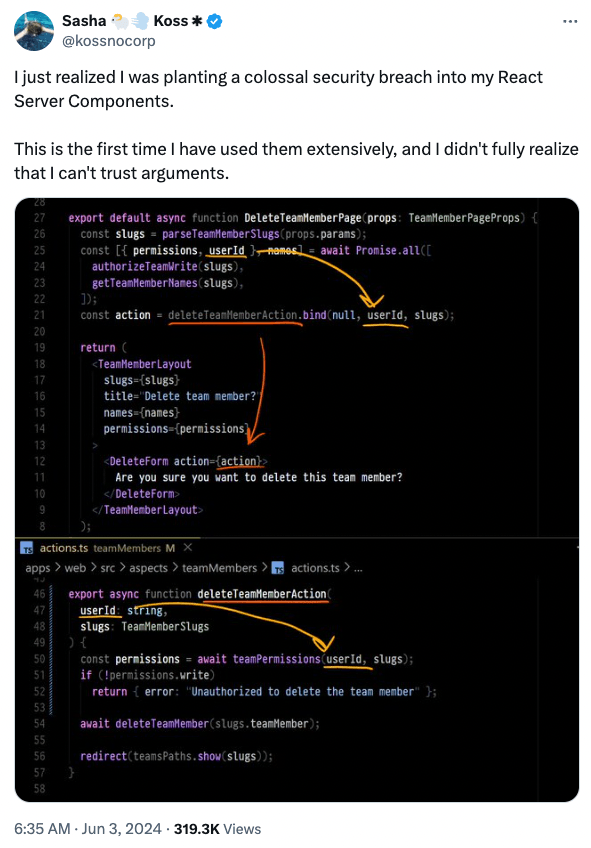
security data breach in React Server Components

At the gist of it, the userId variable in the DeleteTeamMemberPage component is passed down to a child component <DeleteForm> which is in fact a React Server Component. The DeleteForm component relies on a deleteTeamMemberAction action to delete a team member, and the userId variable is used to identify the team member to delete.

Once the userId gets passed to the that action function, it is used to delete the team member from the database, using the deleteTeamMember function.

A software developer at Netflix mentioned they got hacked due to the same React Server Components pattern. What do you think is the security risk here?

Unfortunately, as it was not initially obvious to Sasha, the security risk is also not obvious to many developers. Some developers might think this is about client-side input validation and that the fix should be moved to a server-side input validation (which isn’t the point here and not the security risk entailed with Sasha’s security refactor). Others might think client-side request forgery (CSRF) is the issue, but again, that’s not the security risk here.

So the security risk comes down to 2 security threats and security vulnerabilities:

  1. Broken access control: if the userId is not properly authorized, an attacker could potentially delete any team member by guessing the userId value. This is the colossal security risk that Sasha’s refactor fixed.
  2. Enumeration attack: if the userId is in the format of an easily-guessed sequential format such as incrementing integer, and it is not bound by rate-limit or other security control, an attacker could potentially enumerate all the team members in the database by iterating over the userId values.

Perhaps not obvious, the problem isn’t authentication in this case, it’s all about authorization. But unfortunately, many developers fail to recognize where the root-cause of the security risk lies:
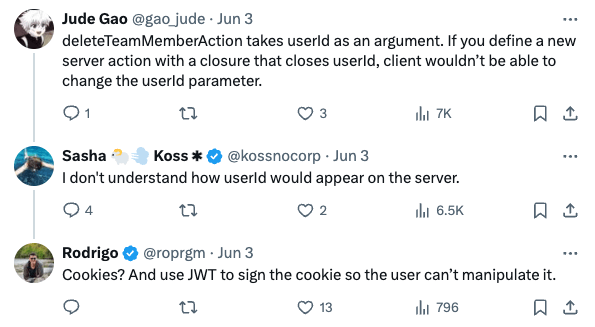
react-server-components-incorrect-advice-for-authz-issue

How to protect against a security breach in React Server Components

One developer suggested that passing arguments to server-side components through a closure will encrypt these props, however this is more of a “security by obscurity” approach and not a recommended security practice. What happens when the component’s code is later refactored? The security risk will renew.

Per the Next.js security page and guidelines, the recommended approach to handling user input in a React Server Components is to treat any variables passed to it as hostile input, to validate, sanitize, and authorize the input before using it in any server-side code. Do not blindly trust user input passed to server-side action functions.

Other security practices and controls to be aware of are:

  • Data leak: React components are most notably a frontend asset, and it has been witnessed many times that developers pass sensitive data to the frontend which gets buried in transpiled JavaScript code, seemingly hidden from the user. In other cases, this is due to sensitive API keys and tokens loaded from environment variables configuration that leak onto the frontend.
  • CSRF: React Server Components are not immune to CSRF attacks and so fullstack developers who utilized RSC should be aware of the security implications of server-side rendering and how request forgery attacks can be exploited.
  • Routes discovery: unrelated to React Server Components, but a common security risk in React applications is the discovery of routes and endpoints that are not meant to be publicly accessible. This is a common security risk in frontend and client-side applications code that developers should be aware of. Never take for granted that a route is secure just because it’s not linked to from the frontend or that a frontend router requires authentication to access it.