






As a Node.js developer and security researcher, I recently stumbled upon an interesting security regression in the Node.js core project related to prototype pollution.
This happened to be found while I was conducting an independent security research for my Node.js Secure Coding books and yet the discovery highlights the complex nature of security in open-source projects and the challenges of maintaining consistent security measures across a large codebase. Even at the scale of a project like Node.js, regressions can occur, potentially leaving parts of the codebase vulnerable to attack.
Back in 2018, I opened a Pull Request to address a potential prototype pollution vulnerability in the child_process module. The PR aimed to fix shallow object checks like if (options.shell), which could be susceptible to prototype pollution attacks. However, the Node.js core team and Technical Steering Committee (TSC) decided not to land the PR at the time due to concerns that such change would then merit bigger API changes in other core modules. As such, an agreement could not be reached to guard against prototype pollution in the child_process module.
Fast forward to July 2023 with a similar change that did get merged through a Pull Request to harden against prototype pollution for child_process. This got me thinking: has the issue been fully resolved, or are there still lingering vulnerabilities?
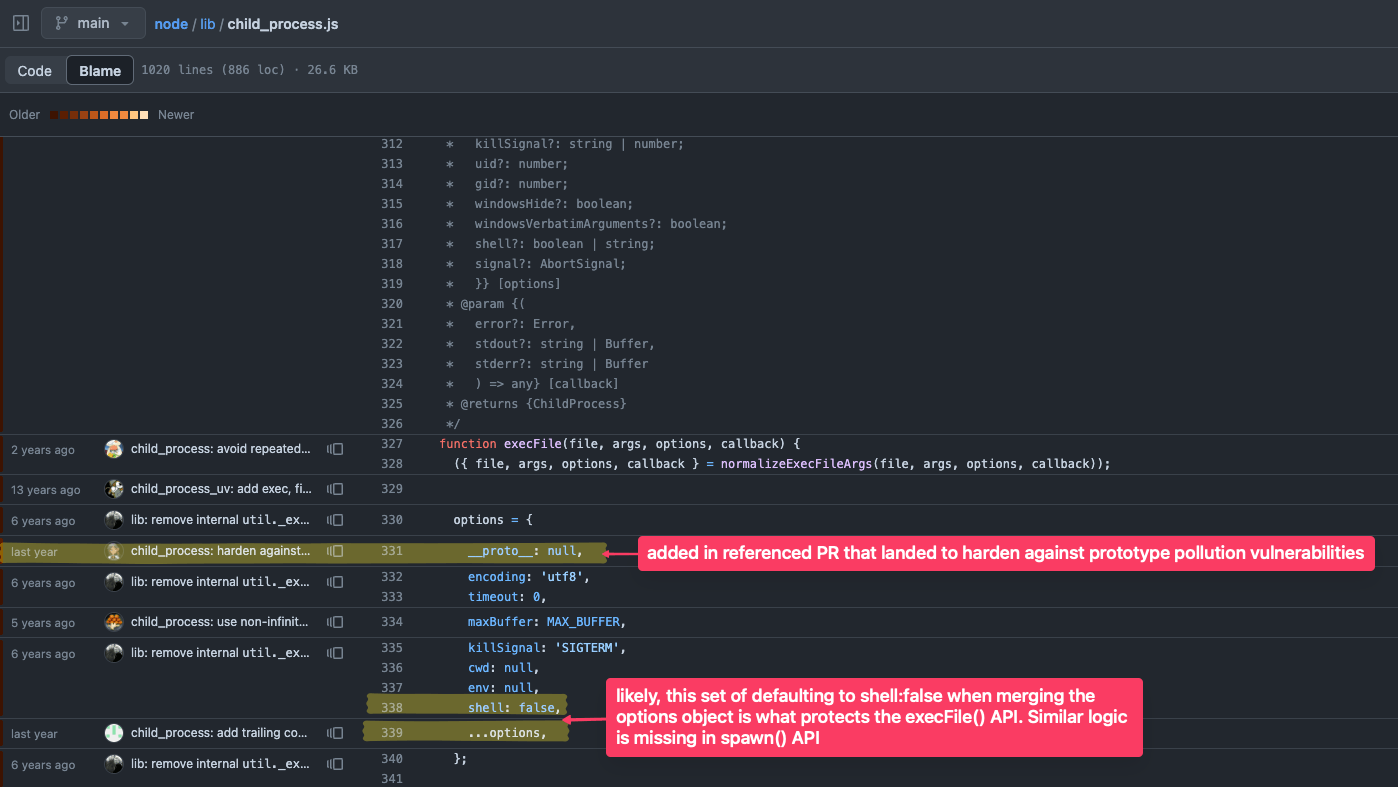
To investigate, I set up a simple proof-of-concept to test various child_process functions. Here’s what I found:
const { execFile, spawn, spawnSync, execFileSync } = require("child_process");
// Simulate a successful prototype attack impact:
const a = {};
a.__proto__.shell = true;
console.log("Object.shell value:", Object.shell, "\n");
// Test various child_process functions:
execFile("ls", ["-l && touch /tmp/from-ExecFile"], {
stdio: "inherit",
});
spawn("ls", ["-la && touch /tmp/from-Spawn"], {
stdio: "inherit",
});
execFileSync("ls", ["-l && touch /tmp/from-ExecFileSync"], {
stdio: "inherit",
});
spawnSync("ls", ["-la && touch /tmp/from-SpawnSync"], {
stdio: "inherit",
});
Running the above code snippet in a Node.js environment yields the following output:
$ node app.js
Object.shell value: true
[...]
$ ls -alh /tmp/from*
Permissions Size User Date Modified Name
.rw-r--r-- 0 lirantal 4 Jul 14:14 /tmp/from-ExecFileSync
.rw-r--r-- 0 lirantal 4 Jul 14:14 /tmp/from-Spawn
.rw-r--r-- 0 lirantal 4 Jul 14:14 /tmp/from-SpawnSync
The results are surprising:
execFile() and spawn() were properly hardened against prototype pollution.execFileSync(), spawnSync(), and spawn() (when provided with an options object) were still vulnerable.This inconsistency means that while some parts of the child_process module are protected, others remain exposed to potential prototype pollution attacks.
The detailed expected vs actual results are as follows:
Expectation:
shell: false. Similarly, execFile() follows the same.Object.prototype.shell = true; child_process.spawn('ls', ['-l && touch /tmp/new'])Actual:
Object.prototype.shell = true; child_process.execFile('ls', ['-l && touch /tmp/new']) - ✅ No side effects, hardening works well for.Object.prototype.shell = true; child_process.spawn('ls', ['-l && touch /tmp/new']) - ✅ No side effects, hardening works well for.Object.prototype.shell = true; child_process.execFile('ls', ['-l && touch /tmp/new'], { stdio: 'inherit'}) - ✅ No side effects, hardening works well for.Object.prototype.shell = true; child_process.spawn('ls', ['-l && touch /tmp/new'], { stdio: 'inherit'}) - ❌ Vulnerability manifests, hardening fails.Now, you might be wondering: “Is this a critical security vulnerability in Node.js?” The answer is not as straightforward as you might think.
According to the Node.js Security Threat Model:
Prototype Pollution Attacks (CWE-1321) Node.js trusts the inputs provided to it by application code. It is up to the application to sanitize appropriately. Therefore any scenario that requires control over user input is not considered a vulnerability.
In other words, while this regression does introduce a security risk, it’s not officially classified as a vulnerability in the Node.js core project. The reasoning behind this is that Node.js expects developers to handle input sanitization in their applications.
As a Node.js developer, this finding underscores a few important points:
While this issue may not be classified as an official security vulnerability (and did not warrant a CVE), it’s still a bug that needs addressing.
I’ve opened a Pull Request to the Node.js core project to address this inconsistency in the child_process module. The PR aims to ensure that the remaining vulnerable functions in the child_process module are consistently hardened against prototype pollution attacks.
This discovery serves as a reminder that security is an ongoing process, even in well-established projects like Node.js. Another interesting aspect here in terms of data analysis is how long this security regression has been present in the Node.js core project without anyone pointing it out. It’s a testament to the complexity of maintaining security across a large codebase and the challenges of ensuring consistent security measures.
Learn how to write secure code in Node.js with my latest 2023 and 2024 Node.js Secure Coding books, where I cover topical security vulnerabilities and security best practices and techniques for Node.js developers.
此内容由惯性聚合(RSS阅读器)自动聚合整理,仅供阅读参考。 原文来自 — 版权归原作者所有。