
惯性聚合 高效追踪和阅读你感兴趣的博客、新闻、科技资讯
阅读原文 在惯性聚合中打开

推荐订阅源

F
Full Disclosure
WordPress大学
WordPress大学
小众软件
小众软件
Cloudbric
Cloudbric
AWS News Blog
AWS News Blog
腾讯CDC
量子位
人人都是产品经理
人人都是产品经理
大猫的无限游戏
大猫的无限游戏
freeCodeCamp Programming Tutorials: Python, JavaScript, Git & More
V
Vulnerabilities – Threatpost
Scott Helme
Scott Helme
Hugging Face - Blog
Hugging Face - Blog
博客园_首页
C
CXSECURITY Database RSS Feed - CXSecurity.com
The Hacker News
The Hacker News
奇客Solidot–传递最新科技情报
奇客Solidot–传递最新科技情报
IT之家
IT之家
Jina AI
Jina AI
Attack and Defense Labs
S
SegmentFault 最新的问题
Simon Willison's Weblog
The Cloudflare Blog
阮一峰的网络日志
阮一峰的网络日志
T
Tailwind CSS Blog
Last Week in AI
Last Week in AI
博客园 - 【当耐特】
Google Online Security Blog
美团技术团队
OSCHINA 社区最新新闻
OSCHINA 社区最新新闻
V
Visual Studio Blog
罗磊的独立博客
L
LINUX DO - 最新话题
博客园 - Franky
博客园 - 叶小钗
Apple Machine Learning Research
The Last Watchdog
The Last Watchdog
J
Java Code Geeks
AI
AI
C
Cisco Blogs
酷 壳 – CoolShell
酷 壳 – CoolShell
C
Cyber Attacks, Cyber Crime and Cyber Security
Cisco Talos Blog
Cisco Talos Blog
博客园 - 三生石上(FineUI控件)
雷峰网
雷峰网
Help Net Security
Help Net Security
钛媒体:引领未来商业与生活新知
钛媒体:引领未来商业与生活新知
云风的 BLOG
云风的 BLOG
I
Intezer
S
Securelist

Luca Cavallin

AI Engineering for Developers | Blog AI Engineering for Developers Platform Engineering End-to-End | Blog Google Cloud Networking 101: The Comprehensive TLDR | Blog Google Cloud Networking 101: The Comprehensive TLDR Containers Are Not Automatically Secure | Blog Containers Are Not Automatically Secure Watery Stone Beacon | Photography Blue Iceman Suture | Photography Hidden Emerald Pool | Photography Autumn Chapel Pinnacles | Photography A Tour of eBPF in the Linux Kernel: Observability, Security and Networking | Blog A Tour of eBPF in the Linux Kernel: Observability, Security and Networking Shared Violet Pulse | Photography Kubernetes Networking from Packets to Pods | Blog An Overview of Network Protocols | Blog An Overview of Network Protocols A Quick Journey Into the Linux Kernel | Blog A Quick Journey Into the Linux Kernel OpenTelemetry: A Guide to Observability with Go | Blog I'm on the Cillers Podcast Talking About Tech and Hackathons | Blog Yet Another List of Random Opinions on Writing Readable Code and Other Rants | Blog My post about Istio is now on the Istio blog too! | Blog Tropical Jungle Escape | Photography The Istio Service Mesh for People Who Have Stuff to Do | Blog Dreamy Cartoonscape Windmill | Photography Twilight Windmill Reflections | Photography Notes I took while reading "Applied Machine Learning and AI for Engineers" and "Introducing MLOps" | Blog Things I've Learned About Terraform That I Keep Telling People About | Blog Analyzing Unsplash Photo Performance with Python | Blog Analyzing Unsplash Photo Performance with Python I am a Top Mentor on MentorCruise! 🎉 | Blog CI/CD Observability on GitHub Actions and the Role of OpenTelemetry | Blog CI/CD Observability on GitHub Actions and the Role of OpenTelemetry Silent Water Sentinel | Photography Three Early Crosses | Photography Fiery Twilight Trails | Photography Forested Folds Flowing | Photography Majestic Snowbound Spire | Photography Shrouded Winter Peaks | Photography Space Cat Pillar | Photography I am a CNCF (Cloud Native Computing Foundation) Ambassador! | Blog Curved Valley Mist | Photography Highly Independent Tree | Photography Misty Morning Plateau | Photography Sick Shadows Fading | Photography Half Moon Blossom | Photography Serene Pedestal Swinging | Photography Sunset Clouds Reeling | Photography Aerial Nose Parking | Photography How to Structure C Projects: These Best Practices Worked for Me | Blog How to Structure C Projects: These Best Practices Worked for Me I'm on the KubeFM Podcast Talking About "Linux Containers From Scratch" | Blog I am (again) a Google Developers Expert! | Blog How to Configure OIDC with Terraform for GitHub Enterprise Server | Blog How to Configure OIDC with Terraform for GitHub Enterprise Server Modern Frontend Development: A Tooling Overview for Engineers Revisiting the Field | Blog Meet verto.sh: Your Gateway to Open-Source Collaboration. | Blog Crafting a Clean, Maintainable, and Understandable Makefile for a C Project. | Blog Crafting a Clean, Maintainable, and Understandable Makefile for a C Project. barco: Linux Containers From Scratch in C. | Blog barco: Linux Containers From Scratch in C. How to Create a Release With Multiple Artifacts From a GitHub Actions Workflow Using the Matrix Strategy | Blog How Databases Store and Retrieve Data with B-Trees | Blog How Databases Store and Retrieve Data with B-Trees Concurrency in Go: Goroutines, Channels, Mutexes, and More | Blog Concurrency in Go: Goroutines, Channels, Mutexes, and More Club Cloud 2021: Cloud Engineering Panel Discussion | Blog Club Cloud 2021: Cloud Engineering Panel Discussion How to Prepare for the Google Cloud Engineer Associate Certification Exam | Blog How to Prepare for the Google Cloud Engineer Associate Certification Exam What is Google Cloud Deploy? | Blog What is GitOps? | Blog Club Cloud Stories #2 - News from Around the Cloud | Blog Club Cloud Stories #2 - News from Around the Cloud Club Cloud Stories #1 - The First Episode with Antoni Tzavelas & Mark van Holsteijn | Blog Club Cloud Stories #1 - The First Episode with Antoni Tzavelas & Mark van Holsteijn | Blog Quiet Oak Shining | Photography How to Read Firestore Events with Cloud Functions and Golang | Blog How to Read Firestore Events with Cloud Functions and Golang | Blog Google Cloud Pub/Sub vs NATS: An Easy-to-Understand Comparison | Blog Google Cloud Pub/Sub vs NATS: An Easy-to-Understand Comparison | Blog How to Deploy a Multi-cluster Service Mesh on GKE with Anthos | Blog How to Deploy a Multi-cluster Service Mesh on GKE with Anthos | Blog How to Safely Store Secrets in Terraform Using Cloud KMS | Blog How to Safely Store Secrets in Terraform Using Cloud KMS | Blog Designing Serverless Applications on AWS - Jacco Kulman and Luca Cavallin @ End2End LIVE | Blog Designing Serverless Applications on AWS - Jacco Kulman and Luca Cavallin @ End2End LIVE | Blog How to Use Terraform Workspaces to Manage Environment-based Configuration | Blog How to Use Terraform Workspaces to Manage Environment-based Configuration | Blog Puffy Steel Spreading | Photography How to Deploy ElasticSearch on GKE using Terraform and Helm | Blog How to Deploy ElasticSearch on GKE using Terraform and Helm | Blog Summer Windmills Spinning | Photography How to Optimize PHP Performance on Google Cloud Run | Blog How to Optimize PHP Performance on Google Cloud Run | Blog Foggy Boats Rusting | Photography How I Prepared for the Google Cloud Associate Cloud Engineer Exam | Blog How I Prepared for the Google Cloud Associate Cloud Engineer Exam | Blog Winter Kids Chasing | Photography
How to Create a Release With Multiple Artifacts From a GitHub Actions Workflow Using the Matrix Strategy
Luca Cavallin · 2023-08-25 · via Luca Cavallin

Recently, I built a rudimentary DNS server using Rust to enhance my understanding of the topic. The project, named vòdo, can be accessed here.

Everyday Workflows

With each push to the main branch and on pull requests, I want to build the project and run tests to ensure no bugs are introduced. I utilize a basic Actions workflow configuration for this purpose:

yaml

name: Rust
 
on:
  push:
    branches: ["main"]
  pull_request:
    branches: ["main"]
 
env:
  CARGO_TERM_COLOR: always
 
jobs:
  build:
    runs-on: ubuntu-latest
 
    steps:
      - uses: actions/checkout@v3
      - name: Build
        run: cargo build --verbose
      - name: Run tests
        run: cargo test --verbose

This configuration works well for everyday development, but it is insufficient for creating a "production build" release once I am satisfied with the outcome. Although there are Actions from the Actions Marketplace that can be used to effortlessly generate a new release with artifacts, I want to include the vòdo executable for all major operating systems in the release, which complicates the process slightly. Moreover, the release should not be created if any of the builds fail.

The Matrix Job Strategy

GitHub Actions offers a feature known as "Matrix", which outlines a job strategy allowing you to utilize variables within a single job definition to automatically generate multiple job runs based on the variable combinations. For instance, you can employ a matrix strategy to test your code across various language versions or multiple operating systems. More details can be found in the GitHub Documentation.

This is the approach I employed to build Vodo for Linux, MacOS, and Windows in parallel. I generated a new Actions workflow configuration file specifically for releases. This workflow is activated by new tags in the repository, meaning that to create a new release, I simply need to generate a new Git tag and push it to the repository.

yaml

name: Release
 
on:
  push:
    tags:
      - "*"
 
jobs:
  release:
    strategy:
      matrix:
        include:
          - os: ubuntu-latest
            artifact_name: ${{ github.event.repository.name }}
            asset_name: ${{ github.event.repository.name }}-linux-amd64
          - os: windows-latest
            artifact_name: ${{ github.event.repository.name }}.exe
            asset_name: ${{ github.event.repository.name }}-windows-amd64.exe
          - os: macos-latest
            artifact_name: ${{ github.event.repository.name }}
            asset_name: ${{ github.event.repository.name }}-macos-amd64
    runs-on: ${{ matrix.os }}
    steps:
      - name: Checkout code
        uses: actions/checkout@v2
      - name: Set up Rust
        uses: actions-rs/toolchain@v1
        with:
          toolchain: stable
      - name: Build release
        run: >-
          cargo build --release

Using this configuration, Actions runs multiple jobs in parallel, one for each operating system:

  • The job running on ubuntu-latest creates an executable for Linux named vodo-linux-amd64

  • The job running on macos-latest creates an executable for MacOS named vodo-macos-amd64

  • The job running on windows-latest creates an executable for Windows named vodo-windows-amd64

This is the simplest approach that gets the job done: it took me a considerable amount of time to find the best way to achieve this without an overly complex workflow configuration! In the GitHub UI it looks like this:
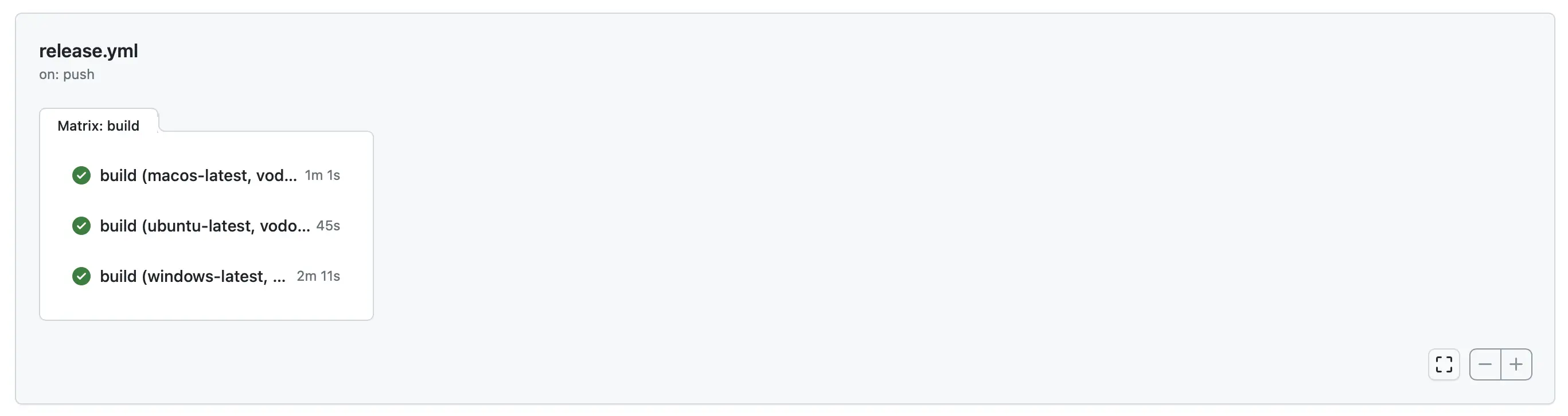
Release workflow on GitHub UI

Creating the Release

The previous steps only create the artifacts, and an additional step is required to create a release and attach the executables to it. This step uses svenstaro/upload-release-action@v2 and runs in each OS-specific build. However, the release is created only once, and if any of the builds fail, the release is removed. The necessary configuration is as follows:

yaml

- name: Upload binaries to release
  uses: svenstaro/upload-release-action@v2
  with:
    repo_token: ${{ secrets.GITHUB_TOKEN }}
    file: target/release/${{ matrix.artifact_name }}
    asset_name: ${{ matrix.asset_name }}
    tag: ${{ github.ref }}

After completing this step, the release corresponding to the tag is created and can be accessed through the GitHub user interface 🎉.
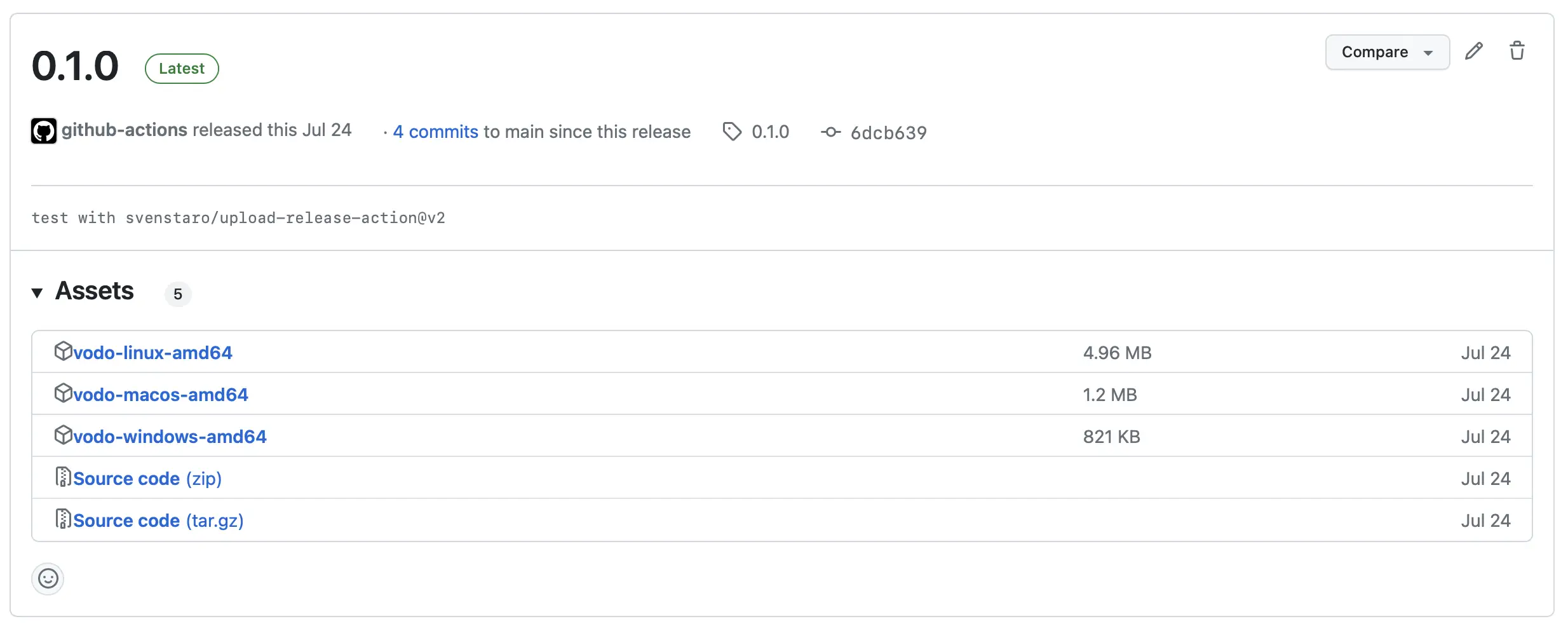
Release page in GitHub UI

Summary

In this article, I explained how I built a rudimentary DNS server called vòdo using Rust and set up a GitHub Actions workflow to build and test the project. I discussed the use of the Matrix job strategy to create production builds for multiple operating systems and how to create a release with attached executables using svenstaro/upload-release-action. The result is an efficient and automated release process for the project using an easy-to-understand workflow configuration file.