




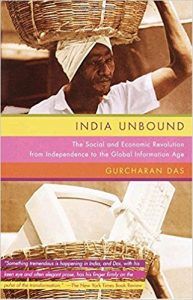
The book is divided primarily into three parts, the pre-independence era [focused on the British Raj including some stories of the Mughal period], the post-independence pre-liberalized era, and post-liberalized India. The author was born in 1943 in West Punjab, which is now under the occupation of Pakistan. The author narrates his personal experiences of the economic conditions of India from 1947-2001.
While British Raj did harm India [economically], the reason that Indian handicrafts lost to machine-driven goods is also significant. Handlooms all over the world were impacted by the emergence of technology and since India was the largest textile maker in the world, it got impacted the most. The author further notes that while “some” Britishers made huge profits in India, overall British India did not provide a lot of profit to the crown. The prevailing culture of looking down on merchants as greedy, as opposed to viewing them as the lifeblood of the economy, did further harm.
The emergence of “brown sahib” in the British Raj: Primarily Brahmins learned English and took up clerical and managerial jobs for Britishers. The author notes that those who were quick, as opposed to being better, to grab the opportunity benefitted at that time.
Indians prefer vertical over horizontal relations, on numerous instances from wars to running industries, it has been seen that Indians prefer/are more comfortable with their managers and subordinates as opposed to colleagues. The author believes that with globalization (read “fight for survival”) this trend has to change.
State-controlled planning of the 1950s Almost all newly independent nations and many economists of that period had the feeling that state planning and state-controlled industries are necessary which just led to inefficient, high-priced, low-quality goods. Also, in that era, most Western nations were going through a phase of emphasizing wealth distribution since “wealth creation” was going on at a good pace. Unfortunately, many of the Indian bureaucrats trained in these nations forgot that India needed wealth creation first. Among the common man, trade was not seen as a positive-outcome game, but it was perceived as a zero-sum game.
Note: John Rawls showed that it is possible for a group to agree to different outcomes provided every one of them is better off by accepting the outcome (market-based liberal democracy) which convinces the author that inequality can sometimes be acceptable.
Nehru’s economic policies Nehru emphasized state control. He looked down at the private sector. He pursued the policy of import substitution over export promotion and promoted big state-owned industries like steel as opposed to “small toy-making wage goods” industries. The Asian tigers took the latter route. extreme license control where several months will be spent for approval. India was the only non-communist where manufacturing goods beyond the licensed limit was a crime. The tax rates shot up to ~80% and thus, the creation of tax-less cash transactions. Despite repeated warnings from the USA, India decided not to focus on agriculture since it was believed that it was a Western conspiracy to keep India backward and eventually suffered a food crisis. Finally, when Lerma Rojo was imported, which led to the green revolution, it was criticized as being sold to America. Slowly the businesses learned the tricks like exhausting all the licenses of a product to prevent any future competition and this reduced their capability to work in the competitive economy.
Indira’s Era While socialism was popular during Nehru’s era, it lost most of its charm in a couple of decades, but during Indira’s rule, controls were further tightened. Several state-owned enterprises emerged during this era that was not profitable and sometimes did not produce any goods eg. Scooters India Ltd. and it was illegal to close them. By 1980, 75% of state-owned companies were in losses, 14 banks were nationalized and in a decade, most of them were bankrupt. The final nail was the Monopolies Restrictive Trade Practices Act of 1969 which implied anyone with a 10 Billion Rupee in combined assets cannot invest any further, which forced Aditya Birla to establish companies in Indonesia, Thailand, and Hong Kong. The author laments that while everyone remembers the emergency as 2 years of political suppression, very few realize the 40 years of economic suppression. The author bluntly criticizes Congress politicians and leftist intellectuals for being anti-free market and anti-west and refers to Indians of this era as the lost generation.
Being short of foreign exchange reserves, India asks for a loan from the IMF and starts economic reforms in parallel. The author praises Narasimha Rao, Prime Minister; Manmohan Singh, Finance Minister, and P Chidambaram, Commerce Minister, for their role in liberalizing the Indian economy. Several examples like Zee TVs Subhash Chandra, and NIIT’s Rajendra Pawar have been given to illustrate first-generation millionaires created by liberalization. While some Indian business houses have reformed and separated ownership from management, others are still struggling with the new world order, Ranbaxy’s Parvinder Singh set an example by passing his company to professionals instead of his sons. There are three ways to compete - superior (lower) prices, a superior product, and superior service, as of now, Indian industries follow superior prices and they should move to superior service now, the growth of the middle class is one of the most significant consequences of liberalization. A major area where reform has still not occurred is education and the nation is in a dire need of it. The author criticizes the Swadeshi policy of nationalists, terming it as another form of license raj since he believes that rather than asking for protection from competition, indigenous companies should learn to compete in a free market. “Ideas can be copied, execution decides who is the winner” India missed the Industrial Revolution, the IT Revolution is, therefore, critical for India. While some people fear that Indians are westernizing, the author believes India is “modernizing” and the “spiritual component of life” is here to stay in Indian life.
此内容由惯性聚合(RSS阅读器)自动聚合整理,仅供阅读参考。 原文来自 — 版权归原作者所有。