The
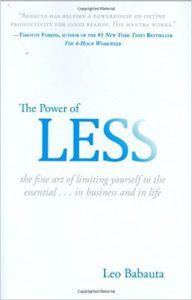
book contains pragmatic advice for dealing with the clutter and noise of the everyday world, which disguises itself in the form of work. The book has two parts. First one focuses on the principles and the second one provides concrete practical advice based on the same.
Principles
- Why less is powerful - In the contemporary world, whether it’s physical or virtual goods, we consume more and we produce more. Doing more pushes us towards things which are easier and usually unimportant. By deciding to do less, we can actually do things which are essential and more important albeit more challenging.
Principle 1: By setting a limit to what we do, we focus ourselves to choose only the essentials. Principle 2: By choosing to do only the essential, we create maximum impact with minimal resources. Thus, one should always choose essential to maximize time and energy. The idea is to start with a list of things to be done, the impact they will create and to prune the list based on how they correlate with the long-term goals.
- The art of setting limits - Setting limits simplifies things, improves focus, increases the effectiveness of efforts and helps us in achieving our goals.
To set limits, one should look into areas of life which are overwhelming and then set experiment with reasonable limits till a final value is reached.
- Choosing the essential and simplifying - It’s important to decide what is essential. A simple guide to deciding essential questions will look like this -
What are your values?
What are your goals?
What do you love?
What is important to you?
What has the biggest impact?
What has the most long-term impact?
Needs vs wants? [do you really need it or do you just want it]
Eliminate the non-essential things
[Repeat above steps from time to time]
Principle 3: Simplify - Eliminate the nonessential
- Simple focus - focus on one task to improve productivity. Multitasking is inefficient, complicated and just causes anxiety and stress.
Principle 4: Focus is the most important tool in becoming more effective There are many aspects to focus - one should focus on a particular goal. One should focus on the present (mindfulness). One should focus on the task at hand (single-tasking). And one should focus on the positive outcomes of the task.
- Create new habits - create new habits but don’t attempt all of them at once or even all of it at once. Attempt slow and stable changes over time.
Principle 5: Create new habits to make long-lasting improvements. Select one habit, decide the plan and publicly post about it, try to stick to the habit for 30 days and then it will be well entrenched.
It is important that there is a measurable goal associated with the habit to mark the progress.
- Start small
Principle 6: Start new habits in small increments to ensure success. Gradual changes are easy to make, have a higher chance of success and narrows down the focus leading to long-lasting impact. So, for example, rather than trying to wake an hour earlier, try in increments of 15 minutes.
Practice
- Simple Goals and Projects - Choose one goal at a time, which is doable in 6 months to 1-year timeframe. Break it into sub-goals and then decide weekly goals and daily actions to attain that. List all projects in your life and focus on completing at most three of them at a time. Start with three since some projects will be held back due to external reasons. Don’t move onto new projects till you finish all three.
- Simple Tasks - Create a list of MITs (Most Important Tasks) in the morning. Finish them asap working on one at a time. If tasks are big, divide it into subtasks of size 15 min to 1 hour, that makes it less intimidating.
- Simple Time Management - First focus on MITs. Then do batch processing of things like inbox, paper mails, house cleaning, etc. after finishing MITs. Use time management tools like Calendar.
- Simple E-mail - List all sources of information like blogs etc. Combine multiple sources of information, check it 2-3 times a day. Do not check e-mail as the first thing in the morning. Turn off email notifications. Keep zero inbox, to-do emails should go to the to-do list, don’t let them linger in the inbox as unread emails.
- Simple Internet - Track your usage using
Toggl,
yaTimer or
Tick. Make a plan to set blocks of time for work, another block for e-mails, another for fun, etc. Try working by disconnecting the Internet. Control the urge to visit the internet by writing questions on a notepad and then process them in a single batch later.
- Simple filing - Reduce paper junk by moving to paperless delivery. File it using alphabetically listed folders, file immediately.
- Simple commitments - Over time, we take up more commitments than we can handle. List all commitments including work, family, personal, etc. Reduce it to a short list of 4-5 most important ones. Eliminate all commitments which are not on the short list of important commitments. Learn to say “No” to people, keep the margin between multiple appointments to avoid the rush.
- Simple Daily Routine - Have a morning routine of 4-6 items like having coffee, taking shower, reading, exercise, deciding MITs, etc. Email does not deserve to be in the morning routine. Similarly, have an evening routine of 4-6 items. Email does not deserve to go here either. Try to include activities which you like in these routines to avoid boredom. Log your progress to see how well you are doing on these.
- Declutter the workspace - since it allows you to focus and brings a sense of calmness. Remove everything from desk apart from essential items. Schedule regular decluttering sessions to keep clutter in check. If possible, reduce the habits which cause clutter in the first place.
- Slow Down - Try to focus attention on one task at a time. If needed, do meditation in the morning to increase attention span. Focus on MITs (one a time), choose an important and challenging task (neither hard nor too easy). Eat slowly to reduce the amount of food you eat, it improves digestion as well. Drive slowly - keep to the right, leave early.
- Simple Health and Fitness - Form a habit of exercise, start with a simple plan and improve it over time. Preferably, get a partner to have better discipline. For diet, improve gradually by eating light food slowly until you are lightly full (and not stuffed). having a blog recording such things also provides motivation.
- On Motivation - When starting something learn to hold yourself back a bit. Don’t put maximum effort in the beginning or else you will exhaust yourself soon. Replace negative thoughts with positive ones. Think about the benefits, never skip a daily activity two days in a row (one is OK, but two is too much). Have a coach and visualize your success.







