惯性聚合 高效追踪和阅读你感兴趣的博客、新闻、科技资讯
阅读原文 在惯性聚合中打开

推荐订阅源

Jina AI
Jina AI
C
Check Point Blog
K
KPMG report finds enterprise disconnect between AI and its ROI | CIO
T
Threatpost
D
Darknet – Hacking Tools, Hacker News & Cyber Security
Know Your Adversary
Know Your Adversary
C
Cyber Attacks, Cyber Crime and Cyber Security
T
Tor Project blog
Threat Intelligence Blog | Flashpoint
Spread Privacy
Spread Privacy
Latest news
Latest news
Project Zero
Project Zero
T
Threat Research - Cisco Blogs
P
Palo Alto Networks Blog
雷峰网
雷峰网
Exploit-DB.com RSS Feed
cs.AI updates on arXiv.org
N
News and Events Feed by Topic
P
Privacy International News Feed
Vercel News
Vercel News
T
The Exploit Database - CXSecurity.com
S
Secure Thoughts
Application and Cybersecurity Blog
OSCHINA 社区最新新闻
OSCHINA 社区最新新闻
F
Full Disclosure
T
Tenable Blog
Last Week in AI
Last Week in AI
Y
Y Combinator Blog
SecWiki News
SecWiki News
C
CERT Recently Published Vulnerability Notes
Forbes - Security
Forbes - Security
CTFtime.org: upcoming CTF events
S
Security Affairs
The GitHub Blog
The GitHub Blog
J
Java Code Geeks
Blog — PlanetScale
Blog — PlanetScale
N
Netflix TechBlog - Medium
O
OpenAI News
Google DeepMind News
V
Vulnerabilities – Threatpost
Engineering at Meta
Engineering at Meta
Hacker News - Newest:
Hacker News - Newest: "LLM"
N
News and Events Feed by Topic
The Cloudflare Blog
Stack Overflow Blog
Stack Overflow Blog
Schneier on Security
W
WeLiveSecurity
Recorded Future
Recorded Future
C
CXSECURITY Database RSS Feed - CXSecurity.com
博客园 - 三生石上(FineUI控件)

ashishb.net

A day in Luxembourg - the richest country in the world I was asked to install malware during a fake interview Book summary: Breakneck - China's quest to engineer the future by Dan Wang Book summary: How to Teach Your Baby to Read Book Summary: The Discontented Little Baby Book by Pamela Douglas Introducing Amazing Sandbox - run third-party tools and AI agents securely on your machine Why software outsourcing gets a bad reputation? Book summary: The Natural Baby Sleep Solution by Polly Moore A day in Antwerp, Belgium Journey of online influencers Two days in Brussels, Belgium Shortcuts - when we love them and when we don't A visit to Rakhigarhi Three days in overhyped Paris Empty Japan, crowded Tokyo The real lock-in in GitHub is not the code, but the stars 11-day Norwegian Breakaway East Caribbean cruise Sanskrit and Sri Lankan Air Force Use REST with Open API The Achilles heel of American capitalism Costa Rica in 4 days At a juice stall in Sri Lanka A short stay at Warsaw, Poland Best practices for using Python & uv inside Docker Two days in Vilnius, Lithuania How IntelliJ IDEs waste disk space Pregnancy Why there aren't many digital nomads from India Two days in Riga, Latvia To keep your machine secure, run third-party tools inside Docker Family Ties in Your DNA: Some relatives are closer than others Doctors per capita Two days in Tallinn, Estonia Ship tools as standalone static binaries Made in America Two days in Helsinki, Finland Maintaining an Android app is a lot of work The land of good deals Two days in Oslo, Norway FastAPI vs Flask performance comparison Google Search is losing to Perplexity Two days in Dublin, Ireland Continuous integration ≠ Continuous delivery World's simplest project success heuristic London in 5 days It is hard to recommend Python in production Inflation, IRS, Credit cards, and Vendors Temu and the Chinese approach Things to do in Miami Florida Revenue vs Cost Axis Language learning as an adult The unanchored babies of the green card limbo Price variance in the United States A day in Louisville, Kentucky A surprisingly positive experience with Air India Unhospitable Airports Android: Don't use stale views USA = Union of Sales and Advertisement A day in Nashville, Tennessee Minimize Javascript in your codebase A day in Birmingham, Alabama In defense of ad-supported products Real vs artificial world The science behind Punjabi singers Hiking Mt. Fuji The Indian startup bubble is insane Repairing database on the fly for millions of users Book Summary: One up on Wall Street by Peter Lynch It is hard to recommend Google Cloud At the Prague airport Kyoto in three days Migrating from WordPress to Hugo Book summary: Sick Societies by Robert B. Edgerton Statistical outcomes require statistical games Illegal immigrants to Europe via Cairo Tokyo in three days Mobs are Status Games Writing Script matters as much as the spoken language Sri Lanka in 5 days LLMs: great for business but bad business Book Summary: Safe Haven by Mark Spitznagel Mac shortcut for typing Avagraha symbol On a bus with an asylum seeker Nicaragua in 5 days When to commit Generated code to version control Why I always buy a local SIM in a foreign country Use Makefile for Android Four days in Guadalajara, Mexico Android Navigation: Up vs Back Hotels vs Airbnb vs Hostels Currency issues in Argentina Abstractions should be deep not wide Some data on podcasting Always support compressed response in an API service A day in El Calafate - Patagonia, Argentina Hermetic docker images with Hugging Face machine learning models American Elections The sound of "ch" API services should always have usage Limits Hiking in El Chaltén - trekking capital of Argentina
Book Summary: The Start-Up of You
Ashish Bhatia · 2013-05-15 · via ashishb.net

The book tries to reflect on an individual’s professional growth in the contemporary era of fickle employment guarantees. The best part about the book is that it tries to offer pragmatic, as opposed to principled advice, regarding career development and branding.
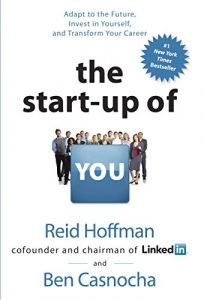
The Start-Up of You

Following is my short summary of the same.

  1. Avoid complacency: The world changes really fast, Detroit use to be what Silicon Valley is today, but then it became complacent and has been reduced to abandoned buildings. People who become complacent with their skill set would realize that it has become outdated. The book emphasizes that one must update his/her skill set, both hard and soft, regularly.
  2. Competitive advantage: The authors reject the theoretical notion of “inherent passion” and a “static world”. Since the world is dynamic, one cannot expect a fixed plan to work, the plan has to evolve as the world changes.
    • What you have - assets ( qualitative skills as well as quantitative money/real estate) - these alone are not sufficient unless someone is willing to pay for them.
    • What you aspire to be - Aspirations - it’s good to have, but they must be realistic.
    • One has to see assets, aspirations, and market realities in conjunction with each other and realize that all of them will evolve with time.
    • The author recommends that one should look around for a good opportunity with less competition than a great opportunity with extreme competition.
  3. Plan to Adapt: Flickr was originally a game (Neverending) but then its photo-sharing feature became more popular than the game, so, it transformed itself into a photo-sharing site.
    • Make plans - be ready to change them as market demands - don’t make random changes make planned changes.
    • ABZ planning:
      1. Plan A - what you are doing right now
      2. Plan B - pivot from A when it feels it might be better than A
      3. Plan Z - fallback, if both A and B fail
    • All plans should be explicit in terms of time.
    • Prioritize learning over making money and try learning by doing.
    • Avoid immediate gratification.
    • Try making small reversible bets (eg. trying out a FOSS project on the side related to any idea you might have)
  4. Network: Understand the importance of the network, and put aside some time and money specifically to meet people, when trying to meet someone says “what you can do for him/her”, and occasionally send emails to maintain contact. Have some core allies, who defend you, and you defend them and then have weaker ties surrounding the core.
  5. Pursue Breakout opportunities: Keep an eye around for breakout opportunities. These are random but can have a huge impact on career.
  6. Take Intelligent Risks: Think about whether you can face the worst-case scenario, also, don’t conflate uncertainty with risk. Uncertainty is fine, risk must be accounted for. It’s good to take regular small risks to avoid ending up taking a much larger one later. Several small shocks are better than a big one.
  7. Network Intelligence: Use your network for guidance along with general as well as specific questions, and schedule lunches with friends/people ahead of you/people in another interesting industry. Such non-specific conversations can lead to serendipitous intelligence.

One can read a more comprehensive summary on the official website.


