






Joel Gustafson / Posts / 2021--11-29
Warpaint is an American indie rock band whose most-streamed track on Spotify is Love Is to Die. I'm a real sucker for this kind of stuff. Swirling, hazy, atmospheric. The Weather Station, Karen O, This Is The Kit, Sharon Van Etten. You get the idea.
But for me, the most memorable aspect of the track is the lyrics in the chorus. Obviously the music is the foundation that makes any of it possible, and my interpretation and attachment are framed by and entangled with the instrumentals in a way that can't be decomposed. But whenever I think of the song, I think of these four lines:
Love is to die Love is to not die Love is to dance Love is to dance and dance
This is what clatters around my head on Sunday morning Lindy walks. Love is to die. Love is to not die. Love is to dance. These words are, on the surface, so simple that it's hard to imagine they mean anything at all. Why are they so memorable?
The easy answer is: "They're memorable because they're meaningless! The ambiguity serves as a canvas that you project meaning onto. It's a trick, Warpaint just gave you a handful of evocative words and you've been coaxed into an endless cycle of speculation that jacks up their streams on Spotify."
This may be more true than false. But hey, either way, let's just take a crack at what it could mean.
One image that comes to mind is an argument. Maybe it's between two lovers - the woman thinks that love is to die, the man thinks that love is to not die. The woman sees love as annihilation, the obliteration of the self, to love so much that you get lost in it. To give yourself up entirely. But the man is more pragmatic, teasing the woman by being deliberately dense and literal: "No! Love is to not die! Love is to be here, with you. Love is exactly this (gestures around)". Maybe he doesn't have the same illusions about romance, and to him, love is simple acts of everyday devotion. But eventually they compromise - love is to dance. It's a real thing that happens here, in the physical world, but at the same time signifies and enacts something far beyond it.
Or maybe it's all internalized - a deliberation with one's self. "Love is definitely to die... no! wait! It's to not die." I picture this as exasperation - "I keep forgetting whether love is to die or not!" - "will someone please tell me if love is to die??" - like a crucial fact during an exam. "It's definitely one of the two... unless?" This plays out as a comedy, as someone trying to identify "what love is" like a factoid or trivia question, cycling through absurd answers to an absurd question.
It also matches the "thesis -> antithesis -> synthesis" pattern that I love so much (but Hegel apparently... hated?). Love is to die, sure. i am completely convinced. But, counterpoint: love is to not die. o shit that is also very persuasive how will we resolve this. Finally we see the light: love is to dance, love is to dance and dance.
There's definitely some kind of structure going on here. We've emptied the box and now "love", "dying", and "dancing" are all on the table (plus a bonus "NOT" modifier that nobody knows how to use), and this itself would be meaning enough to last several days. But there's more to it, since Warpaint have gone ahead and arranged them into this little triangle shape for us.
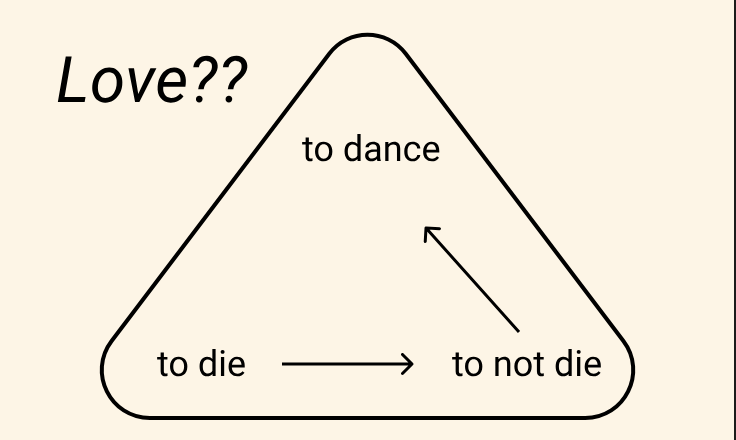
It certainly makes you think.
Personally, it makes me think about negation. Negation is stronger than disagreement, and even stronger than contradiction. We're not just saying something different, or even something mutually exclusive, we're saying the straight opposite in the truest sense. What does it mean to say something and to also say its opposite? Well... meaning is usage, so we may as well ask what circumstances we find people doing that in.
One that comes to mind is like... koans or parables. I'm too lazy to look any up or know anything about them at all but it feels like their wheelhouse, right? The master says "X", the student says "well what about NOT(X)", the master says "yes NOT(X) too", the student says "???", and the master says "exactly" with an infuriating twinkle in his eye.
It's like the words "trivial" and "obvious". People hear their math professor say that some result is "obvious" and interpret this as an insult on an emotional level - that the professor is flexing on them, or setting expectations about what they should have already deduced, or making them feel bad for not keeping up. But these words have a different meaning to the professor - "obvious" describes something that follows directly from whatever is already on the table, and "trivial" describes something that has no arbitrary content. They're actual descriptions used to characterize situations, and we need them because some deceptively simple situations can trick us into making them more complicated than they really are. Often the trivial is far from trivial, and that is precisely why the word is so useful! It's only because the obvious can be so easily mistaken for the non-obvious that mathematicians are always saying "obviously": they're using it to communicate crucial information to each other!
In the same way, it's understandable for the student to respond with frustration, because from their perspective the master is just toying with them by saying self-evidently nonsensical things. But nonsense is of course the master's intent, because the lesson was never about X or NOT(X) but rather something completely different that lurks behind X but can't be noticed if you're only looking at X itself. The purpose of saying "NOT(X)" is to indicate that you never in the first place meant literally "X"; negation is used as a signal to point toward more subtle layers of meaning! To the mathematician, "trivial" is a warning saying "you're in danger of overthinking this", and to the master, nonsense is a warning saying "you're in danger of taking this too literally and I am going out of my way to make sure that you don't".
The diagram here is a little different - instead of stepping through a progression from dying to not dying to dancing, we feel the pressure that dying and not dying exert against each other and use that stress to break up and into into a new dimension.
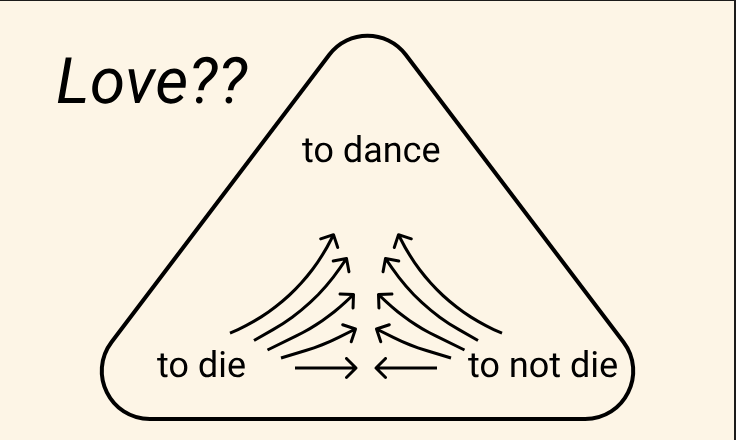
(it turns out that there is no type of type tectonic fault that looks like this and my image of how volcanoes form was completely wrong)
Speaking of math, we should also talk about numbers. The diagrams I'm drawing are all triangles, but the chorus has four lines and looks like a rectangle. This is concerning, what gives?
Warpaint makes it fit by repeating the top of the triangle to fill out the line: Love is to dance... Love is to dance and dance. This makes for (count carefully) three (3) dances! Isn't that so cool!? How did that work out?? Not only do we fit three into four, but we do so by introducing another set of three! If this doesn't excite you I don't know how to help.
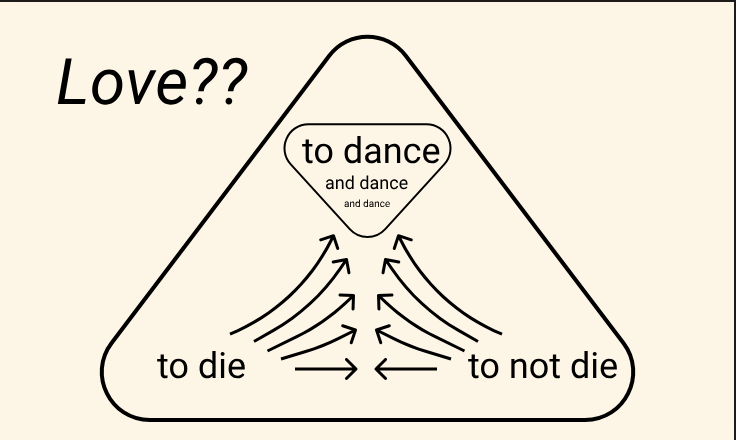
Repeating "dance" has a couple effects. The most significant is that it reinforces the sense of resolution. Having confronted the conflict between the thesis and antithesis, we arrive at the synthesis, and the synthesis has such good vibes that we decide to hang out there for a while. The song has some layering around this part; "to dance and dance" echoes off into the distance. Some say love is still dancing.
But repetition does more than reinforce. Picture this exchange:
ALICE: So what'd you do at the club last night?
BOB:   I danced. What'd you do?
ALICE: I danced and danced.
Alice and Bob had very different experiences! This is another case of language being absolutely magical. Saying something twice doesn't just emphasize it, it transforms it into something entirely new. I wrote about repetition more in a separate post a couple years ago:
Repetition is the shadow of "structure": the 2d shadow of a cube looks like several squares all hanging out, and the 3d shadow of a tesseract looks like a cube with extra cubes... I think all the 2d people subconsciously understand that a bunch of squares all in the same place represents something seriously significant, even if they don't quite know what.
... repetition is one of our few tools for expressing the inexpressible. I think music has this figured out in a big way. Layered and looped phrases can take on lives of their own in a really grand way that's hard to describe.
"To die and not die" hints at something beyond life and death: dancing. And "to dance and dance" hints at something beyond dancing! The chorus is a two-stage gravitational meaning slingshot packed into four lines. I think that's why I like it.
As an epilogue, here's a Cat Power lyric from Say, also about negation, but in an entirely different context.
Learn to say the same thing What defeats people is a double confession One time they will confess one thing And the next they will confess something else Talk to them, they will say
Learn to say the same thing Let us hold fast to saying the same thing
此内容由惯性聚合(RSS阅读器)自动聚合整理,仅供阅读参考。 原文来自 — 版权归原作者所有。