











Update: news sites have pulled the video now, confirming parts of it were AI generated.
Right now, you might have read the news that a Chinese paraglider pilot, Peng Yujiang, got sucked into a cloud and ended up at 8,598 meters / 28,000 feet.
It's literally on every news website: CNN, BBC, The Guardian.
Now, what makes this story really interesting is the accompanying video. Here is one version from The Guardian, which had 300k views in 17 hours:
I've been paragliding for 18 years and follow the progress of AI very closely, but even I couldn't say with 100% certainty if this video is real or fake.
One scene is definitely fake: the one where the camera makes a move that would only be possible from a drone. In this scene, the otherwise black helmet is white, and the perspective falls apart in a strange, distorted way, typical of lower-quality AI-generated videos. Also, here, he is using a sitting harness (legs visible) whereas in the real ones, he is in a pod-style harness.
A screenshot from the fake scene:

I think the other two scenes might be real though, recorded with a 360 camera on a selfie stick - a common setup for paragliding videos.
There are definitely some questions:
Why did he (or someone) have to make a fake AI-generated scene and insert it between the two real ones (if they are indeed real)?
How does the camera move in both scenes, while his hands are definitely not moving it? In one scene, the camera makes a circular move, while in the other, it's moving away from the pilot slowly. I'm not saying it's impossible; I just don't yet understand what is moving the camera. Is the dolly-like move just a zoom effect? The resolution seems to remain the same.
Why is the camera not frozen at all? Everything is covered in thick ice, but somehow the camera's lens is not. (The phone's screen is also perfectly clear and ice-free.)

To me, it seems like the pilot's face slightly changes between the two scenes. In one, he is a bit skinnier and paler; in the other, he is a bit more rounded and darker in color. Maybe the two scenes were recorded at different times?
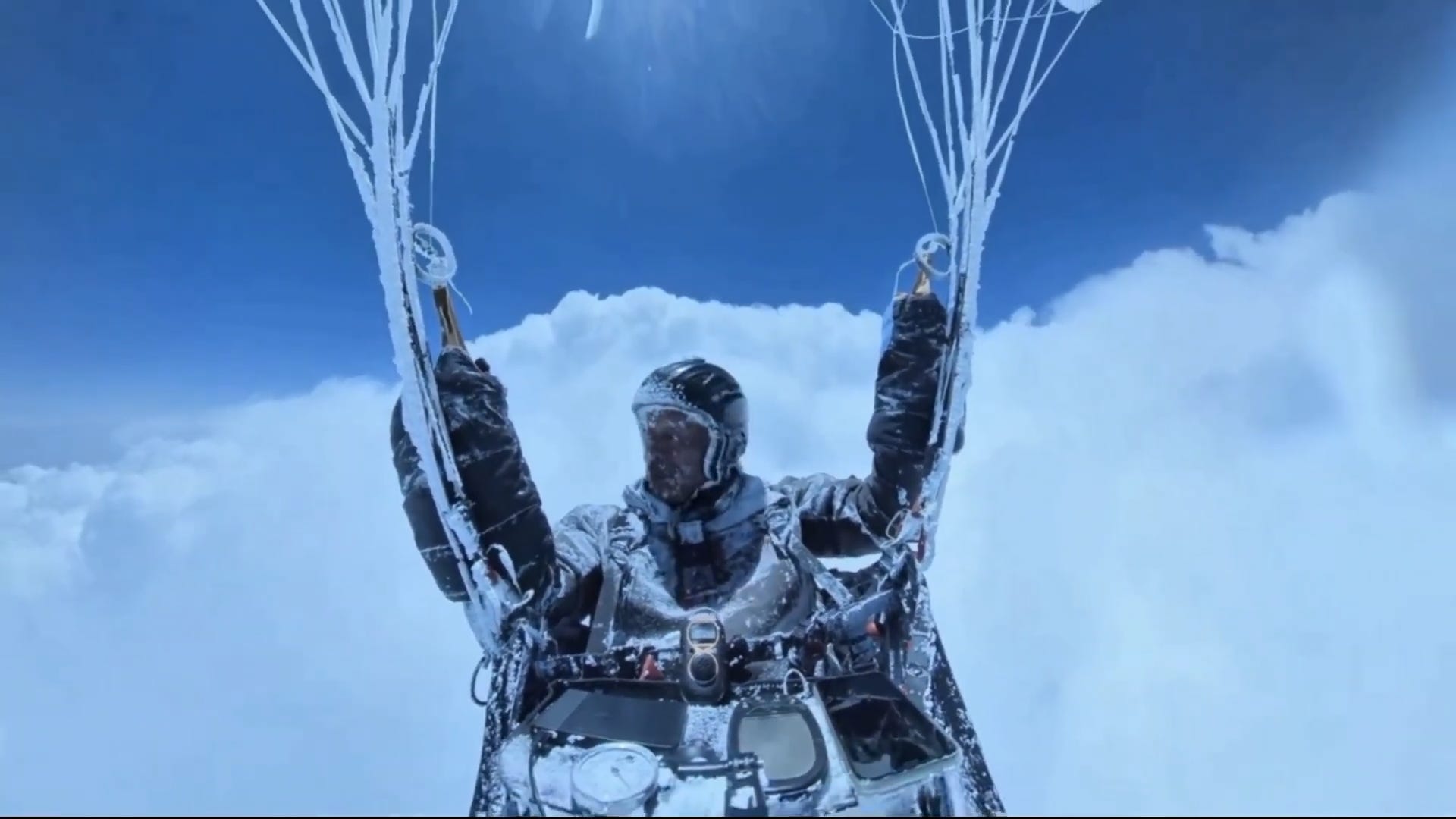
Looking closer at the equipment, we can conclude that this is indeed the case. He is using a different harness with a different setup in the two scenes.
In one scene he has a phone with a glossy screen (left arrow), whereas in the second image, he has a plastic power bank.

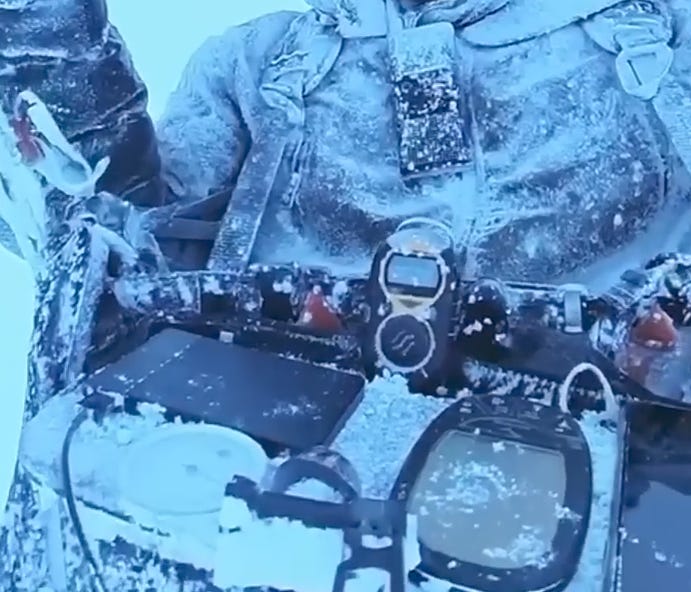
Also, the harness is different: one has shiny metal connectors (right arrow), the other has orange straps.
So we can definitely conclude that these two scenes were recorded at different times.
Here is a YouTube search page for "Chinese paraglider" - ordered by upload date.
The oldest version is from 4 days ago, interestingly from the possible manufacturer of the hand-warming "mittens" he is using. Maybe the whole idea came from the manufacturer?

After that, there is this YouTube Short, which, to me, looks like the best-quality footage so far.
Afterwards, AI-generated fake scenes start to be mixed into the videos, which in turn are copied by all major news outlets.
Even the No. 1 paragliding magazine is linking to one such video, whereas it should be obvious to every paraglider pilot that it contains AI-generated scenes.
Don't worry too much about the articles saying he just accidentally got "caught" up in the cloud; this was a super-well-planned and carefully executed flight. He, of course, has to say this; otherwise, he'd get in even bigger trouble with the authorities.
Additionally, it appears that this is a mechanical altimeter. Paraglider pilots typically never use such instruments because our electronic devices are much more precise, more lightweight and function reliably at the altitudes and temperatures we normally encounter. This particular gauge is a bulky, industrial-style metal instrument, specially carried for these record attempts.

Yes, most people would lose consciousness long before reaching such altitudes. However, Sherpas can climb Mount Everest without supplemental oxygen, even while performing intense physical activity. Therefore, I don't see why a suitably adapted person couldn't reach the same altitude, comfortably seated in a paragliding harness.
So, to answer some of my questions, I believe:
The video contains three scenes: one is 100% AI-generated, one is from an older attempt, and one is from the current flight.
The dolly effect in the current flight might be AI-generated, but the footage is real. The linked YouTube Short is definitely original footage.
I believe the pilot definitely made the flight, and it was planned long in advance, possibly over many months or even years. He might even have had a sponsor from the mitten manufacturer.
Interestingly, in that climate, all glass surfaces stayed clear of frost, so the camera had a perfect picture. I mean, airplane windows also don't get icy from the outside, so it's possible that glass just stays 100% clear in that environment.
It's a pity that an AI-generated scene got mixed into the video, as well as an older recording. If not for this, the footage would have been authentic.
The real story, however, might be how major media outlets shared this as authentic footage, yet the AI-generated portion looks laughably fake by today's standards.
But here's what's truly concerning: what we consider state-of-the-art AI generation today will look just as crude in twelve months. AI video quality makes massive leaps every year. If news outlets already struggle with primitive AI content, how will they cope when the technology becomes perfect?
For finish, below are some videos possible with today’s latest model, Google’s Veo 3.
Emotional support kangaroo not allowed on airplane
Prompt theory
By @emollick
By @PJaccetturo