
惯性聚合 高效追踪和阅读你感兴趣的博客、新闻、科技资讯
阅读原文 在惯性聚合中打开

推荐订阅源

cs.CL updates on arXiv.org
B
Blog RSS Feed
宝玉的分享
宝玉的分享
腾讯CDC
博客园_首页
T
Tailwind CSS Blog
月光博客
月光博客
博客园 - 司徒正美
奇客Solidot–传递最新科技情报
奇客Solidot–传递最新科技情报
M
MIT News - Artificial intelligence
A
About on SuperTechFans
云风的 BLOG
云风的 BLOG
钛媒体:引领未来商业与生活新知
钛媒体:引领未来商业与生活新知
有赞技术团队
有赞技术团队
freeCodeCamp Programming Tutorials: Python, JavaScript, Git & More
大猫的无限游戏
大猫的无限游戏
MongoDB | Blog
MongoDB | Blog
博客园 - 聂微东
V
Visual Studio Blog
H
Hackread – Cybersecurity News, Data Breaches, AI and More
SecWiki News
SecWiki News
美团技术团队
P
Privacy International News Feed
H
Help Net Security
让小产品的独立变现更简单 - ezindie.com
Microsoft Security Blog
Know Your Adversary
Know Your Adversary
Y
Y Combinator Blog
D
DataBreaches.Net
Project Zero
Project Zero
T
The Blog of Author Tim Ferriss
Cyberwarzone
Cyberwarzone
C
Cybersecurity and Infrastructure Security Agency CISA
C
Cisco Blogs
S
Schneier on Security
G
GRAHAM CLULEY
博客园 - 三生石上(FineUI控件)
Cisco Talos Blog
Cisco Talos Blog
小众软件
小众软件
Forbes - Security
Forbes - Security
D
Docker
T
Tenable Blog
S
Secure Thoughts
雷峰网
雷峰网
S
Security @ Cisco Blogs
T
The Exploit Database - CXSecurity.com
The Cloudflare Blog
博客园 - 【当耐特】
Spread Privacy
Spread Privacy
阮一峰的网络日志
阮一峰的网络日志

Arpit Bhayani

Temporal Primer - Building Long-Running Systems What Matters in Production RAG Structure of Every LLM Chat How LLMs Really Work Your Monolith Is Already A Distributed System Databases Were Not Designed For This BM25 JOIN Algorithms Venting at Work Comes at a Reputation Cost Why Half Your Skills Expire Every Few Years Multi-Paxos - Consensus in Distributed Databases MySQL Replication Internals Bloom Filters When You Increase Kafka Partitions Product Quantization The Q, K, V Matrices The Day I Accidentally Deleted Production How LLM Inference Works What are Blocking Queues and Why We Need Them Heartbeats in Distributed Systems How Writes Work in Apache Cassandra Redis Replication Internals How to Handle Arrogant Colleagues at Work How Does a CDN Handle Content Replication You Can't Fix Everything on Day One When Emotions Spill Over at Work Why gRPC Uses HTTP2 Meetings With No Agenda Are a Waste of Time Career Longevity Beats Constant Job Hopping Stay Relevant at Higher Salary Levels Why Distributed Systems Need Consensus Algorithms Like Raft Why Do Databases Deadlock and How Do They Resolve It Why and How Cache Locality Can Make Your Code Faster Why Eventual Consistency is Preferred in Distributed Systems Why does DNS use both UDP and TCP Should You Do a Master's My Honest Take Empathy Makes Great Engineers Unstoppable Good Mentors Build People, Not Just Skills Why You Should Always Have Back-Burner Projects Before You Push Back, Know What You're Standing On Be the One They Can Count On How Much Are People Willing to Bet on You How to Get Leadership to Say Yes to Your Project Don't Let Your Best Ideas Die in Silence Be the Person Everyone Wants to Work With The XY Problem and How to Avoid It The Startup Hiring Lie Nobody Talks About You Won't Be Promoted Unless You Ask It's Not Enough to be Right; Learn to be Heard No One Ships Great Software Alone You Don't Win by Proving Others Wrong Appreciate Generously; It Costs Nothing, But Builds Everything Your Soft Skills Aren't Soft at All Before you form an opinion, experience it Why You Need Both Curiosity and Action to Thrive A Daily Worklog Changed Everything How We Handle Mistakes Defines Us Own Your Mistakes Don't Wait. Step Up. Temporary Fixes Are Permanent Why Interviews Are Biased And What Sets You Apart Saying 'This isn't my problem' is actually the problem How to Write Effective OKRs Never Lose a Battle due to Miscommunication When In Doubt, Code It Out How to Follow Up Without Annoying People Lead Projects That Land, Execution Over Everything Abstract Thinking Will Define Your Next Decade We Engineers Suck at Task Estimation Shiny Obect Syndrome in Tech When to Change Jobs - The 3P Framework Comfort and Competition - Know When to Switch Gears Paper Notes - On-demand Container Loading in AWS Lambda Paper Notes - SQL Has Problems. We Can Fix Them Pipe Syntax In SQL Paper Notes - NanoLog - A Nanosecond Scale Logging System Don't Wait, Learn - The Best Resource is Mythical Paper Notes - WTF - The Who to Follow Service at Twitter The Unexpected Benefit of Reading Random Engineering Articles Roadmaps Are Limiting Your Growth Stop Leaving Money on the Table - Negotiate Your Job Offer Never Bad-Mouth Your Past Employers Show You're a Culture Fit Quantify your resume, Know Your Numbers The Importance of Being Likeable in Interviews Questions to Ask Your Interviewer How to Build Trust Through Collaboration Do This, Once You Are Out of the Interview Cycle Stop Pitching Ideas, Start Pitching Projects Read Those Design Docs, Even the Ones That Seem Irrelevant The Best Engineering Lessons Happen During Outages Great Engineers Start Broad LLM Summaries are Ruining Your Learning Turn System Design Interviews into Discussions Title Inflation At Work, Find Your Own Projects 6 Simple Strategies to Cracking Any Tech Interview How to Remain Unblocked Solving the Knapsack Problem with Evolutionary Algorithms Generating Pseudorandom Numbers with LFSR Local vs Global Indexes in Partitioned Databases
The 2Q Algorithm - Addressing LRU's Sub-Optimality
Arpit Bhayani · 2020-11-29 · via Arpit Bhayani

LRU is one of the most widely used cache eviction algorithms that span its utility across multiple database systems. Although popular, it suffers from a bunch of limitations especially when it is used for managing caches in disk-backed databases like MySQL and Postgres.

In this essay, we take a detailed look into the sub-optimality of LRU and how one of its variants called 2Q addresses and improves upon it. 2Q algorithm was first introduced in the paper - 2Q: A low overhead high-performance buffer management replacement algorithm by Theodore Johnson and Dennis Shasha.

LRU

The LRU eviction algorithm evicts the page from the buffer which has not been accessed for the longest. LRU is typically implemented using a Doubly Linked List and a Hash Table. The intuition of this algorithm is so strong and implementation is so simple that until the early ’80s, LRU was the algorithm of choice in nearly all the systems. But as stated above, there are certain situations where LRU performs sub-optimal.
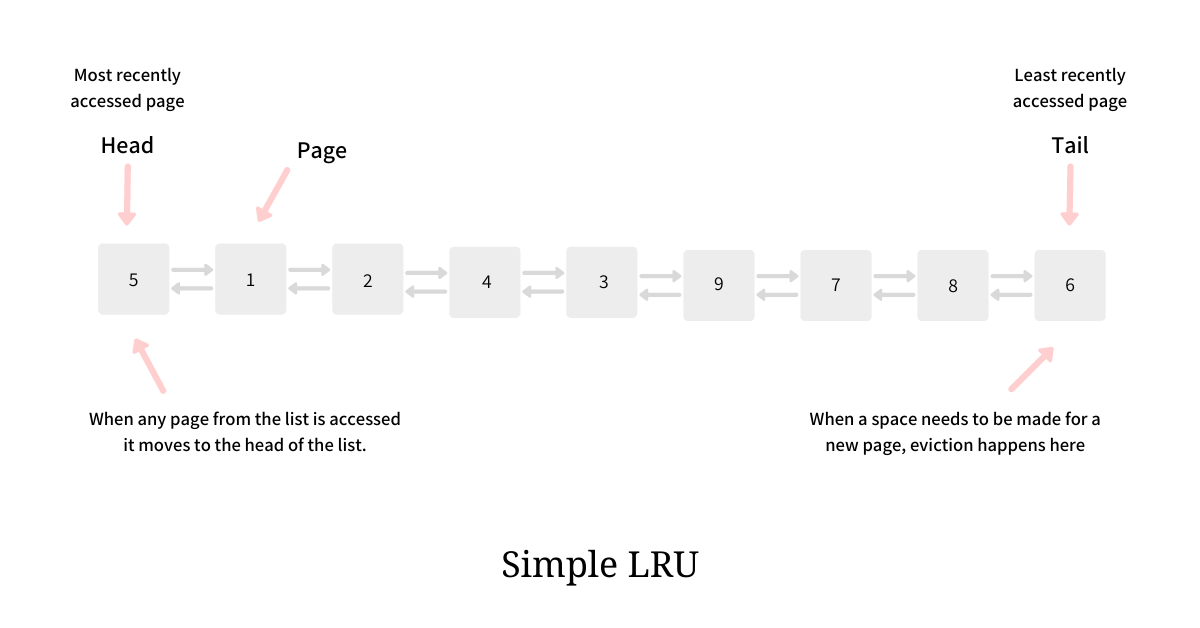
https://user-images.githubusercontent.com/4745789/100534745-43ae8400-3238-11eb-8855-752a6ef2f3c6.png

Sub-optimality during DB scans

If the database table is bigger than the LRU cache, the DB process, upon scanning the table will wipe out the entire LRU cache and fill it with the pages from just one scanned table. If these pages are not referenced again, this is a total loss and the performance of the database takes a massive hit. The performance will pickup once these pages are evicted from the cache and other pages make an entry.

Sub-optimality in evictions

LRU algorithm works with a single dimension - recency - as it removes the pages from the buffer on the basis of recent accesses. Since it does not really consider any other factor, it can actually evict a warmer page and replace it with a colder one - a page that could and would be accessed just once.

2Q Algorithm

2Q addresses the above-illustrated issues by introducing parallel buffers and supporting queues. Instead of considering just recency as a factor, 2Q also considers access frequency while making the decision to ensure the page that is really warm gets a place in the LRU cache. It admits only hot pages to the main buffer and tests every page for a second reference.

The golden rule that 2Q is based on is - Just because a page is accessed once does not entitle it to stay in the buffer. Instead, it should be decided if it is accessed again then only keep it in the buffer.

Below we take a detailed look into two versions of the 2Q algorithm - simplified and improved.

Simplified 2Q

Simplified 2Q algorithm works with two buffers: the primary LRU buffer - Am and a secondary FIFO buffer - A1. New faulted pages first go to the secondary buffer A1 and then when the page is referenced again, it moves to the primary LRU buffer Am. This ensures that the page that moves to the primary LRU buffer is hot and indeed requires to be cached.

https://user-images.githubusercontent.com/4745789/100536835-41a0f100-3249-11eb-920b-0bcaff905906.png

If the page residing in A1 is never referenced again, it eventually gets discarded, implying the page was indeed cold and did not deserve to be cached. Thus this simplified 2Q provides protection against the two listed sub-optimality of the simple LRU scheme by adding a secondary buffer and testing pages for a second reference. The pseudocode for the Simplified 2Q algorithm is as follows:

def access_page(X: page):
    # if the page already exists in the LRU cache
    # in buffer Am
    if X in Am:
         Am.move_front(X)

    # if the page exists in secondary storage
    # and not it gets access.
    # since the page is accessed again, indicating interest
    # and long-term need, move it to Am.
    elif X in A1:
         A1.remove(X)
         Am.add_front(X)

    # page X is accessed for the first time
    else:
         # if A1 is full then free a slot.
         if A1.is_full():
             A1.pop()

         # add X to the front of the FIFO A1 queue
         A1.add_front(X)

Tuning Simplified 2Q buffer is difficult - if the maximum size of A1 is too small, the test for hotness becomes too strong and if it is too large then due to memory constraint Am will get relatively smaller memory making the primary LRU cache smaller, eventually degrading the database performance.

The full version 2Q algorithm remediates this limitation and eliminates tuning to a massive extent without taking any hit in performance.

2Q Full Version

Although Simplified 2Q algorithm does a decent job there is still scope of improvement when it comes to handling common database access pattern, that suggests, a page generally receives a lot of references for a short period of time and then no reference for a long time. If a page truly needs to be cached then after it receives a lot (not just one) of references in a short span it continues to receive references and hits on regular intervals.

To handle this common database access pattern, the 2Q algorithm splits the secondary buffer A1 into two buffers A1-In and A1-Out, where the new element always enters A1-In and continues to stay in A1-In till it gets accesses ensuring that the most recent first accesses happen in the memory.

Once the page gets old, it gets thrown off the memory but its disk reference is stored in the A1-Out buffer. If the page, whose reference is, residing in A1-Out is accessed again the page is promoted to Am LRU implying it indeed is a hot page that will be accessed again and hence required to be cached.

https://user-images.githubusercontent.com/4745789/100538168-0bb53a00-3254-11eb-8f69-ddcaf8d33a84.png

The Am buffer continues to be the usual LRU which means when any page residing in Am is accessed it is moved to the head and when a page is needed to be discarded the eviction happens from the tail end.

2Q in Postgres

Postgres uses 2Q as its cache management algorithm due to patent issues with IBM. Postgres used to have ARC as its caching algorithm but with IBM getting a patent over it, Postgres moved to 2Q. Postgres also claims that the performance of 2Q is similar to ARC.

References