

惯性聚合 高效追踪和阅读你感兴趣的博客、新闻、科技资讯
阅读原文 在惯性聚合中打开

推荐订阅源

罗磊的独立博客
Apple Machine Learning Research
The Cloudflare Blog
WordPress大学
WordPress大学
钛媒体:引领未来商业与生活新知
钛媒体:引领未来商业与生活新知
奇客Solidot–传递最新科技情报
奇客Solidot–传递最新科技情报
博客园 - 叶小钗
博客园 - 聂微东
阮一峰的网络日志
阮一峰的网络日志
腾讯CDC
博客园 - 三生石上(FineUI控件)
V
V2EX
有赞技术团队
有赞技术团队
V
Visual Studio Blog
小众软件
小众软件
Jina AI
Jina AI
酷 壳 – CoolShell
酷 壳 – CoolShell
博客园 - Franky
量子位
T
Tailwind CSS Blog
cs.CV updates on arXiv.org
P
Palo Alto Networks Blog
Cisco Talos Blog
Cisco Talos Blog
I
Intezer
Project Zero
Project Zero
A
Arctic Wolf
P
Privacy International News Feed
V
Vulnerabilities – Threatpost
L
Lohrmann on Cybersecurity
S
Securelist
C
Cybersecurity and Infrastructure Security Agency CISA
C
CXSECURITY Database RSS Feed - CXSecurity.com
T
Tor Project blog
Hacker News - Newest:
Hacker News - Newest: "LLM"
S
Security @ Cisco Blogs
cs.AI updates on arXiv.org
Threat Intelligence Blog | Flashpoint
Google DeepMind News
N
News and Events Feed by Topic
TaoSecurity Blog
TaoSecurity Blog
L
LINUX DO - 热门话题
G
GRAHAM CLULEY
Help Net Security
Help Net Security
N
News | PayPal Newsroom
W
WeLiveSecurity
G
Google Developers Blog
Microsoft Security Blog
Engineering at Meta
Engineering at Meta
MongoDB | Blog
MongoDB | Blog
C
Check Point Blog

Pierce Freeman

A browser for agents | Pierce Freeman The grey market of podcast appearances The way I travel | Pierce Freeman Fixing slow AWS uploads | Pierce Freeman Local tools should still use vaults We solved scratch content first Starting a podcast in 2025 Being late but still being early Automating our home video imports Adding my parents to tailscale A deep dive on agent sandboxes Language servers for AI | Pierce Freeman My simple home podcast studio We need centralized infrastructure | Pierce Freeman Coercing agents to follow conventions using AST validation My unified theory of social selling My personal backup strategy | Pierce Freeman July updates to the homelab How the KV Cache works httpx is the right way to do web requests in Python Reputation is becoming everything | Pierce Freeman Building a (kind of) invisible mac app Updated knowledge in language models Making an ascii animation | Pierce Freeman How speculative decoding works | Pierce Freeman Under the hood of Claude Code Doing things because they're easy, not hard Speeding up sideeffects with JIT in mountaineer Firehot for hot reloading in Python Misadventures in Python hot reloading How text diffusion works | Pierce Freeman The tenacity of modern LLMs The ergonomics of rails | Pierce Freeman How language servers work | Pierce Freeman Just add eggs | Pierce Freeman Unfortunately SEO still matters | Pierce Freeman The futility of human-only web requirements Setting up Input Leap | Pierce Freeman Checking in on Waymo | Pierce Freeman The react revolution | Pierce Freeman Speeding up many small transfers to a unifi nas Quick notes on swift libraries AI engineering is a different animal San Francisco | Pierce Freeman Debugging a mountaineer rendering segfault Local network config on macOS Building our home network | Pierce Freeman Introducing Envelope.dev | Pierce Freeman Legacy code and AI copilots Typehinting from day-zero | Pierce Freeman Generating database migrations with acyclic graphs Lofoten | Pierce Freeman Mountaineer v0.1: Webapps in Python and React Constraining LLM Outputs | Pierce Freeman Passthrough above all | Pierce Freeman Accuracy in kudos | Pierce Freeman How quick we are to adapt The curious case of LM repetition Costa Rica | Pierce Freeman Debugging chrome extensions with system-level logging Speeding up runpod | Pierce Freeman Inline footnotes with html templates Parsing Common Crawl in a day for $60 An era of rich CLI All or nothing with remote work The Next 10 Years | Pierce Freeman Adding wheels to flash-attention | Pierce Freeman LLMs as interdisciplinary agents | Pierce Freeman New Zealand | Pierce Freeman Representations in autoregressive models | Pierce Freeman Let's talk about Siri | Pierce Freeman Minimum viable public infrastructure | Pierce Freeman Reasoning vs. Memorization in LLMs Automatically migrate enums in alembic Greater sequence lengths will set us free On learning to ski | Pierce Freeman Dolomites | Pierce Freeman Using grpc with node and typescript Opportunity years | Pierce Freeman Buzzword peaks and valleys | Pierce Freeman Buenos Aires | Pierce Freeman Network routing interaction on MacOS Independent work: November recap | Pierce Freeman Debugging slow pytorch training performance The provenance of copy and paste Debugging tips for neural network training Patagonia | Pierce Freeman Santiago | Pierce Freeman My 2022 digital travel kit AWS vs GCP - GPU Availability V2 Planning Patagonia | Pierce Freeman Relationship modeling | Pierce Freeman The power of status updates A new chapter | Pierce Freeman Give my library a coffee shop AWS vs GCP - GPU Availability V1 Switzerland | Pierce Freeman Headfull browsers beat headless | Pierce Freeman Webcrawling tradeoffs | Pierce Freeman Copenhagen | Pierce Freeman
Independent work: October recap | Pierce Freeman
2022-11-05 · via Pierce Freeman

It's been a month since going full time on my own thing. In some ways I'm surprised by how natural the transition has been. My morning standup meeting has morphed into a journaling session. My 1:1s have migrated to Discord chats about open source projects. Quarterly planning and tech designs have been replaced with my IDE. I was expecting many more moments of friction with the new lifestyle and a constant question of "What in the world are you doing?" They never really materialized.

As it is - there's just the right amount of boredom and business. I have a growing todo list but the things on it really excite me. It's been awhile since I've had the feeling where everything seems new.

Lifestyle

My days structurally look similar to how I was spending them at my last job. Just way fewer Zoom calls. I start every day with a cup of coffee, spend ten minutes writing in my journal, and then fire up my laptop. The rest of the day until evenings is spent at the keyboard, punctuated by a few walks. I always try to get out for a stroll around sunset.

I've spent a lot more time walking around, thinking, and working in the code. I have a few lingering side projects that have been taking my primary attention and I've noticed a palpable difference in outlook. A few months ago I would be fatigued after even a few hours of staring at Python. Now I've been feeling so invigorated that I can easily sit down for a 10 hour session of deep work.

We haven't stayed in one place for more than three weeks since the start of the summer. My only rig is my trusty M1 MacBook. Working exclusively on a 13" laptop is a far cry from a more formal setup, but I've been surprised at how quickly I've adapted to it. I'm still figuring out the best keyboard setup to give slightly better ergonomics but I don't mind the screen real estate too much.
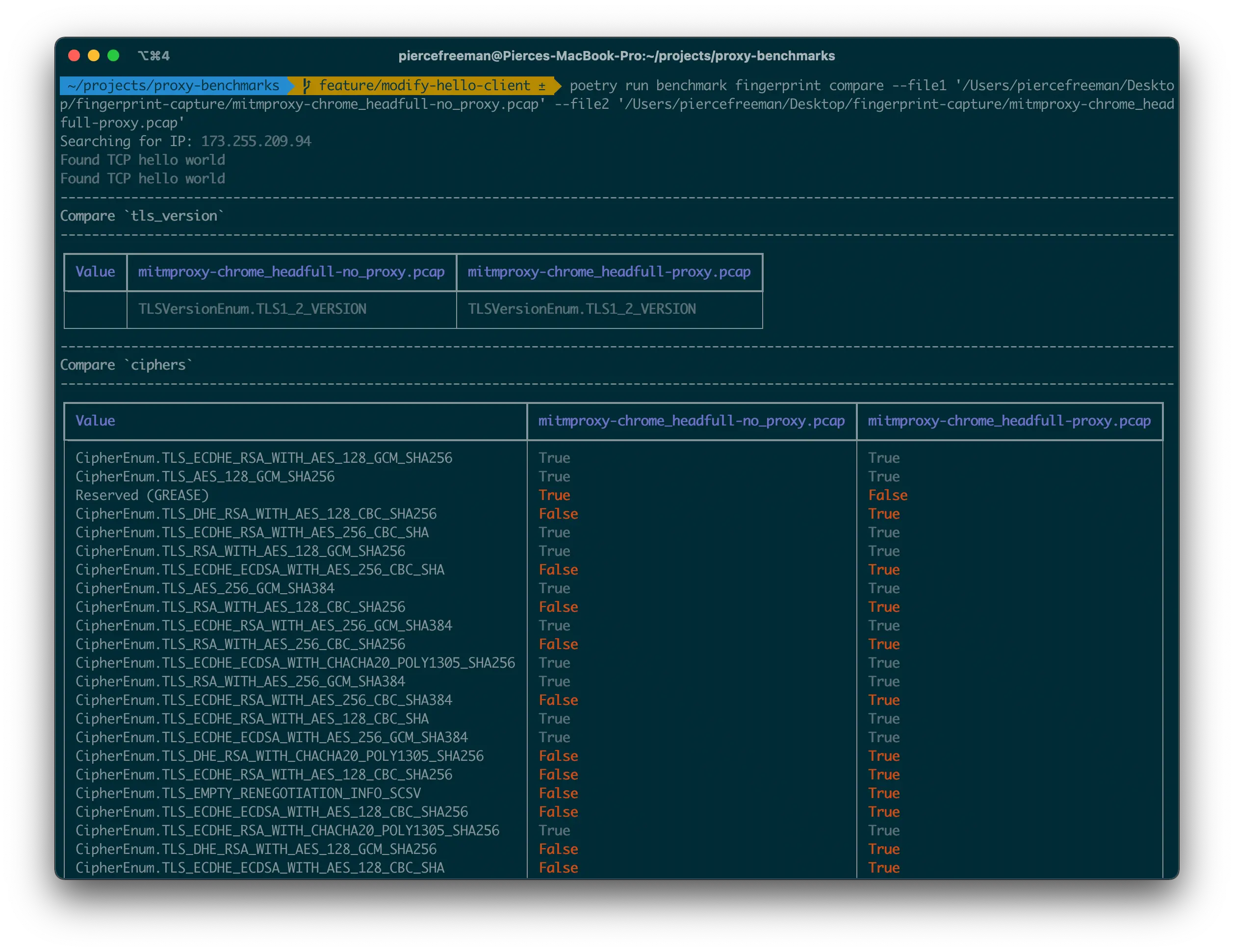
GrooveProxy

Screenshot of TLS Support

Benchmarking script, comparison of TLS handshake signatures for different proxy servers and browser combinations.

As part of some data acquisition work I've been doing I've needed browsers that efficiently browse webpages like humans do. I also want to be able to test against webpages that occur in the wild as a way to do regression testing and ensure parsing logic stays constant.

There are a few challenges to this:

  • Headfull browsers are only a part of the solution. Almost all control suites (like selenium, puppeteer, playwright) inject some javascript elements into the webpage that are detectable to fingerprinting libraries. These libraries then might change website behavior.
  • Most (but importantly not all) web requests pass through the chromium developer tools and are able to be intercepted. The devtools support typically lags web technology somewhat, like for service worker requests where support under certain conditions is still pending.
  • Capturing all requests effectively requires a man-in-the-middle proxy server, but all of the available options use the default networking stack in their language core. Python, Node, and Golang all implement their own handshake that has unique TLS fingerprints that differ from the end browser.

I got started here by benchmarking a variety of MITM proxies and their current state of TLS fingerprints. None of them foot the bill as a crawl coordinator so I started working on GrooveProxy. It addresses the above crawl challenges with some additional support for proxy servers, request passthroughs, and request replaying. It also has Python and Node client library support.

The main sprint on it took place over two weeks during the beginning of October. It's now relatively stable. I'm in the process of deploying in the wild and addressing any bugs that crop up along the way.

Source: Github

Popdown

Screenshot of popovers

A random website that I was browsing while writing this article. Case in point I suppose.

I was reminded when I wiped my computer at how many popups pollute the modern web even with adblockers. There are subscription prompts, paywall blocks, and GDPR notifications. I just want a clean webpage to read.

Some browser plugins exist for this problem like I don't care about cookies, which rely on a blacklist of regex and javascript patterns that eliminate common popups. But these lists are laborious to maintain and typically only apply to one specific target website. The second that a webpage changes its format or dom elements you'll start seeing the popups again.

I'm working to come up with a more generic solution here that featurizes DOM elements and predicts whether the element is part of an unnecessary popover. If so, it will remove it. Users can optionally undo this manipulation in case it was overly ambitious.

I started hacking on this during the weekends in-between work. I haven't made as much progress since going independent as I would have liked. Data collection is proving the main friction, as well as Groove taking more of my attention. I still have to aggregate a list of websites with popups or removable paywalls and add this to an index. But I have some prototypes of featurization so I think the ML stage will be relatively straightforward.

Source: Github

Next month

November has already kicked off. With it comes a bit more traveling where I can further stress-test this setup.

I've spent the last few days working on a new background processing computational graph library dagorama. Hoping to get this stable and wrapped up within the next week. Then turning towards some core business challenges.