



惯性聚合 高效追踪和阅读你感兴趣的博客、新闻、科技资讯
阅读原文 在惯性聚合中打开

推荐订阅源

S
SegmentFault 最新的问题
S
Secure Thoughts
Google DeepMind News
cs.AI updates on arXiv.org
S
Security Affairs
TaoSecurity Blog
TaoSecurity Blog
Cloudbric
Cloudbric
Cisco Talos Blog
Cisco Talos Blog
cs.CV updates on arXiv.org
H
Heimdal Security Blog
The Last Watchdog
The Last Watchdog
T
Threatpost
Hacker News: Ask HN
Hacker News: Ask HN
Security Latest
Security Latest
Know Your Adversary
Know Your Adversary
Threat Intelligence Blog | Flashpoint
S
Securelist
Microsoft Azure Blog
The GitHub Blog
The GitHub Blog
阮一峰的网络日志
阮一峰的网络日志
D
Docker
V
Vulnerabilities – Threatpost
Attack and Defense Labs
Hugging Face - Blog
Hugging Face - Blog
W
WeLiveSecurity
Engineering at Meta
Engineering at Meta
aimingoo的专栏
aimingoo的专栏
Last Week in AI
Last Week in AI
L
LINUX DO - 热门话题
NISL@THU
NISL@THU
D
Darknet – Hacking Tools, Hacker News & Cyber Security
The Cloudflare Blog
博客园_首页
P
Privacy International News Feed
Scott Helme
Scott Helme
N
News and Events Feed by Topic
WordPress大学
WordPress大学
宝玉的分享
宝玉的分享
T
Tenable Blog
H
Hacker News: Front Page
N
News and Events Feed by Topic
罗磊的独立博客
Google Online Security Blog
S
Security @ Cisco Blogs
Hacker News - Newest:
Hacker News - Newest: "LLM"
A
About on SuperTechFans
有赞技术团队
有赞技术团队
K
KPMG report finds enterprise disconnect between AI and its ROI | CIO
G
GRAHAM CLULEY
Application and Cybersecurity Blog

Pierce Freeman

A browser for agents | Pierce Freeman The grey market of podcast appearances The way I travel | Pierce Freeman Fixing slow AWS uploads | Pierce Freeman Local tools should still use vaults We solved scratch content first Starting a podcast in 2025 Being late but still being early Automating our home video imports Adding my parents to tailscale A deep dive on agent sandboxes Language servers for AI | Pierce Freeman My simple home podcast studio We need centralized infrastructure | Pierce Freeman Coercing agents to follow conventions using AST validation My unified theory of social selling My personal backup strategy | Pierce Freeman July updates to the homelab How the KV Cache works httpx is the right way to do web requests in Python Reputation is becoming everything | Pierce Freeman Building a (kind of) invisible mac app Updated knowledge in language models Making an ascii animation | Pierce Freeman How speculative decoding works | Pierce Freeman Under the hood of Claude Code Doing things because they're easy, not hard Speeding up sideeffects with JIT in mountaineer Firehot for hot reloading in Python Misadventures in Python hot reloading How text diffusion works | Pierce Freeman The tenacity of modern LLMs The ergonomics of rails | Pierce Freeman How language servers work | Pierce Freeman Just add eggs | Pierce Freeman Unfortunately SEO still matters | Pierce Freeman The futility of human-only web requirements Setting up Input Leap | Pierce Freeman Checking in on Waymo | Pierce Freeman The react revolution | Pierce Freeman Speeding up many small transfers to a unifi nas Quick notes on swift libraries AI engineering is a different animal San Francisco | Pierce Freeman Debugging a mountaineer rendering segfault Local network config on macOS Building our home network | Pierce Freeman Introducing Envelope.dev | Pierce Freeman Legacy code and AI copilots Typehinting from day-zero | Pierce Freeman Generating database migrations with acyclic graphs Lofoten | Pierce Freeman Mountaineer v0.1: Webapps in Python and React Constraining LLM Outputs | Pierce Freeman Passthrough above all | Pierce Freeman Accuracy in kudos | Pierce Freeman How quick we are to adapt The curious case of LM repetition Costa Rica | Pierce Freeman Debugging chrome extensions with system-level logging Speeding up runpod | Pierce Freeman Inline footnotes with html templates Parsing Common Crawl in a day for $60 An era of rich CLI All or nothing with remote work The Next 10 Years | Pierce Freeman Adding wheels to flash-attention | Pierce Freeman LLMs as interdisciplinary agents | Pierce Freeman New Zealand | Pierce Freeman Representations in autoregressive models | Pierce Freeman Let's talk about Siri | Pierce Freeman Minimum viable public infrastructure | Pierce Freeman Reasoning vs. Memorization in LLMs Automatically migrate enums in alembic Greater sequence lengths will set us free On learning to ski | Pierce Freeman Dolomites | Pierce Freeman Using grpc with node and typescript Opportunity years | Pierce Freeman Buzzword peaks and valleys | Pierce Freeman Buenos Aires | Pierce Freeman Network routing interaction on MacOS Independent work: November recap | Pierce Freeman Debugging slow pytorch training performance The provenance of copy and paste Debugging tips for neural network training Patagonia | Pierce Freeman Santiago | Pierce Freeman My 2022 digital travel kit AWS vs GCP - GPU Availability V2 Independent work: October recap | Pierce Freeman Planning Patagonia | Pierce Freeman Relationship modeling | Pierce Freeman The power of status updates A new chapter | Pierce Freeman Give my library a coffee shop Switzerland | Pierce Freeman Headfull browsers beat headless | Pierce Freeman Webcrawling tradeoffs | Pierce Freeman Copenhagen | Pierce Freeman
AWS vs GCP - GPU Availability V1
2022-09-21 · via Pierce Freeman

There's an updated (and more accurate) comparison here: AWS vs GCP - GPU Availability V2

Cloud compute is usually seen as an ethereal resource. You launch VMs and spin them down, billed to the second. The billing and the mental model make it seem like these resources are limitless. That's typically one of the selling points versus on-prem compute. They can scale responsively to your load so you're not paying for excess compute that you don't need but it's there when you want it.

Of course, in reality they're not limitless. Cloud compute is backed by physical servers. And with the chip shortage of CPUs and GPUs those resources are more limited than ever. This is particularly true for GPUs, which are uniquely squeezed by COVID shutdowns, POW mining, and growing deep learning models. This can lead to resource availability issues when you need to spin up boxes on-demand, like for training and heavy inference load. And resource availability constraints mean you can't count on them being around when you need them.

After encountering some reliability issues with on-demand provisioning of GPU resources on Google Cloud, I put together a benchmarking harness to test AWS vs. GCP availability. It spins up GPUs at random times of the day to account for on-demand usage with unknown forecasts. We also expect that GCP and AWS will have different loads throughout the day as customers are doing different intensive jobs.

In total it scaled up about 3,000 T4 GPUs per platform over the course of two weeks. The y axis here measures duration that it took to successfully spin up the box, where negative results were requests that timed out after 200 seconds. The results are pretty staggering
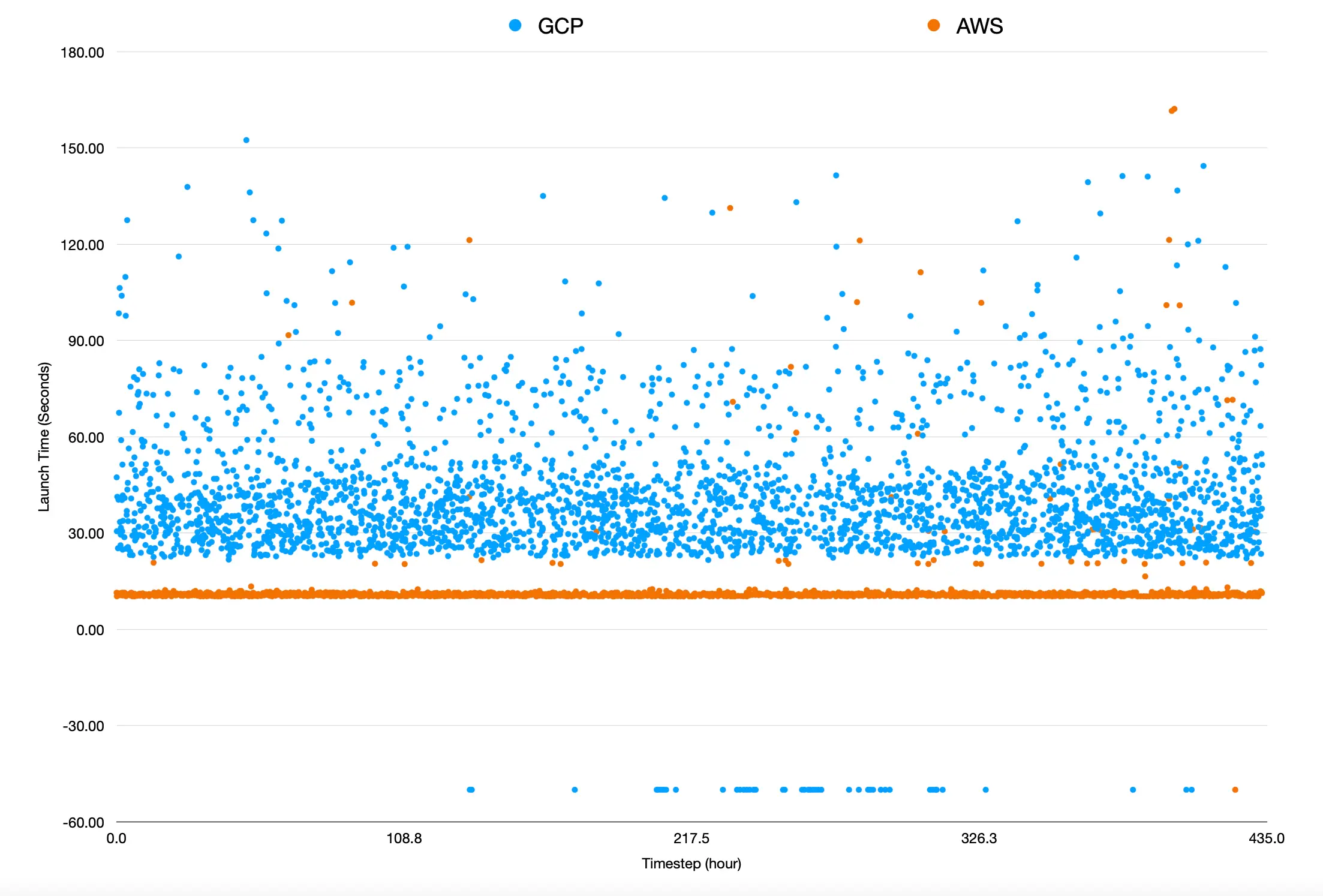
AWS consistently spawned a new GPU in under 15 seconds (average of 11.4s). GCP on the other hand took closer to 45 seconds (average of 42.6s). AWS encountered one valid launch error in these two weeks whereas GCP had 84. Some caveats are below, but the takeaway was:

AWS beat GCP in launch time by 66% and by errors by 84x.

These differences are so extreme they made me double check the process. Are the "states" of completion different between the two clouds? Is an AWS "Ready" premature compared to GCP? It anecdotally appears not; I was able to ssh into an instance right after AWS became ready, and it took as long as GCP indicated before I was able to login to one of theirs. You'll also notice there are some instances where AWS takes longer to spawn; they're just few and far between the fast launches. This also gives some support to the experimental procedure.

The offerings between the two cloud vendors are also not the same, which might relate to their differing response times. GCP allows you to attach a GPU to an arbitrary VM as a hardware accelerator - you can separately configure quantity of the CPUs as needed. AWS only provisions defined VMs that have GPUs attached - the g4dn.x series of hardware here. Each of these instances are fixed in their CPU allocation, so if you want one particular varietal of GPU you are stuck with the associated CPU configuration.

Quantile breakdowns of response times, when they succeeded -

GCP(GCP Support)AWS(AWS Support)
Mean42.66310311.443485
25% Quantile29.86226410.382613
50% Quantile37.76151010.681742
75% Quantile47.5675511.09871
90% Quantile70.3830211.33349
99% Quantile111.83130.4435

These error codes broke down as follows -

GCP (84 total)

  • 74x - 409 Conflict
  • 5x Operation timeout, GPU not available in 200 seconds

AWS (1 total)

  • 1x - Instance did not reach break condition

A note on 409 Conflicts: This one was a weird error. It doesn't usually indicate capacity issues (ie. GCP did not report being out of GPUs) but there wasn't another good explanation. The error coming back from the API was vague about a conflict, but requests were spawned with unique identifiers based on clock time. So there shouldn't have been a conflict, especially not on the order of magnitude that was experienced here.

Even disregarding 409 errors, GCP fails to create GPUs more frequently - and has a higher spin up time across the board when they do succeed. Assuming you need on-demand boxes to succeed right when you need them, the consensus seems to clearly point to AWS. If you can stand to wait or be redundant to spawn failures, maybe Google's hardware acceleration customizability can win the day.

The entire testing harness is open source and I encourage you to run your own analysis - on different GPU configurations, spot instances, etc.