








December 31, 2025
Most financial advice says that keeping the bulk of your money in a savings account is a bad idea as it gets eaten up by inflation. The theory goes that the cost of things you might do with that money go up in price faster than the amount of interest the bank pays on that money, so effectively you've lost money as you can't buy the same things you used to.
That's true if you assume the interest the bank pays you is the RBA's cash rate and that the cost of things goes up by the CPI rate published by the ABS, but that's not what happens outside of an economics textbook.
When I put my money in a high interest savings account (aka HISA) or a term deposit with a not-shit bank, the interest rate is much higher than the cash rate. e.g: 4.25% at call with Macquarie or 4.4%/4.5% for 6/12 months at Unity Bank vs the RBA's cash rate of 3.6%.
Meanwhile, the impact of CPI on my household is different than the average household. I don't drink or smoke, I don't rent or have a mortgage, I drive an EV so don't pay for fuel. These costs make up a big chunk of what constitutes CPI but don't apply to me.
I wanted to see how many quarters/years do real world interest rates exceed real world cost of living increases, so I grabbed some data from the RBA & ABS:
"Retail deposit and investment rates; Banks' term deposits ($10000); 3 months" - all the authorised deposit-taking institutions (ADIs) in Australia report their rates to ARPA each month and the RBA then averages them out. I can walk into a bank on the 31st of March 2009 and get a 3 month term deposit at 2.45% that matures on the 30th of June.
"Selected Living Cost Index - percentage change from corresponding quarter of previous year for self-funded retiree households" - the ABS takes the stuff they use to measure CPI, but weights the categories differently based on surveys and other data for different types of lifestyles. This figure is how much more things cost over the last 3 months (e.g: groceries cost 0.5% more in June 2009 than March 2009).
With this data, I can pretend that I started a 3 month term deposit at 3.15%pa on the 31st of March, 2002 so on the 30th of June, I have 0.725% more money. Over that same period of time cost of living went up by 0.8%, so for that quarter I lost money. The data I have lets me do this every quarter until September 2025.
I juiced the RBA's term deposit rates by 0.8% because I looked at the best rates on offer from all the ADIs for the last few years on Yield Report and found that on average, they were 1.48% higher than the RBA's average. Realistically, I should be depositing my cash in ADIs that are competitive considering how easy it is to find the best rate, sign up online and move money around.
Another gotcha is tax. Term deposits could outpace SLCI, but I gotta pay tax on the interest! Let's say I'm earning $100,000/yr from employment. If I earn less than $35,000 in interest, that interest is going to be taxed at 32% each year (30c for every $1 between $45,000 - $135,000, plus 2% Medicare Levy). This means the real interest rate is 32% lower as 32% of that goes straight to the ATO. If the bank is giving me 3% interest, the "real" rate is 2.04%.
In regard to SLCI, I really wanted to get a figure without alcohol and tobacco as I do not consume any, but it was a pain in the arse to get this figure. However, the ABS does publish quarterly CPI without alcohol and tobacco in it ("Percentage Change from Previous Period ; All groups CPI excluding Alcohol and tobacco ; Australia ;"), so I included that in the mix to see if that makes a difference. If I wanted to waste even more time I could probably come up with my own personal CPI measure by adjusting the weights and excluding certain categories.
Put all this on a chart and this is what you get this - I am not good with charts, I'm tried my best! (click to view big)
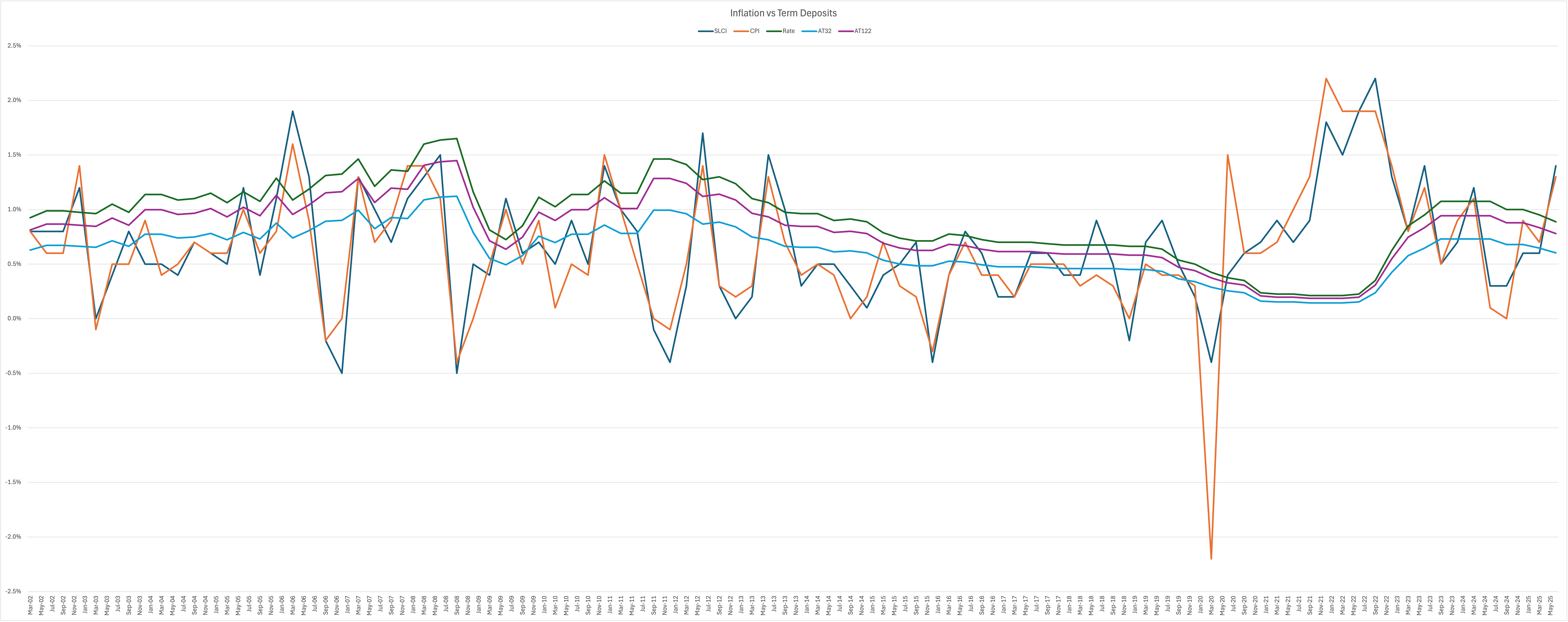
The lines on the chart are:
What you want to see is the blue or purple lines above the blue or orange line - if the rate at the bank is higher than the rate of inflation, your money is growing. As you can see, there are spikes where that doesn't happen!
But if we put it into some context using $1,000 on this graph (click to view big):
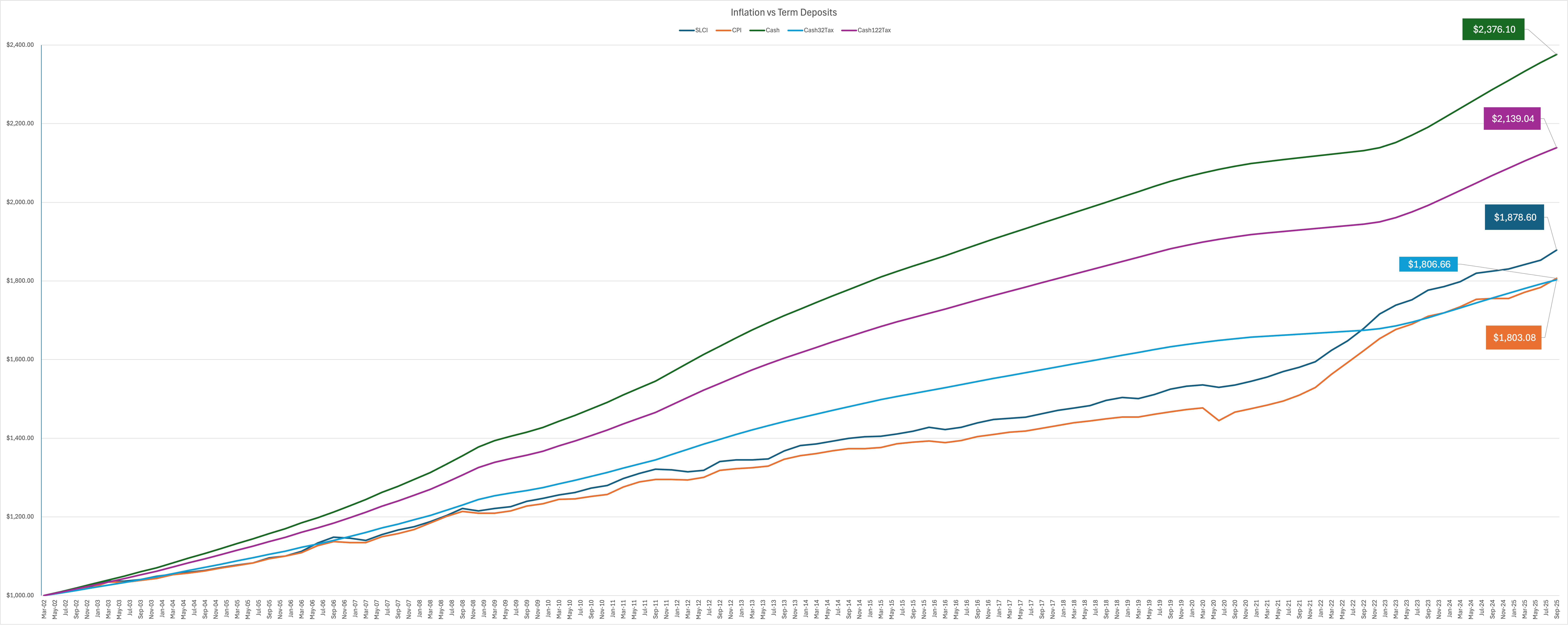
You can see that if you are paying a high rate of tax, the $1,000 placed in the bank back in 2002 is worth basically the same as it was 23 years ago compared to CPI minus booze and cigs. It's worth less using the Standard Living Cost Index. But if you don't pay tax (legend) or you only pay a bit of tax, the money actually grew. Sure, not by much, but it didn't wither away and you had 0% risk.
From doing this I learned that before tax, the term deposits outpace cost of living - but once the ATO gets their grubby hands on my money, the money in the bank whittles away. If I'm not paying much tax the term deposits keep up more often than not.
So to answer my question - does a term deposit lose money when considering the cost of living? It depends how much tax you pay. If you're paying below ~20% tax, the money doesn't lose ground to inflation. You can leave it there and sleep at night knowing your money is safe - no volatility like other investments (but also little growth). If you are earning more than $45,000 a year from a job, you're paying 32% tax on the extra income your savings earn and because of that, should keep a minimum level of cash in savings to avoid losing money to inflation. I am not an expert don't listen to me, see a financial advisor, etc.
It's an Ausse take on tech news that I write daily. No ads, no tracking, no affiliate links, no AI slop. 100% subscriber-funded since 2015.

此内容由惯性聚合(RSS阅读器)自动聚合整理,仅供阅读参考。 原文来自 — 版权归原作者所有。