



The CNCF recently released a great documentary named Inside Argo: Automating the Future which explores the journey of the Argo Project and its evolution over time. Having worked extensively with Argo tools for several years, I find this movie extremly exciting. Argo is one of the most impactful and innovative projects in the Kubernetes landscape.
I strongly recommend this movie, one of the better documentaries in the devops space.
In this post, I’ll highlight some of the key milestones I captured, the main contributors, and the companies that played key roles in the development of the Argo Project.

The Argo project consists of four subprojects that can be implemented separately but are designed to work together:
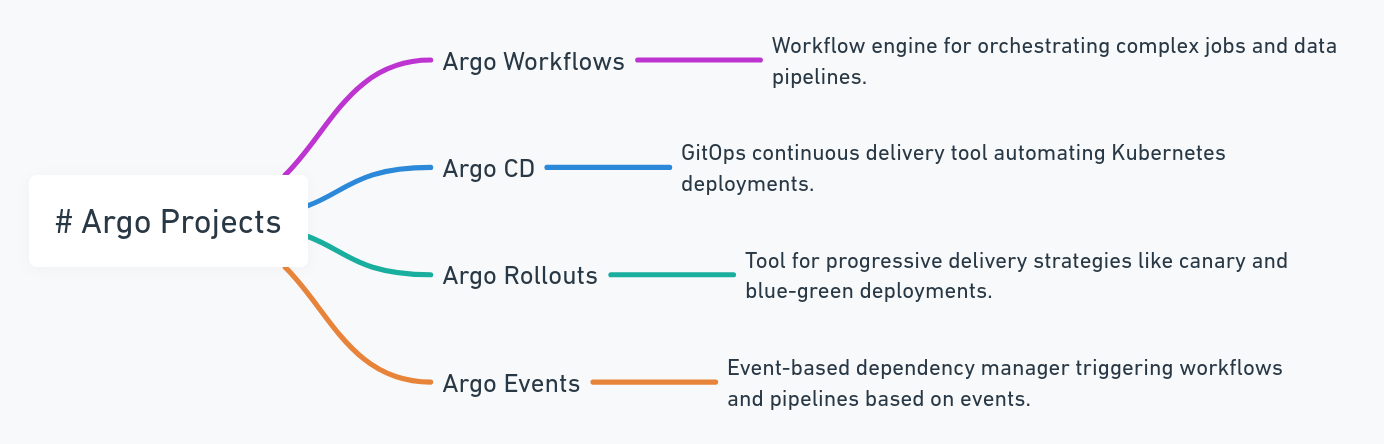

The success of the Argo project can be attributed to several key individuals whose vision, technical expertise, and leadership played a crucial role in its development and growth:
Alexander Matyushentsev - Lead Developer & Architect
Alexander was the main developer who built the initial prototype of Argo Workflows in just two days. He played a crucial role in designing the core architecture of Argo as a Kubernetes-native tool, leveraging Custom Resource Definitions (CRDs). His contributions were instrumental in making Argo Workflows a scalable, flexible solution for orchestrating complex workflows.
Pratik Wadher - SVP of Product Development at Intuit
Pratik was pivotal in driving Intuit’s adoption of Argo. After Intuit acquired Applatix (the original creators of Argo), Pratik led the charge in implementing Argo CD for GitOps practices across Intuit’s Kubernetes clusters. His leadership helped transform Argo into a vital tool for Intuit’s cloud-native strategy, enabling scalable and compliant deployments.
Hong Wang - Core Engineer at Applatix
Hong was deeply involved in the initial development of Argo Workflows and contributed significantly to its open-source release. He was one of the key engineers who helped adapt the workflow engine to leverage Kubernetes’ emerging features, such as Custom Resource Definitions (CRDs).
Edward Lee - Co-Founder of Applatix
Edward was instrumental in pushing Argo’s early development and ensuring its alignment with the broader Kubernetes ecosystem. He played a key role in demonstrating Argo’s capabilities at industry events like KubeCon, which helped attract early adopters and generate buzz within the cloud-native community.
Mariana Tessel - Former VP of Engineering at Intuit (now CTO at Intuit)
Mariana was a strong advocate for cloud-native technologies at Intuit. She played a key role in championing the adoption of Kubernetes and GitOps practices, which led to the creation of Argo CD. Her strategic vision helped drive Intuit’s commitment to open-source projects and the broader cloud-native ecosystem.
The success of the Argo project was made possible through collaboration with several key organizations that not only adopted Argo early on but also contributed significantly to its growth. Here’s a look at the companies that played a crucial role:
Applatix
Applatix, a Silicon Valley startup, was the company that originally developed the Argo Project. Founded with a vision to simplify cloud-native application deployment, Applatix aimed to help enterprises leverage Kubernetes for scalable and efficient infrastructure management. In 2017, Applatix open-sourced the Argo Project, which included tools like Argo Workflows, to address the challenges of orchestrating and automating Kubernetes workloads.
Applatix’s innovative approach laid the foundation for Argo’s widespread adoption in the DevOps community. The company’s commitment to open source not only led to the success of Argo but also attracted the attention of Intuit, which later acquired Applatix in 2018 to further scale its cloud-native transformation.
Intuit
After acquiring Applatix, Intuit became a driving force behind the development of Argo, especially Argo CD. Under the leadership of Pratik Wadher and Mariana Tessel, Intuit adopted Argo to automate its Kubernetes deployments using GitOps principles. This integration allowed Intuit to efficiently manage thousands of microservices while meeting stringent compliance standards. Intuit’s decision to open-source Argo CD played a pivotal role in expanding the tool’s adoption across the industry.
BlackRock
BlackRock was an early adopter of Argo Workflows and Argo CD, using them to manage their trading platform, Aladdin. They went a step further by contributing to the development of Argo Events, allowing for event-driven automation and orchestration. This contribution helped broaden the Argo ecosystem’s capabilities.
Codefresh
Codefresh joined the Argo Project as a major contributor, and played a significant role in expanding the capabilities of Argo CD. By joining the project, Codefresh aimed to accelerate innovation within the Argo ecosystem, contributing to the continuous improvement of Argo tools. Their involvement helped drive the adoption of GitOps practices in the DevOps community.
Red Hat
Red Hat became a contributor to the Argo project, particularly with Argo CD, which aligns with Red Hat’s mission to enhance developer-centric tools within its OpenShift Kubernetes platform.
Akuity
Akuity was founded by Argo co-creators Hong Wang, Jesse Suen, and Alexander Matyushentsev, who were also founding engineers at Applatix, the company that originally open-sourced the Argo Project in 2017. Leveraging their deep experience in cloud-native technologies and Kubernetes, they established Akuity to further advance the capabilities of the Argo projects.
此内容由惯性聚合(RSS阅读器)自动聚合整理,仅供阅读参考。 原文来自 — 版权归原作者所有。