









Since laying Oden aside, I have been getting back into PureScript, and started working on a project called Hyper that I would like to introduce you to.
Other than experimenting with extensible records and row typing, and spamming my followers on Twitter, I have tried to document the design and purpose of the project so that it will be approachable for others. Now, however, I feel that a blog post introducing the project without diving too deep into implementation details would be helpful and interesting.
If you have any feedback, or like me to write more about Hyper here, please let me know in the comments at the bottom of this page.
I have been working with NodeJS for web servers, on and off, for the last 3-4 years. As projects grow, and even at the start of a project, programming errors creep in around the middleware setup. Many things can go wrong, and they are often hard to debug. You have no static guarantees that third-party middleware and your handlers are correctly setup — that they cover all cases, execute in the correct order, do not interfere with each other, and handle errors properly.
After an inspiring talk by Edwin Brady on dependent types for state machines, I decided to try to improve this situation for web server middleware using extensible records and row types in PureScript, to see if I could provide similar safety guarantees to those demonstrated in Idris. It turns out that extensible records work really well for this case!
Another thing circling around in my head, to the point of real concern, is the amount of energy that gets directed towards pure functional programming in single-page applications. The ideas are great, and very cool designs emerge, but I am afraid we completely abandon progressive enhancement and “regular” server-side rendered web applications. Thus, I wanted to direct some of the FP love towards good ol’ web server software.
I messed around a bit in Haskell with GADTs and phantom types, but PureScript records really stood out, so I decided to go ahead with PureScript. I think it deserves a web server library like the one Hyper aims to become. With alternative PureScript backends emerging, Hyper could also run on Erlang and C++ servers, not only NodeJS.
The basic building blocks of Hyper are Conn and
Middleware. They are heavily inspired by other middleware
libraries, like Plug in Elixir and connect in NodeJS.
The Conn represents the entirety of an HTTP connection, both the request
and response.
type Conn req res components =
  { request :: req
  , response :: res
  , components :: components
  }
A Conn is a record containing some request req, and some
response res. What are those values? Well, it depends on
the middleware. Usually they are also records, where middleware specify
the fields that they require, or provide, in both the request and
response records. The structure of request and response records are
open, and the compiler guarantees that the composition of
middleware is correct.
You might wonder what the purpose of components is. For
the sake of this blog post, let us just say that it is a place for
user-defined things not directly related to HTTP.
The following type requires the request to have at least a
body of type String, and headers of type
StrMap String. The request can have more fields, this type
does not care. The response and components are not constrained at all by
this type.
forall req res c.
Conn { body :: String
     , headers :: StrMap String
     | req
     }
     res
     c
The second building block, middleware, are simply functions
transforming connection values. They take a pure connection, and return
another connection inside some type m, where m
is usually an Applicative or a Monad.
type Middleware m c c' = c -> m c'As middleware are monadic functions, just as the computations used with Bind, they compose using Kleisli composition.
-- Compose three middleware functions sequentially,
-- from left to right:
authenticateUser >=> parseForm >=> saveTodo
As m is a parameter of Conn, you can customize the
middleware chain to use a monad stack for tracking state, providing
configuration, gathering metrics, and much more.
In Hyper, the state of a response is tracked in its type. This guarantees correctness in response handling, preventing incorrect ordering of headers and body writes, incomplete responses, or other similar mistakes.
The contract of state transitions is encoded in a type class implemented by response writers for specific servers. This makes it possible to write reusable functions on top of the protocol that can run with different server implementations.
To safe a few keystrokes, and your innocent eyes, let us begin by looking at the type alias for middleware transitioning between response states.
type ResponseStateTransition m rw from to =
  forall req res c.
  Middleware
  m
  (Conn req {writer :: rw from | res} c)
  (Conn req {writer :: rw to | res} c)
Now, on to the encoding of state transitions, the
ResponseWriter type class.
class ResponseWriter rw m b | rw -> b where
  writeStatus
    :: Status
    -> ResponseStateTransition m rw StatusLineOpen HeadersOpen

  writeHeader
    :: Header
    -> ResponseStateTransition m rw HeadersOpen HeadersOpen

  closeHeaders
    :: ResponseStateTransition m rw HeadersOpen BodyOpen

  send
    :: b
    -> ResponseStateTransition m rw BodyOpen BodyOpen

  end
    :: ResponseStateTransition m rw BodyOpen ResponseEnded
I know, it looks a bit scary with all the types. Stay strong, or have a look at it rendered as a state diagram instead.
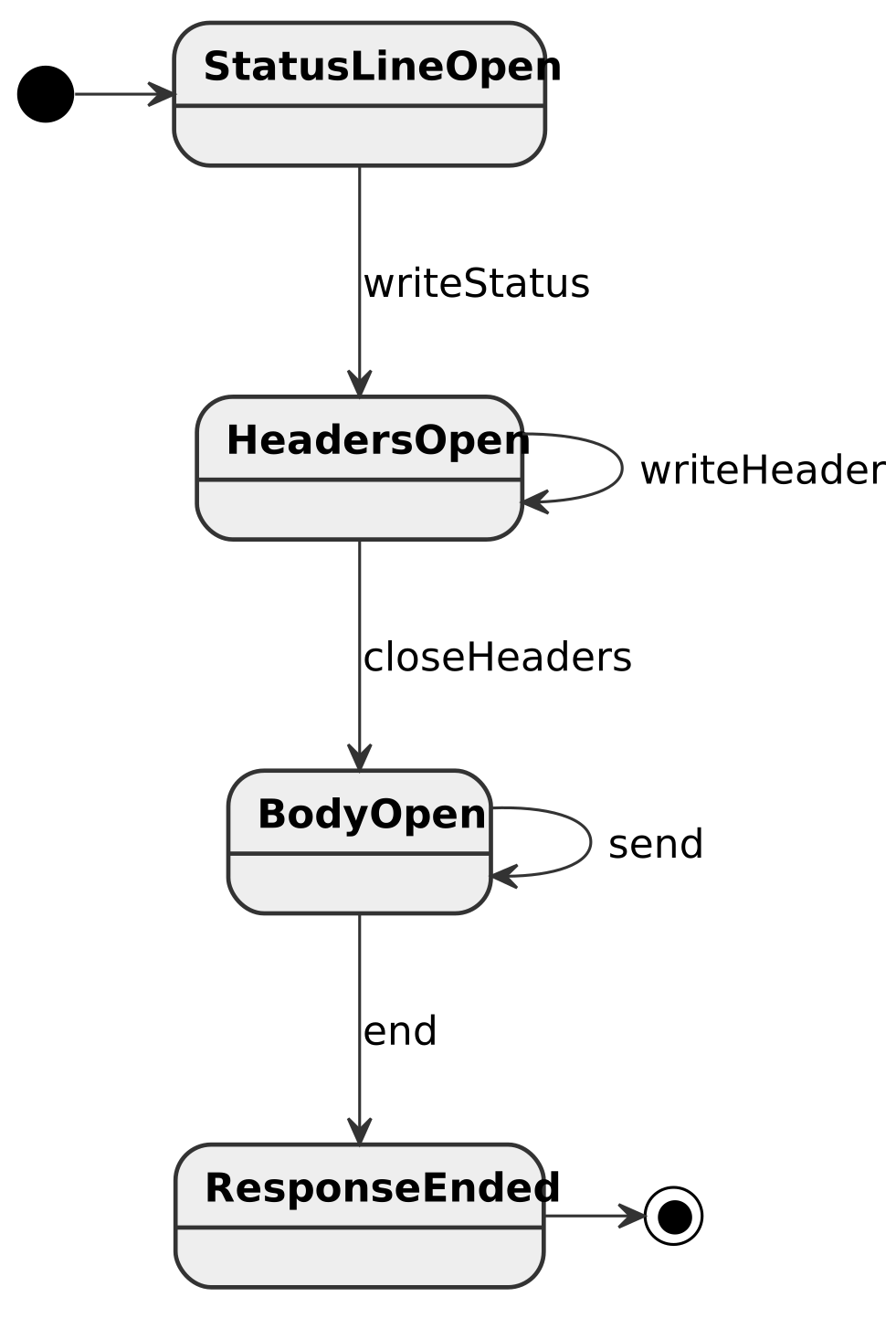
We can write a middleware, based on the state transition functions of the type class, that responds friendly to all requests.
writeStatus (Tuple 200 "OK")
>=> writeHeader (Tuple "Content-Type" "text/plain")
>=> closeHeaders
>=> write "Greetings, friend!"
>=> end
Say we forget the line with closeHeaders. What do we
get? An informative type error, of course!
Could not match type

  HeadersOpen

with type

  BodyOpen
There are easier-to-use functions written on top of the response API so that you do not have to write out all state transitions explicitly.
writeStatus statusOK
>=> contentType textHTML
>=> closeHeaders
>=> respond (div [] [ h1 [] [ text "Greetings!" ]
                    , p [] [ text "You are most welcome." ]
                    ])
The respond function has the added benefit of decoupling
the response type, in this case HTML, from the response
type required by the server, which for NodeJS is a Buffer.
The transformation between HTML and Buffer is
done behind the scenes by a bit of type class machinery.
The bits presented so far constitute the low level API for responding to HTTP requests in Hyper. I have plans for designing a simpler interface, based on Ring response maps in Clojure, where response handlers simply return a data structure describing the response to be written. Such an API can be built on top of the existing low-level API.
We have looked at the core design of Hyper, and the motivation behind the project, but merely scratched the surface. The documentation describes in much greater detail the implementation and current components of Hyper. I hope, however, that I have caught your interest. If so, please go ahead and check out some of the provided examples at GitHub.
Also, note that the project is highly experimental, not nearly ready for any production use. But it could be! If you are interested in contributing, do not hesitate to send me a tweet or a PM. I need help writing the library, middleware, servers for different PureScript backends, more examples, documentation, etc. If you want to have a look at the source code, it’s also on GitHub.
Thanks for reading!
Note at Feb 13, 2017: Since this blog post was published, the design of Hyper has changed. It is no longer based on simple monadic functions, but instead indexed monads, to provide safer interaction with response writing side effects. The documentation at hyper.wickstrom.tech should always be up-to-date, so please have a look there as well.
此内容由惯性聚合(RSS阅读器)自动聚合整理,仅供阅读参考。 原文来自 — 版权归原作者所有。