










It’s 2026 and people are still searching for answers on the Raspberry Pi 5 vs Raspberry Pi 4.. Well, the Pi 5 release was the biggest generational leap in Raspberry Pi’s history. That said, the Pi 4 is cheaper, and still very capable. So is the Pi 5 actually worth upgrading to, or is the Pi 4 still the smarter buy in the current economy? Through many hours of benchmarking, that’s the question I hope to help you with today!
Throughout this comparison I’ll reference my full Raspberry Pi 5 review and my guide on how to power the Raspberry Pi 5. You can also see the two boards measured head-to-head on sbc.compare’s Raspberry Pi 4 vs Pi 5 page.
Realistically? The Raspberry Pi 5 is 2-3x faster than the Pi 4, it adds PCIe support for NVMe, AI accelerators, and whatever else you can think of via HATs/adapters, and it’s overall a more capable machine. That said, it costs more, and it needs active cooling to really get the best of it. If you’re not chasing the fastest storage speeds, and you’re just getting to grips with Linux and SBCs as a whole, stick with the Pi 4. If you don’t mind splashing a bit more money and have. a use case that requires it, then the Pi 5 will be more powerful, and better value overall.
| Processor | Raspberry Pi 4 2GB | Raspberry Pi 5 2GB |
| SoC | Broadcom BCM2711 | Broadcom BCM2712 |
| CPU | 4× Cortex-A72 @ 1.5GHz | 4× Cortex-A76 @ 2.4GHz |
| GPU | VideoCore VI | VideoCore VII |
| Memory & Storage | ||
| RAM | 2GB LPDDR4 | 2GB LPDDR4X |
| Storage | microSD | microSD |
| Connectivity | ||
| Ethernet | 1GbE · PoE: via HAT | 1GbE · PoE: via HAT |
| WiFi | 802.11ac | 802.11ac |
| USB | 2× USB 2.0 USB-A, 2× USB 3.0 USB-A | 2× USB 2.0 USB-A, 2× USB 3.0 USB-A |
| General | ||
| Launched | Jun 2019 | Oct 2023 |
| Price | $49.45 | $55.00 |
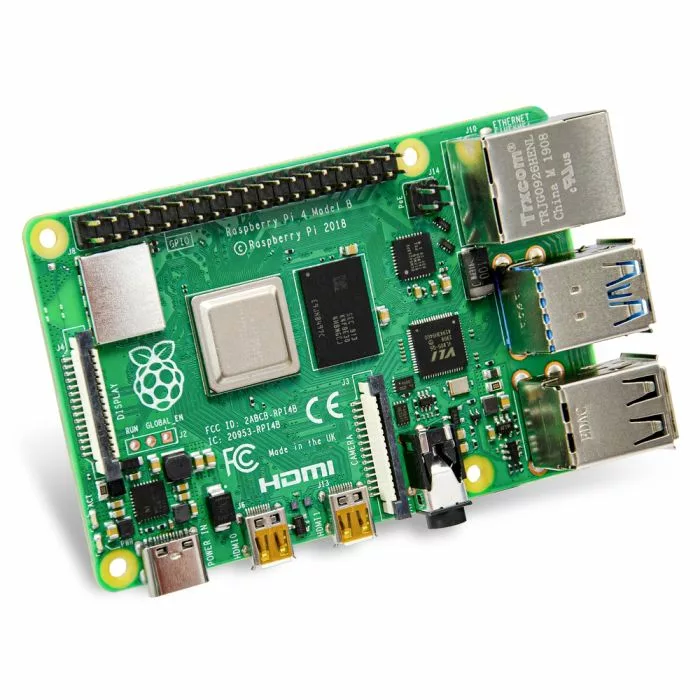
To be blunt, it’s faster. Much faster. How much faster? 2-3x faster in most of the tests!
This translates to a much better desktop feeling if that’s your poison, or just an overall much better experience. Extracting/compressing files is going to be faster, and applications are going to feel a lot more responsive.
Higher Scores are Better
Single-Core
Raspberry Pi 5 2GB
890 Best

Raspberry Pi 4 2GB
258 29%
Multi-Core
Raspberry Pi 5 2GB
1,901 Best
Raspberry Pi 4 2GB
614 32%
Higher Scores are Better
Single-Core Combined
Raspberry Pi 5 2GB
3,334 MIPS Best
Raspberry Pi 4 2GB
1,541 MIPS 46%
Multi-Core Combined
Raspberry Pi 5 2GB
11,521 MIPS Best
Raspberry Pi 4 2GB
5,192 MIPS 45%
Higher Scores are Better
CPU Score
Raspberry Pi 5 2GB
2,297 Best
Raspberry Pi 4 2GB
518 23%
RAM Score
Raspberry Pi 5 2GB
1,169 Best
Raspberry Pi 4 2GB
622 53%
Full CPU benchmark data: Raspberry Pi 4 on sbc.compare and the Raspberry Pi 5 8GB.
Whilst not the most perfect of benchmarks, GLMark2 gives us a rough idea of the performance improvement between the 2 boards’ GPUs, the VideoCore VII and VI, and we’ve tested at both 1080p and 4K to see just how great 4K is (given the Pi 5 is heavily marketed with the 2 4K60 HDMI ports). Note, I didn’t have data for the 2GB model at the time of publishing, so I’ve compared the 8GB model. There will be a slight difference here, so take it with a pinch of salt, but this will be updated with the 2GB model data once ready.
Higher Scores are Better
1080p
Raspberry Pi 5 8GB
657 Best
Raspberry Pi 4 2GB
No Data
4K
Raspberry Pi 5 8GB
150 Best
Raspberry Pi 4 2GB
No Data
If you’re curious how this matches up to the rest of the boards I’ve tested GLMark2 on, the full set of OpenGL ES results is on sbc.compare too.
Arguably this is one of the biggest reasons for people to upgrade from a Pi 4 to a Pi 5. I used to use a SATA SSD over USB on my Pi 4 as its boot disk and hey, it was great, and it worked. It took up a lot of space though. Now? I just have a small HAT on top of the Pi that connects via its PCIe connection et voila, if I run at Gen 3 speeds I have 800MB/s available to me.
Higher is Better
4K Sequential Read
microSD
Raspberry Pi 5: Raspberry Pi 64GB
39.0 MB/s Best
Raspberry Pi 4: Raspberry Pi 64GB
34.0 MB/s 87%
M.2 NVMe
Raspberry Pi 5: Crucial P5 Plus 1024GB
866.5 MB/s Best
4K Sequential Write
microSD
Raspberry Pi 5: Raspberry Pi 64GB
33.0 MB/s Best
Raspberry Pi 4: Raspberry Pi 64GB
10.1 MB/s 31%
M.2 NVMe
Raspberry Pi 5: Crucial P5 Plus 1024GB
608.9 MB/s Best
4K Random Read
microSD
Raspberry Pi 5: Raspberry Pi 64GB
21.9 MB/s Best
Raspberry Pi 4: Raspberry Pi 64GB
16.3 MB/s 74%
M.2 NVMe
Raspberry Pi 5: Crucial P5 Plus 1024GB
866.4 MB/s Best
4K Random Write
microSD
Raspberry Pi 5: Raspberry Pi 64GB
14.7 MB/s Best
Raspberry Pi 4: Raspberry Pi 64GB
12.6 MB/s 86%
M.2 NVMe
Raspberry Pi 5: Crucial P5 Plus 1024GB
590.6 MB/s Best
As you can see, the microSD numbers are slightly better in some places, and much better in others (the Random Read/Write numbers are the ones to look at for the most part) so if you’re planning to just use a microSD card on your Raspberry Pi 5 then you’re still going to be in for an upgrade.
Throw in an M.2 NVMe HAT, however, along with a decent-enough Gen 3 NVMe SSD and you’re going to have a great experience. Assuming you were smart enough to buy one before pricing went through the roof.
Related reading: my guide to USB boot on the Raspberry Pi 5 and the best operating systems for the Pi 5.
Here’s where the Pi 5 doesn’t do so well, depending on how you frame it. Those faster CPU cores don’t appear out of thin air, they need some juice, and some juice they get. Raspberry Pi brought out a new 27W PSU (and later, a 45W model) with the Pi 5, along with the Active Cooler. These are indications that they knew the Pi 5 was going to be a toasty lil guy, and wanted to make sure they handled it off the bat.
Lower is "Better"
Load Power
Raspberry Pi 4 2GB
5.20W Best
Raspberry Pi 5 2GB
6.10W 85%
Ollama Max
Raspberry Pi 4 2GB
5.60W Best
Raspberry Pi 5 2GB
9.30W 60%
Linpack Max
Raspberry Pi 4 2GB
6.90W Best
Raspberry Pi 5 2GB
10.10W 68%
At launch, the Pi 5 was pulling around 4.84 watts at idle versus just 2.44 watts on the Pi 4 — roughly double. That extra power has to go somewhere, and it shows up as heat. The Pi 4’s lower draw keeps it cooler and far less likely to hit thermal throttling; the Pi 5, on the other hand, gets toasty in a hurry. Let’s take a quick look at that though!
Temperature over time during stress test
Raspberry Pi 4 (No Cooling)
CPU frequency (dashed)
Raspberry Pi 4 (No Cooling) peaked at 78°C without throttling.°C4048566472801,4601,4801,5001,5201,540MHz0s15m30m45m60m
Baseline (1m idle)Load (1h stress)Cooldown (1m)
Raspberry Pi 4
The Pi 4 with no cooling gets hot, but it doesn’t throttle. It remained at its target frequencies.
Temperature over time during stress test
Raspberry Pi 5 (No Cooling)
CPU frequency (dashed)
Raspberry Pi 5 (No Cooling) peaked at 87°C, throttling after 28s.°C5663707784911,5001,8002,1002,400MHz0s15m30m45m60m
Baseline (1m idle)Load (1h stress)Cooldown (1m)
Raspberry Pi 5
28s
First Throttle
72 events · 2400 → 1500 MHz (-38%)
6.1W
Load Power
Idle 3.5W · Peak 8.0W
The Pi 5 on the other hand quickly gets up to throttling temperatures, and we drop down to 1.5GHz for a lot of the test.
See my full breakdown in how to power the Raspberry Pi 5.
If we compare how much it costs to get up and running with a base setup, the Pi 4 is about $26 cheaper, or in percentage terms, to get a Pi 5 base setup, you’re paying around 31% more.
If you’re able to afford that 31% difference, you’re unlocking potential performance improvements of 200-300% (depending on the tests and conditions), so the Raspberry Pi 5 is the obvious value choice here, but that’s not always the deciding factor.
If you don’t need the power of a Pi 5, and you’re running something that may need to draw less power, such as a solar or battery-backed deployment, then the Pi 4 saves you on the initial outlay, and on your power budget down the line.
| Cost to get running | Raspberry Pi 4 | Raspberry Pi 5 |
|---|---|---|
| Board | $55 | $65 |
| Power supply | $8 | $12.95 |
| Cooling | N/A | $10.95 |
| Storage (32GB official microSD) | $19.95 | $19.95 |
| Approx. total | $82.95 | $108.85 |
If you’ve decided on the Pi 5 and you’re trying to figure out which model to go for, take a quick look at the performance benchmarks between the 2GB, 4GB, and 8GB models below. There really isn’t too much in it. If it’s a single-threaded workload then you’re going to be seeing near identical performance on each of them. The 2GB RAM option is going to slip behind in all core tests sometimes as much as 10%, but all in all, it’s not massive.
Higher Scores are Better
Single-Core
Raspberry Pi 5 4GB
904 Best
Raspberry Pi 5 8GB
902 100%
Raspberry Pi 5 2GB
890 98%
Multi-Core
Raspberry Pi 5 8GB
2,188 Best
Raspberry Pi 5 4GB
2,179 100%
Raspberry Pi 5 2GB
1,901 87%
Higher Scores are Better
Single-Core Combined
Raspberry Pi 5 4GB
3,344 MIPS Best
Raspberry Pi 5 2GB
3,334 MIPS 100%
Raspberry Pi 5 8GB
3,334 MIPS 100%
Multi-Core Combined
Raspberry Pi 5 8GB
12,000 MIPS Best
Raspberry Pi 5 4GB
11,983 MIPS 100%
Raspberry Pi 5 2GB
11,521 MIPS 96%
Higher Scores are Better
CPU Score
Raspberry Pi 5 8GB
2,394 Best
Raspberry Pi 5 4GB
2,390 100%
Raspberry Pi 5 2GB
2,297 96%
RAM Score
Raspberry Pi 5 8GB
1,374 Best
Raspberry Pi 5 4GB
1,283 93%
Raspberry Pi 5 2GB
1,169 85%
In a lot of cases, yes, and in some, more than twice!
I’m afraid the cases are unlikely to fit due to component placement, but most HATs using the Pi standard GPIO layout should work just fine. Read more about these in my Raspberry Pi 5 FAQ.
Yes, it uses at times more than double the power of the Raspberry Pi 4.
Absolutely! If you want the extra power to be more future-proofed and allow yourself more headroom for Docker containers, vibe coded apps, and whatever else the cool kids are doing these days, the Pi 5 is definitely worth it.
If you’re not focusing solely on pricing, the Pi 5 is the best value option, and has an amazing wealth of accessories thanks to its PCIe connection. Want 2.5Gbit Ethernet? You got it, your Pi 5 is now a capable router! Mobile data modem? You got it. There’s something for nearly every use case these days.
That said, the Pi 4 still has its place, and at a lower cost, and a lower power budget, it performs admirably. It will all come down to your use case and personal situation. If you need a bit of guidance, feel free to leave a comment below, and I, or another friendly individual will come along and lend a hand!
Want to dig into every metric side by side? See the full Raspberry Pi 4 vs Raspberry Pi 5 comparison on SBC Compare.

Bret has worked with Raspberry Pi computers for almost 10 years now and in that time he's benchmarked and tested over 30 Single Board computers. In his day job, he's a systems administrator for a large cloud computing provider.
此内容由惯性聚合(RSS阅读器)自动聚合整理,仅供阅读参考。 原文来自 — 版权归原作者所有。