


惯性聚合 高效追踪和阅读你感兴趣的博客、新闻、科技资讯
阅读原文 在惯性聚合中打开

推荐订阅源

V
Visual Studio Blog
OSCHINA 社区最新新闻
OSCHINA 社区最新新闻
N
Netflix TechBlog - Medium
博客园 - 叶小钗
大猫的无限游戏
大猫的无限游戏
S
SegmentFault 最新的问题
V
V2EX
IT之家
IT之家
J
Java Code Geeks
Hacker News - Newest:
Hacker News - Newest: "LLM"
cs.AI updates on arXiv.org
GbyAI
GbyAI
D
Docker
S
Secure Thoughts
Recent Announcements
Webroot Blog
Webroot Blog
Application and Cybersecurity Blog
云风的 BLOG
云风的 BLOG
博客园_首页
cs.CV updates on arXiv.org
Cyber Security Advisories - MS-ISAC
Security Archives - TechRepublic
酷 壳 – CoolShell
酷 壳 – CoolShell
让小产品的独立变现更简单 - ezindie.com
N
News | PayPal Newsroom
S
Security @ Cisco Blogs
I
InfoQ
Last Week in AI
Last Week in AI
SecWiki News
SecWiki News
钛媒体:引领未来商业与生活新知
钛媒体:引领未来商业与生活新知
W
WeLiveSecurity
T
Troy Hunt's Blog
Recent Commits to openclaw:main
H
Hackread – Cybersecurity News, Data Breaches, AI and More
Attack and Defense Labs
美团技术团队
T
The Blog of Author Tim Ferriss
Google DeepMind News
Martin Fowler
Martin Fowler
B
Blog
CTFtime.org: upcoming CTF events
Scott Helme
Scott Helme
T
Tor Project blog
Know Your Adversary
Know Your Adversary
有赞技术团队
有赞技术团队
Hugging Face - Blog
Hugging Face - Blog
Recorded Future
Recorded Future
C
Cyber Attacks, Cyber Crime and Cyber Security
AI
AI
G
Google Developers Blog

Railway Blog

Where Railway is, and where it's going (Summer 2026) PaaS vs IaaS vs SaaS: What Each Means and Who Should Pick What in 2026 The Best Continuous Deployment Tools in 2026 The Best PaaS for Multi-Region Deployments in 2026 The Best Platforms for Monorepo Deployments in 2026 Compliance Isn't a Feature, It's a Posture What is BYOC (Bring Your Own Cloud)? A Developer's Guide for 2026 The Best Managed Kubernetes Hosting in 2026 The Best Container Registries in 2026 The Vanilla Cloud Tax: What Rolling Your Own on AWS Actually Costs What is a PaaS? A Developer's Guide for 2026 The Best Cloud Observability and Logging Tools in 2026 The Best PostgreSQL Hosting for Developers in 2026 The Best Multi-Region Hosting Platforms in 2026 The Best Platforms to Deploy AI Apps in 2026 (Not the Models, the Apps Around Them) The Agent-Native Cloud: What It Means and Why It Matters Incident Report: May 19, 2026- GCP Account Suspension Counting to 3 with a new builder processing 50M+ monthly builds Railway iOS preview now available via TestFlight Kill your onboarding: selling to 10,000+ new users a day Your AI wants to nuke your database. Guardrails fix that. Better Rails for Agents: A New Remote MCP and Railway Agent in the CLI Moving Railway's Frontend Off Next.js One command deploys, there's a Stripe APP for that A letter to open source builders who deserve more Networking is a black box, we used eBPF to open it Heroku Walked So Railway Can Run Security Features Your Security Team Will Love Railway Runs Open Source, Now We're Funding It Railway raises $100M Series B to unburden the builders Deploy autoscaling services, AI Workflow automation, and LLM APIs Without Kubernetes Hosting Postgres with GeoLite2: a practical guide to IP geolocation, data loading, and updates Serverless functions vs containers: CI/CD, database connections, cron jobs, and long-running tasks Hosting Postgres with pgvector: provider tradeoffs, migrations, indexes, and tuning Introducing the Railway integration on Delve.co Secure Cloud Hosting for Compliance: A Practical Guide for Startups and Regulated Industries How G2X Unlocked Rapid Experimentation at Scale with Railway MindFort Runs 100+ AI Pen Testing Agents Without Their Previous $10k AWS Bill How Bilt's Marketing Engineering Team Delivers at Scale with Railway Railway Technology Partners: Earn Revenue on Templates You Didn't Build ~$1 Million Paid to Developers Who Built Railway Templates CI/CD for Modern Deployment: From Manual Deploys to PR Environments Kernel Powers 1,000+ AI Agents on $444/Month of Railway Infrastructure Deploy Full-Stack TypeScript Apps: Architectures, Execution Models, and Deployment Choices Railway vs Cloudflare: How Their Architectures Differ and When to Use Each Run Scheduled and Recurring Tasks with Cron Monitoring & Observability: Using Logs, Metrics, Traces, and Alerts to Understand System Failures Logs, Metrics, and Traces: What Does Each Signal Tell You? Server rendering benchmarks: Railway vs Cloudflare vs Vercel Top five Heroku alternatives Comparing top PaaS and deployment providers Pricing to Encourage Use The F in SOC2 stands for functional Deploy Together, Earn Together: Introducing Railway Partnerships How We Oops-Proofed Infrastructure Deletion on Railway Bring Back the Free Plan Railway MCP - Stateful, Serverful, Pay-per-use Infrastructure Hackathon: Winners Announced! Mark Your Calendar: Railway User Hackathon with Prizes Launching Railway's Affiliate Program Zero-Touch Bare Metal at Scale Ssh, We’re Announcing One More Thing! $1M for Open Source Introducing Central Station Speed Isn’t Just About Code, It’s About Where That Code Runs One-Second Deploys? We Didn’t Believe It Either Why We’re Moving on From Nix Railway V3: Faster and Cheaper How to Migrate from Cloudflare Pages to Railway Supercharging Directus on Railway with a Static Frontend How to Migrate from AWS Lambda to Railway Deploy Triton Inference Server on Railway How to Handle Database Connection Pooling Building a NestJS App on Railway Manually Optimize Deployments on Railway Implement a GitHub Actions Testing Suite Scaling a SaaS application on Railway Building a SaaS application on Railway Deploy a Dart App on Railway, Part 2 Deploy a Dart App on Railway, Part 1 Implementing Feature Flags from Scratch Cron Jobs with Django and GitHub Actions Deploy Offen on Railway Queues on Railway Working with NX, Railway and CI/CD Automated PostgreSQL Backups Using GitLab CI/CD with Railway Migrating From Heroku To Railway Cron Jobs on Railway Deploy Beam on Railway Deploy Authorizer on Railway Deploying Monorepo Applications How to Backup and Restore Your Postgres Database How to Backup Your Redis Instance Deploy Cusdis on Railway Deploy Ghost on Railway Using Github Actions with Railway Deploy Calendso (cal.com) on Railway Self-hosted website analytics Use Notion as a CMS for your NextJS blog
From registrar to deployed: buying a domain inside Railway
Jake Runzer · 2026-02-25 · via Railway Blog

Railway’s primary objective is to reduce friction. Friction all the way from development through to deploying and sharing your project with the world. Part of that is finding a snazzy domain name. The problem though, is that this process has always been completely outside of Railway and when you finally do find a good domain, bringing it into Railway is a tedious process.

Not anymore. You can now buy domains on Railway. Search for a name, see the price, click purchase and everything is configured for you.

railway.com/domains

To understand what we built, it helps to know what the process looked like before.

Using custom domains in Railway

To bring a custom domain into Railway you need to add two DNS records at your registrar.

First, a TXT verification record that proves you own the domain (the value being an HMAC-SHA256 of the workspace ID and some secret). Second, a CNAME record that points the domain to Railway. With these we can generate a certificate and serve your app's traffic.

That means copying 4 values between tabs, pasting them into the right fields at your registrar, and then waiting. DNS is notoriously slow, so you sometimes don't know if you did something wrong or if records are still propagating. It's frustrating.

We wanted to turn that into a single click.

Adding DNS records in 1-click

If your domain is managed by Cloudflare, the entire process of adding DNS records is now a single click. Add your domain in Railway, authorize Cloudflare, and Railway configures your DNS records automatically.

One-click DNS configuration for Cloudflare-managed domains

How we built it

We became a Domain Connect service provider. Domain Connect is an open standard that allows platforms like Railway to automatically add DNS records for DNS providers like Cloudflare and GoDaddy. It is only supported by a handful of providers, but it is notably supported by Cloudflare, which is used by a large portion of users on Railway.

To add support we first had to PR a template into the Domain-Connect/Template repo on GitHub. This template includes some basic info about Railway and most importantly, which DNS records we want to add.

{
    // more fields above
    "syncPubKeyDomain": "domainconnect.railway.com",
    "syncRedirectDomain": "railway.com",
    "hostRequired": true,
    "records": [
        {
            "type": "CNAME",
            "groupId": "cname",
            "host": "@",
            "pointsTo": "%target%",
            "ttl": "3600"
        },
        {
            "type": "TXT",
            "groupId": "verification",
            "host": "%verifyHost%",
            "ttl": "3600",
            "data": "railway-verify=%verification%",
            "txtConflictMatchingMode": "Prefix",
            "txtConflictMatchingPrefix": "railway-verify="
        }
    ]
}

The syncPubKeyDomain tells DNS providers (e.g. Cloudflare) where to find the public key that we sign requests with. This prevents anyone from impersonating Railway since we are the only ones with the private key. You can find this yourself by running the following command

dig TXT _dcpubkeyv1.domainconnect.railway.com
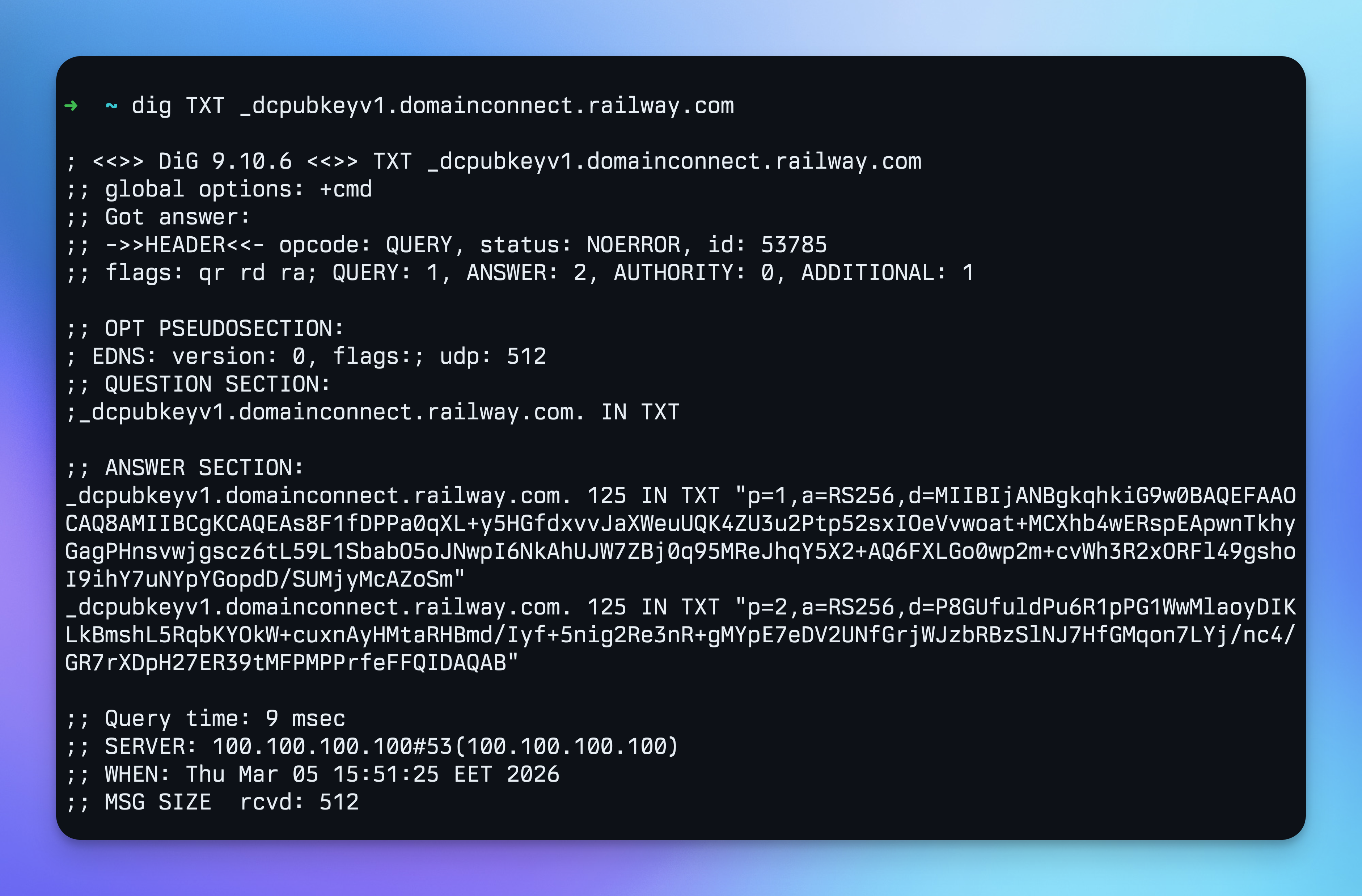
Result of running dig TXT _dcpubkeyv1.domainconnect.railway.com

When you add a custom domain to Railway we check if it supports the DomainConnect protocol (using a Go library that we open sourced) by looking for a TXT record at _domainconnect.{domain}.

$ dig +short TXT _domainconnect.railway.blue
> "api.cloudflare.com/client/v4/dns/domainconnect"

If we see something like this then we can show a fancy button that will redirect you to Cloudflare so that you can authorize the DNS records being added to your account. So much easier than copy and pasting!

One-click DNS setup for Cloudflare managed domains
Authorize DNS records from Railway in your Cloudflare account

This is great if you already have a domain. But finding a domain in the first place is already a tedious process. It is another account you have to manage and make sure has your billing details. We wanted to remove all that friction and just let you search and purchase domains directly from Railway.

Railway domains

When you go to railway.com/domains, you can search for a domain, see the price, and buy it in a couple of clicks. The domain is registered, DNS is configured, and a certificate is provisioned. No tab switching, no copy-pasting records, no waiting around wondering if you did something wrong.

To make the search experience even better, if you type a phrase like "pet store in montreal" instead of a domain name, the domain search field switches to “suggestion” mode and returns relevant domains that are available. Useful when you need to spark some creativity. Under the hood we use Claude Haiku and stream brandable domain suggestions from your description. Each suggestion feeds through the existing search pipeline, and results merge into the same grid.

Sadly furrendezvous.com is taken

But what if going to railway.com/domains is still too much friction? How can we smooth it out even further? By bringing domain search directly into your service settings. You can search and buy a domain without ever leaving the context of what you're working on.

You can also attach your owned Railway domains inline. For example if you type api. , the custom domain combobox suggests api.yourdomain.com automatically.

Purchase a domain directly from the service settings

While the entire search experience seems simple on the surface, a lot of work went into making the search fast and scalable.

How we built Railway Domains

Domain search has a latency problem: users want to search at the speed of thought, but looking up whether a domain is available requires hitting registrar APIs that have rate limits and don't appreciate being spammed with hundreds of requests per second.

To get around this, we split the search in two. Initial queries go to the Fastly domain research API. This has high rate limits and lets us query at the speed someone types. Results populate with availability and pricing for the TLDs we support (over 250), no restricted or claims-based TLDs.

This on its own was not enough to get the experience we wanted, so we implemented various levels of caching through the search.

screenshot-2026-02-26-16.15.11.png

Domain search and availability are cached in Redis on the backend using a stale-while-revalidate approach. Since availability doesn't change that often, we serve the stale data and refetch in the background as opposed to making you wait.

On top of that we use a websocket-based API instead of the GraphQL API we use throughout the rest of the dashboard. This allows much faster communication with our search backend.

Search for domains at the speed of thought

Once you click purchase, we charge your existing payment method, register the domain with WHOIS privacy enabled and auto-renewal on.

If you’re purchasing in the context of a service, we auto-attach the domain and configure the DNS records using the same callback infrastructure as Domain Connect. Certificate provisioning happens through the normal cert workflow.

If you’re purchasing without a specific service in mind, the domain lands in your workspace’s domain inventory. The page shows all your purchased domains: name, expiration, which service it’s connected to, auto-renew toggle. We don’t show any DNS setup instructions for Railway-managed domains since there’s nothing to set up.

Where we are today

These pieces together cover the full range of where a user might start. You own a domain at a supported registrar and Domain Connect handles it in one click. You want a new domain without dealing with an external registrar, so you search and buy it directly from Railway. Either way, you go from zero to serving traffic on a custom domain without leaving the platform.

There are a few things we intentionally left out of the first release.

  • Domain transfers between workspaces. The data model supports it, but the UI doesn't expose it yet. Our support team can handle these today.
  • Transferring domains out of Railway. Not self-serve yet, though we can do it manually for enterprise accounts.
  • Manual DNS record management. You can't add arbitrary DNS records to Railway-owned domains. This is deliberate. We want to own that complexity so you don't have to think about it.

Search for your next domain at railway.com/domains. If you run into anything or have feedback, let us know on Central Station.