




惯性聚合 高效追踪和阅读你感兴趣的博客、新闻、科技资讯
阅读原文 在惯性聚合中打开

推荐订阅源

Cyber Security Advisories - MS-ISAC
U
Unit 42
H
Help Net Security
博客园_首页
雷峰网
雷峰网
CTFtime.org: upcoming CTF events
博客园 - 【当耐特】
Recent Announcements
Recorded Future
Recorded Future
aimingoo的专栏
aimingoo的专栏
爱范儿
爱范儿
C
CXSECURITY Database RSS Feed - CXSecurity.com
The Cloudflare Blog
S
Security @ Cisco Blogs
M
MIT News - Artificial intelligence
Cyberwarzone
Cyberwarzone
Cisco Talos Blog
Cisco Talos Blog
Spread Privacy
Spread Privacy
The GitHub Blog
The GitHub Blog
酷 壳 – CoolShell
酷 壳 – CoolShell
K
Kaspersky official blog
MyScale Blog
MyScale Blog
阮一峰的网络日志
阮一峰的网络日志
C
CERT Recently Published Vulnerability Notes
V
Vulnerabilities – Threatpost
WordPress大学
WordPress大学
C
Cisco Blogs
G
Google Developers Blog
N
News and Events Feed by Topic
P
Palo Alto Networks Blog
Apple Machine Learning Research
Schneier on Security
博客园 - 聂微东
Security Latest
Security Latest
Security Archives - TechRepublic
O
OpenAI News
云风的 BLOG
云风的 BLOG
IT之家
IT之家
PCI Perspectives
PCI Perspectives
Microsoft Security Blog
NISL@THU
NISL@THU
小众软件
小众软件
Scott Helme
Scott Helme
大猫的无限游戏
大猫的无限游戏
L
LINUX DO - 最新话题
Microsoft Azure Blog
Simon Willison's Weblog
N
News and Events Feed by Topic
F
Fortinet All Blogs
The Last Watchdog
The Last Watchdog

blag

SQLite prefixes its temp files with `etilqs_` - blag Setsum - order agnostic, additive, subtractive checksum - blag Oldest recorded transaction - blag Replacing a cache service with a database - blag SQLite commits are not durable under default settings - blag PSA: SQLite WAL checksums fail silently and may lose data - blag Rickrolling Turso DB (SQLite rewrite in Rust) - blag Collection of insane and fun facts about SQLite - blag How bloom filters made SQLite 10x faster - blag In search of a faster SQLite - blag Galloping Search - blag Building a distributed log using S3 (under 150 lines of Go) - blag Zero Disk Architecture - blag PSA: Most databases do not do checksums by default - blag PSA: SQLite does not do checksums - blag Why does SQLite (in production) have such a bad rep? - blag SQLite Slaps - blag Now - blag Learning C - blag Snapshot Testing - blag Win: contribution to libSQL (SQLite) codebase - blag Errata in Hekaton MVCC paper - blag Internet is wholesome: MVCC edition - blag It is becoming difficult for me to be productive in Python - blag MongoDB secondary only index - blag Introducing CaskDB – a project to teach you writing a key-value store - blag Recurse Center: Winter Break - blag Recurse Center Day 24: Hacking Go compiler to add a new keyword - blag Recurse Center Day 20: Django v4 upgrade (from v1) - blag Recurse Center Day 19 - blag Recurse Center Day 18 - blag Recurse Center Day 17 - blag Recurse Center Day 16: Open Source - blag Recurse Center Day 15: B Tree Algorithms - blag Recurse Center Day 14: NoSQL Transactions - blag Recurse Center Day 13: Why 'Raft'? - blag Recurse Center Day 12: Isolation Anomalies - blag Recurse Center Day 11: B Tree Insertions - blag Recurse Center Day 10: Learning Distributed Systems - blag Recurse Center Day 9: Papers We Love - blag Recurse Center Day 8: B Tree Fill Factor (Part 2) - blag Recurse Center Day 7: Basics of ncurses - blag Recurse Center Day 6: B Tree Root - blag Recurse Center First Week - blag Recurse Center Day 5: Garbage Collection Algorithms - blag Recurse Center Day 4: B Tree fill factor - blag Recurse Center Day 3: Hammock Driven Development - blag Recurse Center Day 2: BTree Node - blag Recurse Center Day 1: init - blag What I want to do at Recurse Center - blag Accepted to the Recurse Center! - blag Towards Inserting One Billion Rows in SQLite Under A Minute - blag Marshaling Struct with Special Fields to JSON in Golang - blag I ended up adding duplicate records on a unique index in MongoDB - blag Setting up Github Actions for Hugo - blag Moving to Hugo - blag Catching SIGTERM in Python - blag Git/Github fork-pull request-update cycle - blag Using uWSGI with Python 3 - blag When is my Cake Day? - blag Staying Ahead of Amazon, in Amazon Treasure Hunt Contest - blag How I Am Maintaining Multiple Emails For Git On A Same Machine - blag An exploit on Gaana.com gave me access to their entire User Database - blag Flashing Asus-WRT Merlin by XVortex on NetGear NightHawk R7000 - blag Install Windows 8 UEFI on Legacy BIOS with Clover (and Dual boot with Yosemite) - blag Scraping Javascript page using Python - blag Installing Transmission (remote and CLI) client on Raspberry Pi - blag About - blag Projects - blag
Disaggregated Storage - a brief introduction - blag
2024-11-02 · via blag

I worked on building disaggregated storage on top of SQLite. All the recent database offerings are built on top of storage disaggregation: Amazon Aurora (the most famous one), Neon, Snowflake, TiDB, etc. This post is my attempt at explaining disaggregated storage in the context of database systems.

We can break down a database system into two main components: the frontend and backend. The frontend is responsible for handling connections, parsing requests, and query analysis. The backend serves as the storage layer which fetches data from the disk. While the frontend is CPU-heavy, the backend is I/O-heavy.

Popular databases like PostgreSQL, SQLite, and MySQL all have a similar frontend and backend architecture. The data on disk is stored in a B-Tree (or similar structure). The query layer determines which page to retrieve and issues a request to the storage layer like get_page(page_no=13). (In this context, I/O always refers to disk I/O.)
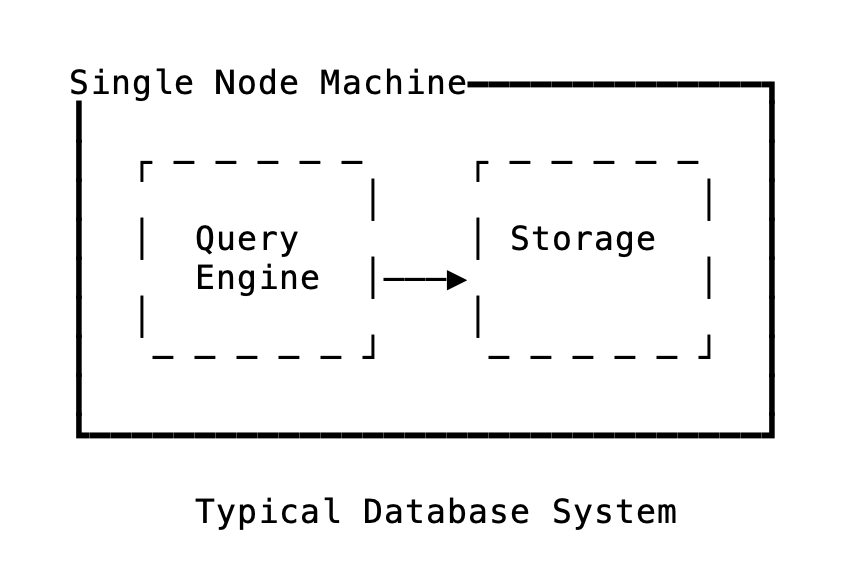
architecture of a typical database

You might have run PostgreSQL locally for development. The database assumes all data is available on the disk, and the frontend and backend are tied to the machine it’s running on. Your database is limited by your disk space – you cannot run a 1TB database on a machine with a 100GB disk. Since the disk is always attached, you cannot just spawn a new node. All the data needs to be copied, which for databases in terabytes and petabytes would take ages for a new node to become active. This affects failover and adding a new node when you have hit the limits of vertical scaling.

What if we separate them, by storing the data in a separate machine? What if, instead of disk I/O, we do network I/O and bring the data from elsewhere, on demand? Suddenly, your disk won’t be a limiting factor anymore!

This is called the separation of compute and storage, also known as storage disaggregation. You typically store the B-Tree pages in a storage server and get_page is now an RPC call. (Neon calls this method as GetPage@LSN)
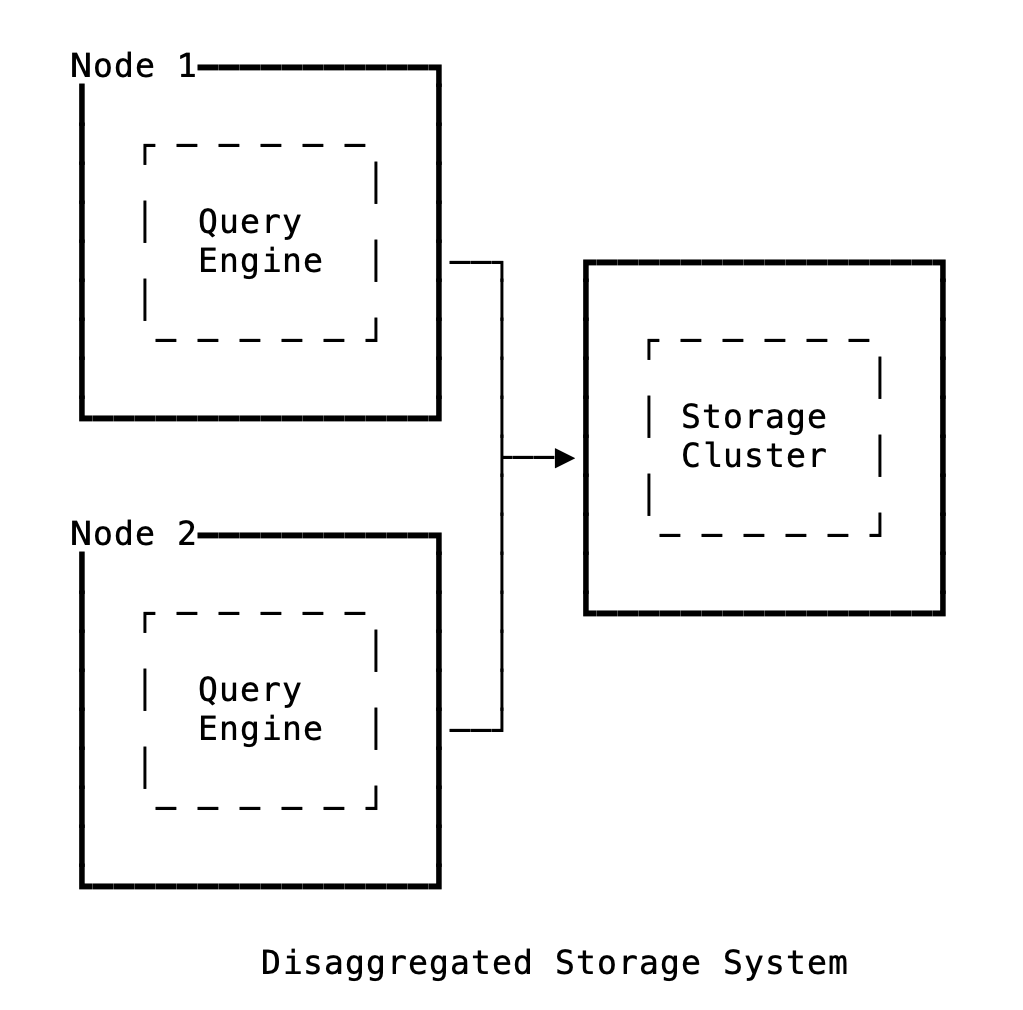
disaggregated storage architecture

Since the disk is no longer attached, it’s easy to scale and scale separately. You can scale CPU and I/O resources independently, and vertical scaling limits won’t matter anymore. You can spawn as many compute machines as needed. Startup and shutdown is instant (hello, Serverless). If your machine crashes, you can spawn a new one without downloading all the database files. Database failover is instant, and you get time travel / Point In Time Restore seamlessly.

But all this comes at a cost: Latency. Disk I/O is way faster than network I/O. Also, while disk I/O operations rarely fail, network I/O calls can fail more frequently.

You might end up doing more network I/O than required. Say your query reads 10 pages but returns only one to the client. To make matters worse, assume the compute layer can read only one page at a time – only after reading a page can it decide whether to read the next one or not. In a traditional model, it’s just 10 disk I/O operations. With storage and compute separated, it will be 10 network I/O operations plus 10 disk I/O operations. Each network call can be expensive in terms of latency!

Most importantly, you need a solid storage server: strongly consistent, fault-tolerant, and horizontally scalable. Compute machines are stateless – they can crash and burn without consequence. But the storage server needs to be fault-tolerant. With the traditional model, all data is on disk, so if that machine crashes, only that database will be down.

If the storage server crashes, the entire fleet of databases will be down. Also, how do we horizontally scale the storage server? Well, that’s a problem for another day!

Thanks to Mr. Aku for reading an early draft of this and bouncing off ideas.


1. Another alternative is a system like Vitess, which enables horizontal scaling by intelligent sharding and connection management.
2. Latency issues in disaggregated storage can be mitigated by caching (at reads) and batching (at writes).
3. There are tricks people do, like predicate pushdown to reduce the amount of read and network latency.
4. Due to operational complexity and trade-offs, disaggregated storage makes sense primarily for database vendors and large tech companies, rather than organizations running just a few databases.