



惯性聚合 高效追踪和阅读你感兴趣的博客、新闻、科技资讯
阅读原文 在惯性聚合中打开

推荐订阅源

S
SegmentFault 最新的问题
Google DeepMind News
G
Google Developers Blog
Martin Fowler
Martin Fowler
MongoDB | Blog
MongoDB | Blog
月光博客
月光博客
Jina AI
Jina AI
宝玉的分享
宝玉的分享
人人都是产品经理
人人都是产品经理
D
DataBreaches.Net
V
V2EX
WordPress大学
WordPress大学
T
The Blog of Author Tim Ferriss
Last Week in AI
Last Week in AI
B
Blog
博客园 - 叶小钗
小众软件
小众软件
Stack Overflow Blog
Stack Overflow Blog
P
Proofpoint News Feed
A
About on SuperTechFans
J
Java Code Geeks
Cyber Security Advisories - MS-ISAC
Y
Y Combinator Blog
Microsoft Security Blog

blag

SQLite prefixes its temp files with `etilqs_` - blag Setsum - order agnostic, additive, subtractive checksum - blag Oldest recorded transaction - blag Replacing a cache service with a database - blag SQLite commits are not durable under default settings - blag PSA: SQLite WAL checksums fail silently and may lose data - blag Rickrolling Turso DB (SQLite rewrite in Rust) - blag Collection of insane and fun facts about SQLite - blag How bloom filters made SQLite 10x faster - blag In search of a faster SQLite - blag Galloping Search - blag Building a distributed log using S3 (under 150 lines of Go) - blag Zero Disk Architecture - blag PSA: Most databases do not do checksums by default - blag PSA: SQLite does not do checksums - blag Disaggregated Storage - a brief introduction - blag Why does SQLite (in production) have such a bad rep? - blag SQLite Slaps - blag Now - blag Learning C - blag Snapshot Testing - blag Win: contribution to libSQL (SQLite) codebase - blag Internet is wholesome: MVCC edition - blag It is becoming difficult for me to be productive in Python - blag MongoDB secondary only index - blag Introducing CaskDB – a project to teach you writing a key-value store - blag Recurse Center: Winter Break - blag Recurse Center Day 24: Hacking Go compiler to add a new keyword - blag Recurse Center Day 20: Django v4 upgrade (from v1) - blag Recurse Center Day 19 - blag
Errata in Hekaton MVCC paper - blag
2023-04-21 · via blag

Hekaton MVCC Paper - High-Performance Concurrency Control Mechanisms for Main-Memory Databases - contains a publication error. After reviewing the paper, I confirmed the error with one of the authors. This blog post explains the mistake, the implications and the fix. I blogged about the background story and my discovery in another post.

Error

Following the conventions of the paper, here is a state diagram:
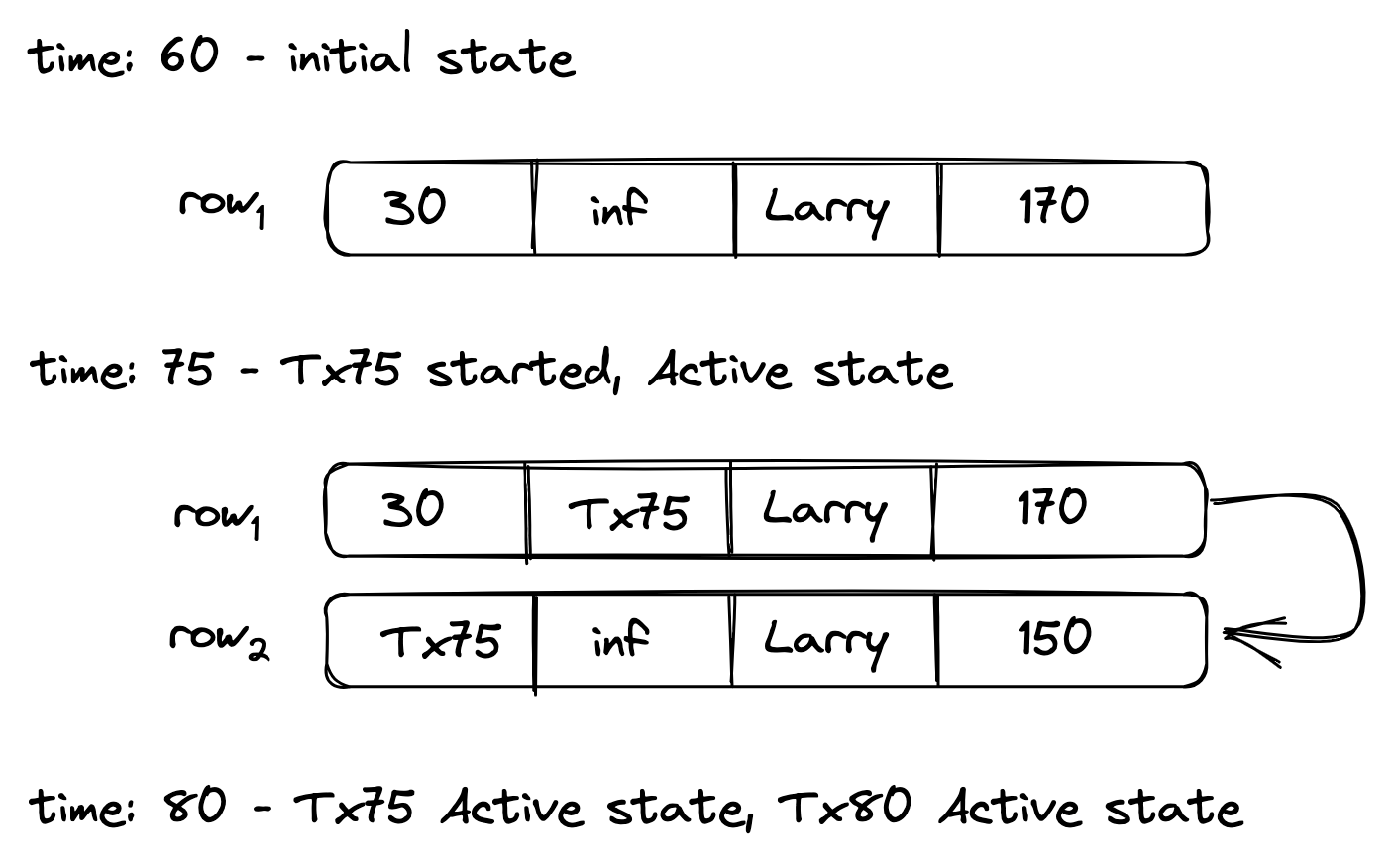
  1. At time 60, we observe our initial state, where the value of Larry is 170. This is a committed row.
  2. At time 75, a transaction is started and is in Active state. It wants to update the value to 150, so it appended row2
  3. At time 80, another new transaction, Tx80 is started, and it wants to read the value of Larry. Both Tx75 and Tx80 are in Active state.

What is the value Tx80 going to read?

Tx80 can’t see row2 because of Table 1 rules. If Tx75 is in Active state, only Tx75 can see row2. This makes sense because row2 is fresh, and Tx75 might drop the changes later. We don’t want any other transactions to see this row.

But can Tx80 see row1? From the paper’s conventions, Tx75 is TE and Tx80 is T, and row1 is V. The rules from the paper contradict that since Tx75 is in Active state:
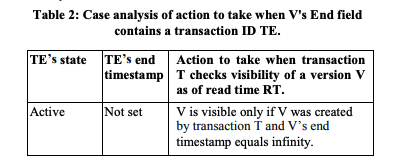
This is a typo, and Tx80 should be able to see row1 since it is a committed row. Also, Tx75 should not be able to see row1 anymore; instead, only row2, which it is updating.

Implications

  • Committed rows can become invisible for new transactions
  • Uncommitted rows can become invisible to the very transactions which are updating them

Fix

The fix is simple, the entire column should read:

V is visible only if TE is not T

The usual rule about the time ranges still apply. By doing this:

  • Tx80 can now see row1 (but not row2)
  • Tx75 can now see row2 (but not row1)