





In this tutorial we'll build a cyclic redundancy check (CRC) hashing function. More specifically, its 32 bit variant called "CRC-32". I bumped into it in the PNG specification, but it's also used in Gzip and bunch of other formats and protocols. In short, it makes a tiny (4 bytes) hash out of whatever binary data you feed to it and changes significantly if data changes even slightly. Of course, such a tiny function is not even close to be crypto secure, therefore it's only used to check if data was transferred correctly.
I love JavaScript, but writing binary algorithm implementations in it is a torture thanks to signed integers conversion in bitwise operations. So, I've decided to write implementation in a strongly typed system language, my other favourite, rust and compile it to WebAssembly.
WebAssembly (a.k.a. WASM) provides a virtual machine that can be created from JavaScript environment (browser, nodejs or deno). This machine is super limited and runs only one binary program in a sandbox environment. It might sound boring, but, in fact, it can run almost anything: media manipulation software, AI, games - you name it.
If you are on a MacOS/Linux/other Unix machine installing rust is as simple as running this command in a terminal and following interactive instructions:
curl --proto '=https' --tlsv1.2 -sSf https://sh.rustup.rs | sh
To install on other OS refer to rustup installation instructions
Once you're done this should work:
rustc --version
# rustc 1.53.0 (53cb7b09b 2021-06-17)
Next step is to install wasm-pack, a tool that compiles your WebAssembly module, generates JavaScript glue and TypeScript types for it.
If you're on a Unix machine the command is:
curl https://rustwasm.github.io/wasm-pack/installer/init.sh -sSf | sh
For other OS: refer to wasm-pack installation instructions.
Once again, make sure it's working:
wasm-pack --version
# wasm-pack 0.10.0
Rust comes with its own dependency manager cargo. It also helps with some routine operations, like project creation. Run this command to generate project folder and navigate into it:
cargo new --lib wasm-test && cd wasm-test
We should add crate type (cdylib) and the wasm binding dependency (wasm-bindgen) in the generated Cargo.toml:
[package]
name = "wasm-test"
version = "0.1.0"
edition = "2018"

# See more keys and their definitions at https://doc.rust-lang.org/cargo/reference/manifest.html

[lib]
crate-type = ["cdylib"]

[dependencies]
wasm-bindgen = "0.2"
Now let's add the CRC-32 algorithm implementation to src/lib.rs:
use wasm_bindgen::prelude::*;
// Pre-computed, see tests
const CRC_TABLE: [u32; 256] = [
    0, 1996959894, 3993919788, 2567524794, 124634137, 1886057615, 3915621685, 2657392035,
    249268274, 2044508324, 3772115230, 2547177864, 162941995, 2125561021, 3887607047, 2428444049,
    498536548, 1789927666, 4089016648, 2227061214, 450548861, 1843258603, 4107580753, 2211677639,
    325883990, 1684777152, 4251122042, 2321926636, 335633487, 1661365465, 4195302755, 2366115317,
    997073096, 1281953886, 3579855332, 2724688242, 1006888145, 1258607687, 3524101629, 2768942443,
    901097722, 1119000684, 3686517206, 2898065728, 853044451, 1172266101, 3705015759, 2882616665,
    651767980, 1373503546, 3369554304, 3218104598, 565507253, 1454621731, 3485111705, 3099436303,
    671266974, 1594198024, 3322730930, 2970347812, 795835527, 1483230225, 3244367275, 3060149565,
    1994146192, 31158534, 2563907772, 4023717930, 1907459465, 112637215, 2680153253, 3904427059,
    2013776290, 251722036, 2517215374, 3775830040, 2137656763, 141376813, 2439277719, 3865271297,
    1802195444, 476864866, 2238001368, 4066508878, 1812370925, 453092731, 2181625025, 4111451223,
    1706088902, 314042704, 2344532202, 4240017532, 1658658271, 366619977, 2362670323, 4224994405,
    1303535960, 984961486, 2747007092, 3569037538, 1256170817, 1037604311, 2765210733, 3554079995,
    1131014506, 879679996, 2909243462, 3663771856, 1141124467, 855842277, 2852801631, 3708648649,
    1342533948, 654459306, 3188396048, 3373015174, 1466479909, 544179635, 3110523913, 3462522015,
    1591671054, 702138776, 2966460450, 3352799412, 1504918807, 783551873, 3082640443, 3233442989,
    3988292384, 2596254646, 62317068, 1957810842, 3939845945, 2647816111, 81470997, 1943803523,
    3814918930, 2489596804, 225274430, 2053790376, 3826175755, 2466906013, 167816743, 2097651377,
    4027552580, 2265490386, 503444072, 1762050814, 4150417245, 2154129355, 426522225, 1852507879,
    4275313526, 2312317920, 282753626, 1742555852, 4189708143, 2394877945, 397917763, 1622183637,
    3604390888, 2714866558, 953729732, 1340076626, 3518719985, 2797360999, 1068828381, 1219638859,
    3624741850, 2936675148, 906185462, 1090812512, 3747672003, 2825379669, 829329135, 1181335161,
    3412177804, 3160834842, 628085408, 1382605366, 3423369109, 3138078467, 570562233, 1426400815,
    3317316542, 2998733608, 733239954, 1555261956, 3268935591, 3050360625, 752459403, 1541320221,
    2607071920, 3965973030, 1969922972, 40735498, 2617837225, 3943577151, 1913087877, 83908371,
    2512341634, 3803740692, 2075208622, 213261112, 2463272603, 3855990285, 2094854071, 198958881,
    2262029012, 4057260610, 1759359992, 534414190, 2176718541, 4139329115, 1873836001, 414664567,
    2282248934, 4279200368, 1711684554, 285281116, 2405801727, 4167216745, 1634467795, 376229701,
    2685067896, 3608007406, 1308918612, 956543938, 2808555105, 3495958263, 1231636301, 1047427035,
    2932959818, 3654703836, 1088359270, 936918000, 2847714899, 3736837829, 1202900863, 817233897,
    3183342108, 3401237130, 1404277552, 615818150, 3134207493, 3453421203, 1423857449, 601450431,
    3009837614, 3294710456, 1567103746, 711928724, 3020668471, 3272380065, 1510334235, 755167117,
];

/**
 * Reference implementation
 * http://libpng.org/pub/png/spec/iso/index-object.html#D-CRCAppendix
 */

#[wasm_bindgen]
pub fn crc(buf: Vec<u8>) -> u32 {
    let mut c: u32 = 0xffffffff;
    for v in buf {
        let idx: usize = (c as usize ^ v as usize) & 0xff;
        c = CRC_TABLE[idx] ^ (c >> 8);
    }
    c ^ 0xffffffff
}

#[cfg(test)]
mod tests {
    use super::*;

    #[test]
    fn test_table() {
        let mut crc_table: [u32; 256] = [0; 256];
        let mut c: usize;

        for n in 0..256 {
            c = n;
            for _ in 0..8 {
                c = if c & 1 == 1 {
                    0xedb88320 ^ (c >> 1)
                } else {
                    c >> 1
                }
            }
            crc_table[n] = c as u32;
        }

        assert_eq!(CRC_TABLE, crc_table);
    }

    #[test]
    fn test_iend() {
        assert_eq!(crc("IEND".as_bytes().to_vec()), 0xAE426082);
    }
}
The implementation uses pre-computed table for each byte value from 0x00 to 0xff and boils down to couple bitwise operations.
Macros #[wasm_bindgen] marks the function we want to export.
The unit tests in the end of the file can be run with:
cargo test

# running 2 tests
# test tests::test_iend ... ok
# test tests::test_table ... ok

# test result: ok. 2 passed; 0 failed; 0 ignored; 0 measured; 0 filtered out; finished in 0.00s
Run this command:
wasm-pack build --target web --release
It creates a pkg folder with WASM module, TypeScript types, package.json and the main wasm_test.js file.
Let's create index.html file in the project root and import the generated script from there:
<!DOCTYPE html>
<html lang="en">
  <head>
    <meta charset="UTF-8" />
    <meta http-equiv="X-UA-Compatible" content="IE=edge" />
    <meta name="viewport" content="width=device-width, initial-scale=1.0" />
    <title>WASM Test</title>
  </head>
  <body>
    <div>
      <textarea id="input" placeholder="Place your data here">
Hello,WASM!</textarea
      >
      <br />
      <textarea
        id="output"
        readonly
        placeholder="Resulting HEX will be displayed here"
      ></textarea>
      <br />
      <button disabled id="btn">Calculate CRC-32</button>
    </div>
    <script type="module">
      import init, { crc } from "./pkg/wasm_test.js";
      const btn = document.getElementById("btn");
      const input = document.getElementById("input");
      const output = document.getElementById("output");
      init().then(() => {
        btn.disabled = false;
        btn.onclick = () => {
          const buffer = new TextEncoder().encode(input.value);
          output.value = crc(buffer).toString(16);
        };
      });
    </script>
  </body>
</html>
For security reasons you won't be able to test this html file by simply opening it, but you can start a simple file server with:
npx serve .
# npx: installed 88 in 6.469s
#
#   ┌────────────────────────────────────────┐
#   │                                        │
#   │   Serving!                             │
#   │                                        │
#   │   Local:  http://localhost:5000        │
#   │                                        │
#   │   Copied local address to clipboard!   │
#   │                                        │
#   └────────────────────────────────────────┘
#
If you can't run this command, that probably means that either NodeJS or NPM is not installed.
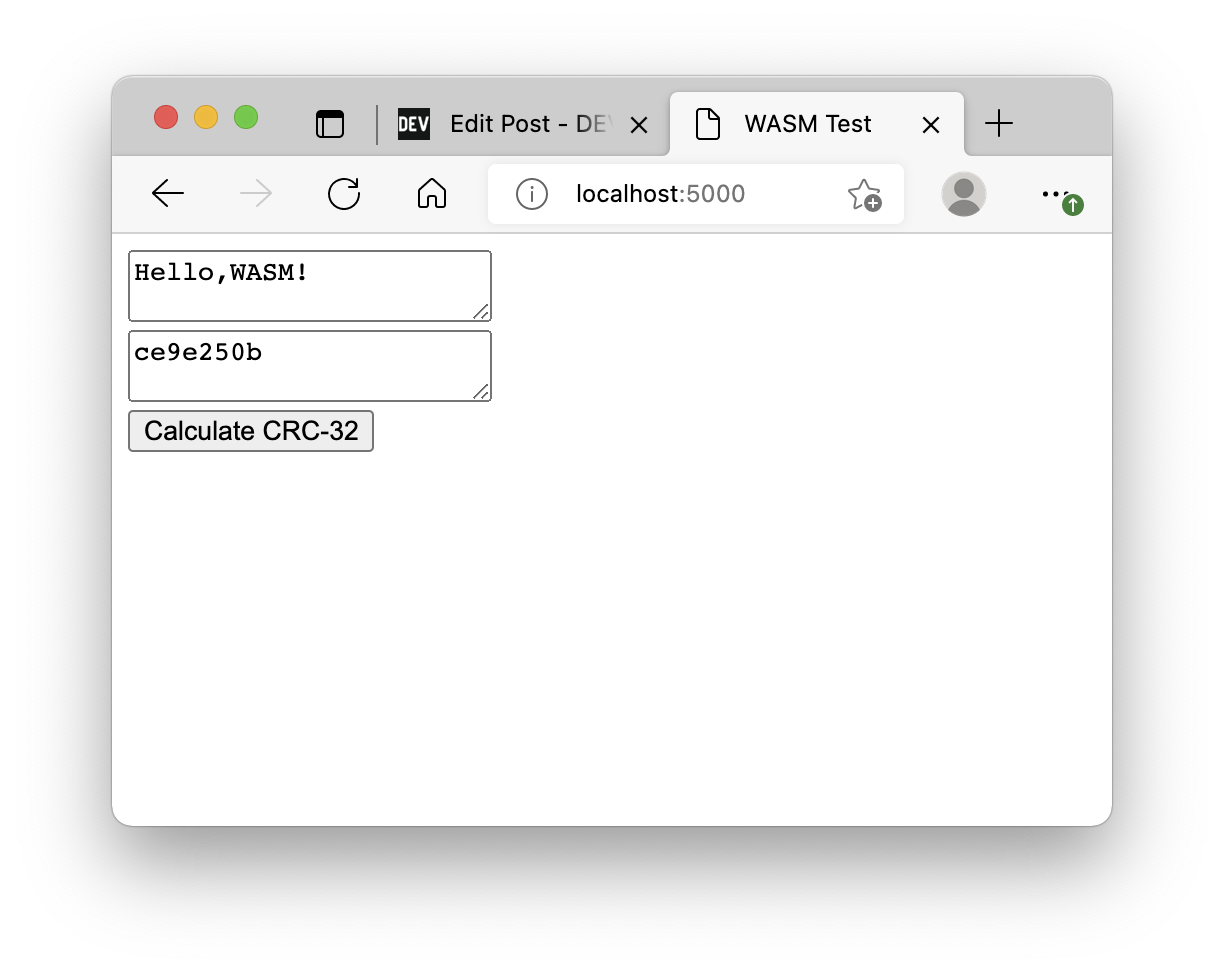
Navigate your browser to http://localhost:5000 and click the "Calculate CRC-32" button to see something like this:
Let's create nearly identical JavaScript implementation of CRC-32 in crc.js:
const CRC_TABLE = new Uint32Array([
  0, 1996959894, 3993919788, 2567524794, 124634137, 1886057615, 3915621685,
  2657392035, 249268274, 2044508324, 3772115230, 2547177864, 162941995,
  2125561021, 3887607047, 2428444049, 498536548, 1789927666, 4089016648,
  2227061214, 450548861, 1843258603, 4107580753, 2211677639, 325883990,
  1684777152, 4251122042, 2321926636, 335633487, 1661365465, 4195302755,
  2366115317, 997073096, 1281953886, 3579855332, 2724688242, 1006888145,
  1258607687, 3524101629, 2768942443, 901097722, 1119000684, 3686517206,
  2898065728, 853044451, 1172266101, 3705015759, 2882616665, 651767980,
  1373503546, 3369554304, 3218104598, 565507253, 1454621731, 3485111705,
  3099436303, 671266974, 1594198024, 3322730930, 2970347812, 795835527,
  1483230225, 3244367275, 3060149565, 1994146192, 31158534, 2563907772,
  4023717930, 1907459465, 112637215, 2680153253, 3904427059, 2013776290,
  251722036, 2517215374, 3775830040, 2137656763, 141376813, 2439277719,
  3865271297, 1802195444, 476864866, 2238001368, 4066508878, 1812370925,
  453092731, 2181625025, 4111451223, 1706088902, 314042704, 2344532202,
  4240017532, 1658658271, 366619977, 2362670323, 4224994405, 1303535960,
  984961486, 2747007092, 3569037538, 1256170817, 1037604311, 2765210733,
  3554079995, 1131014506, 879679996, 2909243462, 3663771856, 1141124467,
  855842277, 2852801631, 3708648649, 1342533948, 654459306, 3188396048,
  3373015174, 1466479909, 544179635, 3110523913, 3462522015, 1591671054,
  702138776, 2966460450, 3352799412, 1504918807, 783551873, 3082640443,
  3233442989, 3988292384, 2596254646, 62317068, 1957810842, 3939845945,
  2647816111, 81470997, 1943803523, 3814918930, 2489596804, 225274430,
  2053790376, 3826175755, 2466906013, 167816743, 2097651377, 4027552580,
  2265490386, 503444072, 1762050814, 4150417245, 2154129355, 426522225,
  1852507879, 4275313526, 2312317920, 282753626, 1742555852, 4189708143,
  2394877945, 397917763, 1622183637, 3604390888, 2714866558, 953729732,
  1340076626, 3518719985, 2797360999, 1068828381, 1219638859, 3624741850,
  2936675148, 906185462, 1090812512, 3747672003, 2825379669, 829329135,
  1181335161, 3412177804, 3160834842, 628085408, 1382605366, 3423369109,
  3138078467, 570562233, 1426400815, 3317316542, 2998733608, 733239954,
  1555261956, 3268935591, 3050360625, 752459403, 1541320221, 2607071920,
  3965973030, 1969922972, 40735498, 2617837225, 3943577151, 1913087877,
  83908371, 2512341634, 3803740692, 2075208622, 213261112, 2463272603,
  3855990285, 2094854071, 198958881, 2262029012, 4057260610, 1759359992,
  534414190, 2176718541, 4139329115, 1873836001, 414664567, 2282248934,
  4279200368, 1711684554, 285281116, 2405801727, 4167216745, 1634467795,
  376229701, 2685067896, 3608007406, 1308918612, 956543938, 2808555105,
  3495958263, 1231636301, 1047427035, 2932959818, 3654703836, 1088359270,
  936918000, 2847714899, 3736837829, 1202900863, 817233897, 3183342108,
  3401237130, 1404277552, 615818150, 3134207493, 3453421203, 1423857449,
  601450431, 3009837614, 3294710456, 1567103746, 711928724, 3020668471,
  3272380065, 1510334235, 755167117,
]);

function update_crc(crc, buf) {
  let c = crc;

  for (const v of buf) {
    const idx = ((c ^ v) & 0xff) >>> 0;
    c = (CRC_TABLE[idx] ^ (c >>> 8)) >>> 0;
  }
  return c;
}
export default (buf) => (update_crc(0xffffffff, buf) ^ 0xffffffff) >>> 0;
The only thing that differs is the unsigned right shift (>>>) we added to get rid of signs in JS numbers.
We can now include this implementation along with some performance measurements in index.html:
<!DOCTYPE html>
<html lang="en">
  <head>
    <meta charset="UTF-8" />
    <meta http-equiv="X-UA-Compatible" content="IE=edge" />
    <meta name="viewport" content="width=device-width, initial-scale=1.0" />
    <title>WASM Test</title>
  </head>
  <body>
    <div>
      <textarea id="input" placeholder="Place your data here">
Hello,WASM!</textarea
      >
      <br />
      <textarea
        id="output"
        readonly
        placeholder="Resulting HEX will be displayed here"
      ></textarea>
      <br />
      <button disabled id="btn-wasm">Calculate CRC-32 (WASM)</button
      ><button id="btn-js">Calculate CRC-32 ( JS )</button>
    </div>
    <script type="module">
      import init, { crc } from "./pkg/wasm_test.js";
      import crcjs from "./crc.js";

      const input = document.getElementById("input");
      const output = document.getElementById("output");

      const calculate = (fn, name) => {
        const buffer = new TextEncoder().encode(input.value);
        const t0 = performance.now();
        output.value = fn(buffer).toString(16);
        const t1 = performance.now();
        console.log(`${name}: ${t1 - t0} ms`);
      };

      document.getElementById("btn-js").onclick = () => calculate(crcjs, "js");

      init().then(() => {
        const btnWASM = document.getElementById("btn-wasm");
        btnWASM.disabled = false;
        btnWASM.onclick = () => calculate(crc, "wasm");
      });
    </script>
  </body>
</html>
Reload the page and check it out (open console to see performance information):
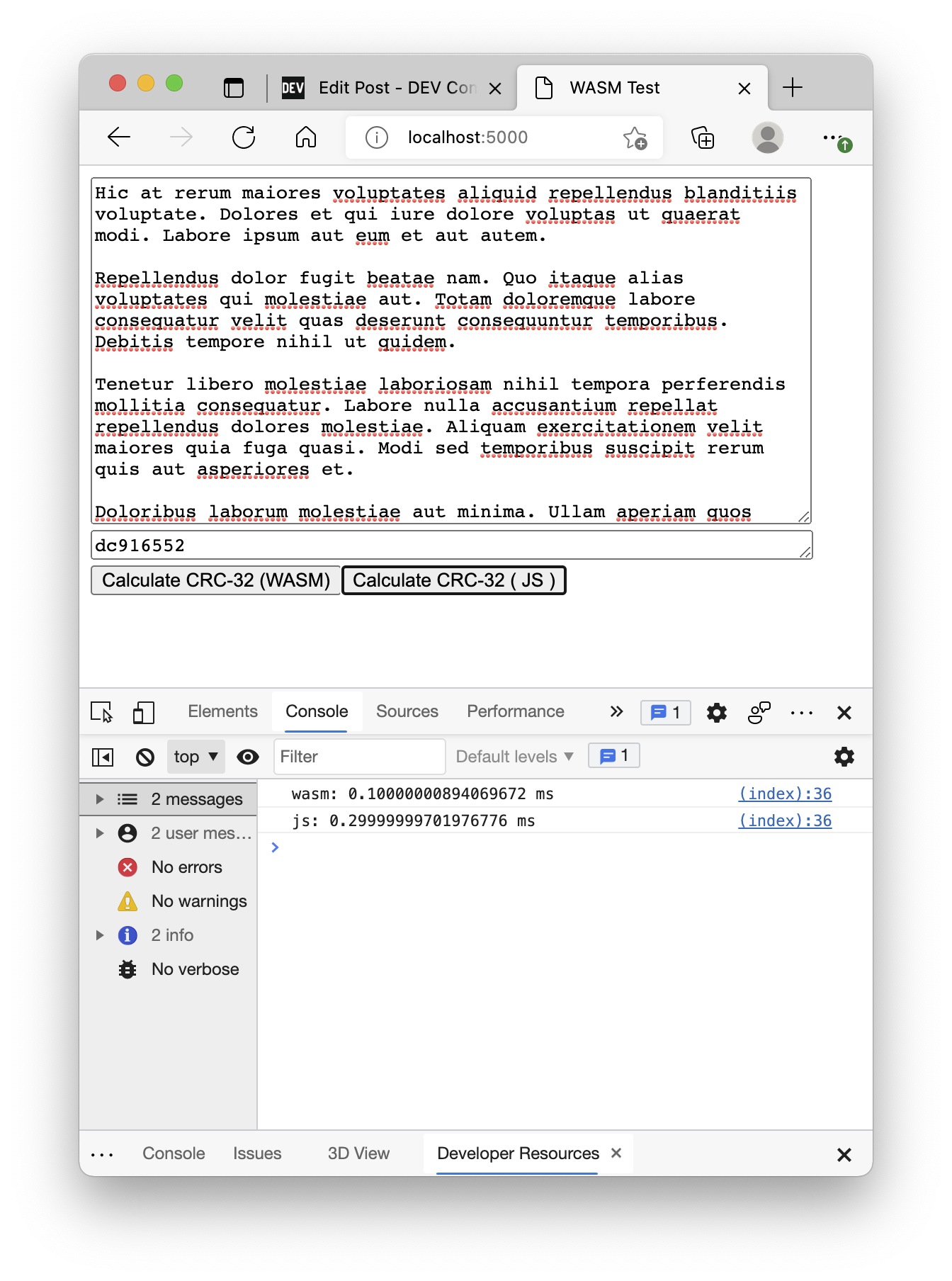
Not bad, WASM is nearly three times faster on 5 paragraphs of text, but both of them are still very fast. How about a bigger challenge?
Update index.html one last time:
<!DOCTYPE html>
<html lang="en">
  <head>
    <meta charset="UTF-8" />
    <meta http-equiv="X-UA-Compatible" content="IE=edge" />
    <meta name="viewport" content="width=device-width, initial-scale=1.0" />
    <title>WASM Test</title>
  </head>
  <body>
    <div>
      <textarea id="input" placeholder="Place your data here">
Hello,WASM!</textarea
      >
      <br />
      <textarea
        id="output"
        readonly
        placeholder="Resulting HEX will be displayed here"
      ></textarea>
      <br />
      <button disabled id="btn-wasm">Calculate CRC-32 (WASM)</button
      ><button id="btn-js">Calculate CRC-32 ( JS )</button>
      <hr />
      <button id="btn-test" disabled>Compare Performance</button>
      <div id="result"></div>
    </div>
    <script type="module">
      import init, { crc } from "./pkg/wasm_test.js";
      import crcjs from "./crc.js";

      const input = document.getElementById("input");
      const output = document.getElementById("output");

      const calculate = (fn, name) => {
        const buffer = new TextEncoder().encode(input.value);
        const t0 = performance.now();
        output.value = fn(buffer).toString(16);
        const t1 = performance.now();
        console.log(`${name}: ${t1 - t0} ms`);
      };

      document.getElementById("btn-js").onclick = () => calculate(crcjs, "js");

      init().then(() => {
        const btnWASM = document.getElementById("btn-wasm");
        btnWASM.disabled = false;
        btnWASM.onclick = () => calculate(crc, "wasm");
        const btnTest = document.getElementById("btn-test");
        btnTest.disabled = false;
        const result = document.getElementById("result");
        btnTest.onclick = () => {
          // Max random buffer
          result.innerHTML = "";
          const data = window.crypto.getRandomValues(new Uint8Array(65536));
          console.info("Test data", data);

          const t10 = performance.now();
          const hash1 = crcjs(data).toString(16);
          const t11 = performance.now();
          result.innerHTML += `<b>js</b>: ${(t11 - t10).toFixed(2)} ms<br/>`;
          console.info("JS hash", hash1.toString(16));

          const t00 = performance.now();
          const hash2 = crc(data).toString(16);
          const t01 = performance.now();
          result.innerHTML += `<b>wasm</b>: ${(t01 - t00).toFixed(2)} ms<br/>`;
          console.info("WASM hash", hash2.toString(16));
        };
      });
    </script>
  </body>
</html>
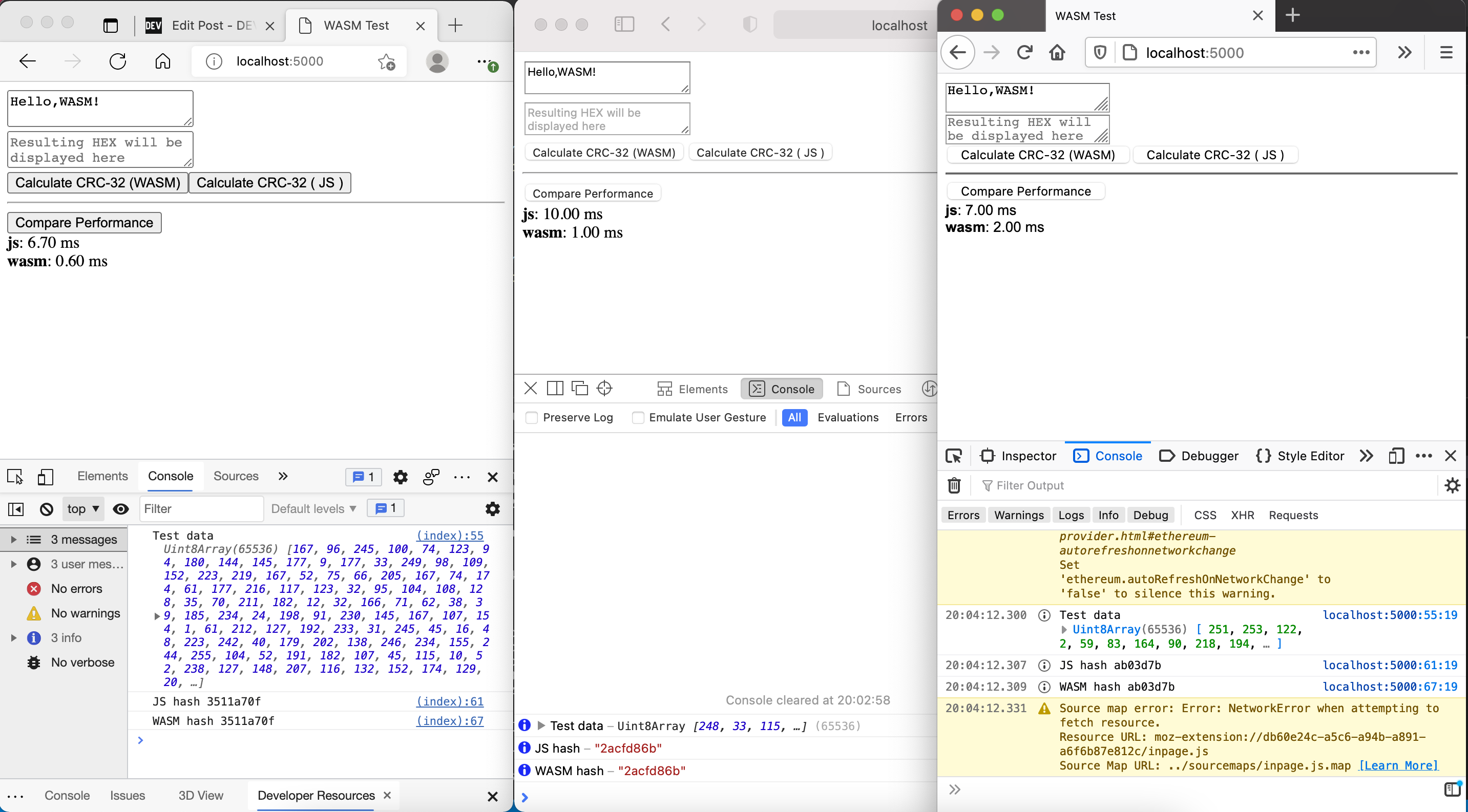
I've added the third button that creates a big random binary array (65.5Kb), marks time, runs JS and WASM CRC-32 implementation over that buffer and shares the findings.
Here are the results I got in Edge, Safari and Firefox:
Similarly to web target, we can build NodeJS-friendly package by running:
wasm-pack build --target nodejs --out-dir pkg-node --release
The contents of pkg-node are mostly the same as web pkg, except for wasm_test.js, that now reads WASM module from the file system.
Create index.js with:
const { PerformanceObserver, performance } = require("perf_hooks");
const crypto = require("crypto");
const { crc } = require("./pkg-node/wasm_test.js");
const crcJS = require("./crc.cjs");

const perfObserver = new PerformanceObserver((items) => {
  items.getEntries().forEach((entry) => {
    console.log(entry.name, entry.duration, "ms");
  });
});

perfObserver.observe({ entryTypes: ["measure"], buffer: true });

const size = 10_000_000;

crypto.randomBytes(size, (err, data) => {
  if (err) throw err;
  console.log(`Generated random ${(size / 1_000_000).toFixed(0)}MB of data`);
  performance.mark("wasm-start");
  const crcwasm = crc(data);
  performance.mark("wasm-end");

  performance.mark("js-start");
  const crcjs = crcJS(data);
  performance.mark("js-end");

  console.assert(crcjs, crcwasm, "CRC values differ!");
  performance.measure("js  ", "js-start", "js-end");
  performance.measure("wasm", "wasm-start", "wasm-end");
});
The imported CommonJS script crc.cjs is identical to crc.js apart from the last line ( export default => module.exports):
const CRC_TABLE = new Uint32Array([
  0, 1996959894, 3993919788, 2567524794, 124634137, 1886057615, 3915621685,
  2657392035, 249268274, 2044508324, 3772115230, 2547177864, 162941995,
  2125561021, 3887607047, 2428444049, 498536548, 1789927666, 4089016648,
  2227061214, 450548861, 1843258603, 4107580753, 2211677639, 325883990,
  1684777152, 4251122042, 2321926636, 335633487, 1661365465, 4195302755,
  2366115317, 997073096, 1281953886, 3579855332, 2724688242, 1006888145,
  1258607687, 3524101629, 2768942443, 901097722, 1119000684, 3686517206,
  2898065728, 853044451, 1172266101, 3705015759, 2882616665, 651767980,
  1373503546, 3369554304, 3218104598, 565507253, 1454621731, 3485111705,
  3099436303, 671266974, 1594198024, 3322730930, 2970347812, 795835527,
  1483230225, 3244367275, 3060149565, 1994146192, 31158534, 2563907772,
  4023717930, 1907459465, 112637215, 2680153253, 3904427059, 2013776290,
  251722036, 2517215374, 3775830040, 2137656763, 141376813, 2439277719,
  3865271297, 1802195444, 476864866, 2238001368, 4066508878, 1812370925,
  453092731, 2181625025, 4111451223, 1706088902, 314042704, 2344532202,
  4240017532, 1658658271, 366619977, 2362670323, 4224994405, 1303535960,
  984961486, 2747007092, 3569037538, 1256170817, 1037604311, 2765210733,
  3554079995, 1131014506, 879679996, 2909243462, 3663771856, 1141124467,
  855842277, 2852801631, 3708648649, 1342533948, 654459306, 3188396048,
  3373015174, 1466479909, 544179635, 3110523913, 3462522015, 1591671054,
  702138776, 2966460450, 3352799412, 1504918807, 783551873, 3082640443,
  3233442989, 3988292384, 2596254646, 62317068, 1957810842, 3939845945,
  2647816111, 81470997, 1943803523, 3814918930, 2489596804, 225274430,
  2053790376, 3826175755, 2466906013, 167816743, 2097651377, 4027552580,
  2265490386, 503444072, 1762050814, 4150417245, 2154129355, 426522225,
  1852507879, 4275313526, 2312317920, 282753626, 1742555852, 4189708143,
  2394877945, 397917763, 1622183637, 3604390888, 2714866558, 953729732,
  1340076626, 3518719985, 2797360999, 1068828381, 1219638859, 3624741850,
  2936675148, 906185462, 1090812512, 3747672003, 2825379669, 829329135,
  1181335161, 3412177804, 3160834842, 628085408, 1382605366, 3423369109,
  3138078467, 570562233, 1426400815, 3317316542, 2998733608, 733239954,
  1555261956, 3268935591, 3050360625, 752459403, 1541320221, 2607071920,
  3965973030, 1969922972, 40735498, 2617837225, 3943577151, 1913087877,
  83908371, 2512341634, 3803740692, 2075208622, 213261112, 2463272603,
  3855990285, 2094854071, 198958881, 2262029012, 4057260610, 1759359992,
  534414190, 2176718541, 4139329115, 1873836001, 414664567, 2282248934,
  4279200368, 1711684554, 285281116, 2405801727, 4167216745, 1634467795,
  376229701, 2685067896, 3608007406, 1308918612, 956543938, 2808555105,
  3495958263, 1231636301, 1047427035, 2932959818, 3654703836, 1088359270,
  936918000, 2847714899, 3736837829, 1202900863, 817233897, 3183342108,
  3401237130, 1404277552, 615818150, 3134207493, 3453421203, 1423857449,
  601450431, 3009837614, 3294710456, 1567103746, 711928724, 3020668471,
  3272380065, 1510334235, 755167117,
]);

function update_crc(crc, buf) {
  let c = crc;

  for (const v of buf) {
    const idx = ((c ^ v) & 0xff) >>> 0;
    c = (CRC_TABLE[idx] ^ (c >>> 8)) >>> 0;
  }
  return c;
}

module.exports = (buf) => (update_crc(0xffffffff, buf) ^ 0xffffffff) >>> 0;
Finally, run the script:
node index
# Generated random 10MB of data
# js   253.875679 ms
# wasm 39.126159 ms
The bigger the size of the data to hash, the bigger is the gap between JS and WASM speeds:
# Generated random 100MB of data
js   2461.758713 ms
wasm 389.698142 ms

# Generated random 1000MB of data
js   25945.486315 ms
wasm 3763.860294 ms
此内容由惯性聚合(RSS阅读器)自动聚合整理,仅供阅读参考。 原文来自 — 版权归原作者所有。