


👋 Welcome to Climate Drift: your cheat-sheet to climate. Each edition breaks down real solutions, hard numbers, and career moves for operators, founders, and investors who want impact. For more: Community | Accelerator | Open Climate Firesides | Deep Dives
Hey there! 👋
Skander here.
You know how food companies handle methane? One sets a Scope 3 target. Another joins a voluntary pledge. A third is running a program to reduce emissions on dairy farms in France. Fifty of the largest food and agriculture companies in North America, each building its own approach, each figuring out measurement from scratch, most of them unable to tell you how much methane their supply chain actually produces.
: According to data released in 2025, out of 50 companies, only 17 have science-based reduction targets. 32 disclose Scope 3 emissions and have emission reduction targets that include Scope 3 and of these only 3 disclose time-bound commitments to reduce non-CO2 emissions, including agricultural methane.
The problem is structural. These companies don’t own the farms. They can’t control what happens three tiers deep in their supply chains, across thousands of producers, in dozens of countries with different regulations. They’re being asked to fix a system they don’t operate.
Nandita Srivastava spent years at the International Food Policy Research Institute managing multi-country food systems programs across Asia and Africa. She coordinated the messy middle ground between research findings, policy frameworks, and what actually happens on the ground. She knows what it looks like when the science exists, the targets exist, and adoption still stalls.
Today she looks at the methane gap and asks: what if the real bottleneck isn’t corporate ambition but the absence of a de-risking layer? What if philanthropy and NGOs stepped in to absorb the early uncertainty, fund the shared infrastructure, and lower the cost of action for everyone?
Why corporate methane commitments keep stalling at pilot scale (and the Ceres data that shows the dropout rate from target-setting to actual strategy)
How philanthropic capital can absorb the R&D risk that no single company will take on alone, with models like the Enteric Fermentation R&D Accelerator already proving it works
The farm-level cost problem: what it actually takes to get anaerobic digesters, methane sensors, and climate-smart rice packages to smallholders
Why measurement infrastructure needs to be treated as a public good, and what Carbon Mapper and the Dairy Methane Action Alliance are building
A capacity-building framework borrowed from IFPRI’s institutional mapping work that changes how companies decide where to invest
Let’s get into it. 🌾
First: Who is Nandita?
Nandita Srivastava is a policy researcher, project manager, and communicator with over nine years of professional experience across government, NGO, and private organizations. She began her career as an economics professor at a national university in India and later worked in regulatory enforcement as an economist with India’s antitrust regulator.
Most recently, she was an analyst with the International Food Policy Research Institute. In this role, she managed a diverse portfolio of food systems and climate-related projects, coordinating global teams across Asia and Africa. She shaped project scopes and budgets, aligned teams to deliver high-quality outputs, and supported stakeholder engagement with universities, research partners, donors, and others. She has translated research insights into practical policy and communication materials. These have informed donor strategies and advocacy efforts on climate change, youth entrepreneurship, systems integration, and capacity strengthening in the food sector.
Nandita is currently in career transition and looking for her next opportunity. She is passionate about connecting the dots between strategy, research, operations, and communication to make complex systems work more smoothly. She is particularly interested in project management, advisory, and communications/advocacy roles where she can leverage her expertise to drive resilience building across global food landscapes.
Connect with Nandita on LinkedIn or directly at nsrivastava06@gmail.com.

Food systems sit at a crossroads in the climate story. It is both a significant driver of the emissions destabilizing our planet and one of the systems most acutely vulnerable to climate change’s consequences. The urgency of methane reduction, for me, is rooted in this interconnection — reducing the sector’s climate footprint while ensuring food and nutrition security.
Among the anthropogenic methane sources, agriculture is a key contributor. The sector is responsible for almost half of the global anthropogenic methane emissions, driven primarily by livestock, rice cultivation, food loss and waste, biomass burning, and certain biofuel sub-sectors.
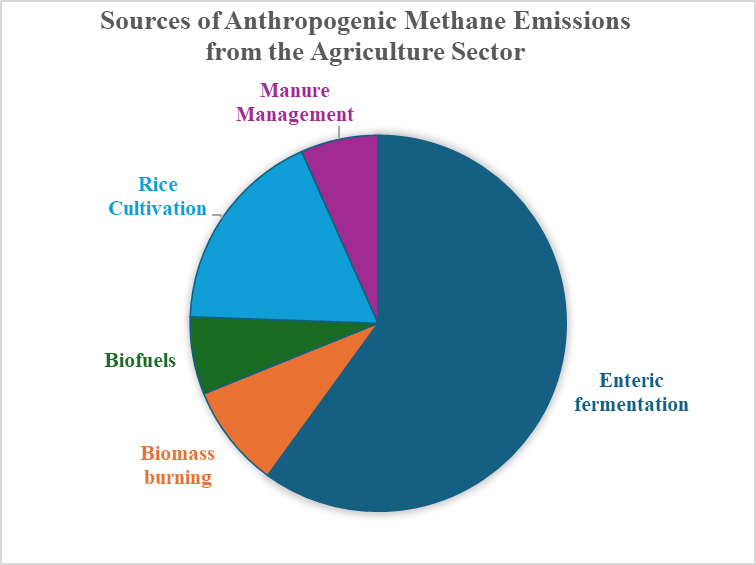
But, despite methane being characterized as a low-hanging fruit to achieve net zero emissions, the implementation story is far from linear. During my years at a leading international food policy NGO, coordinating multi-country programs in the Global South, I witnessed firsthand the challenges in addressing the gaps between scientific knowledge, real world evidence, and on-the-ground implementation.
From the private sector perspective, the structural challenge can be daunting. How does a global food company influence emissions occurring three steps removed in their supply chain, on a farm they do not own, in an evolving regulatory environment? The answer cannot be to ask farmers or private companies to absorb the entire risk of this transition alone. Systemic change requires a shared accountability and a shared investment in progress.
This guidebook is born from the conviction that moving from corporate ambition to system-wide adoption requires realigning the incentives and clarifying how responsibility is distributed. Drawing on my experience synthesizing evidence and providing strategic advisory recommendations for diverse stakeholders, I explore how philanthropy and NGOs can serve as the essential de-risking layer in the methane reduction ecosystem. The goal is not simply a reduction in emissions numbers but to strengthen collaboration architecture between the private sector, NGOs, and philanthropy in service of both a livable climate and a food-secure future.
Methane Mitigation: A Structural Challenge?
According to the latest report by Sightline Climate, total climate tech venture and growth investment rose to $40.5bn in 2025, up 8% year-on-year, and cumulative investment since 2020 increased by 19%. Despite the overall growth, investments in food systems methane mitigation remain inadequate, according to a study by Climateworks Foundation and the Global Methane Hub (GMH).
Food companies are key players in the climate action ecosystem with influence on agricultural production, sourcing practices, processing, retail operations, and consumer demand. They can accelerate low-emissions pathways by setting targets, deploying innovation, and strengthening disclosure systems. Ceres Food Emissions 50 benchmark measures progress made by 50 of the largest public companies in the food and agriculture sector in North America toward addressing climate risk and accelerating lower-emissions transition.
According to the latest data, 38 companies disclose Scope 3 emissions while 30 companies disclose that their Scope 3 emissions include agricultural emissions. There are 32 companies which disclose Scope 3 emissions and have emission reduction targets that include Scope 3 and of these just 17 have Science Based Targets initiative (SBTi)-approved emissions reduction target that is aligned with 1.5˚C or well-below 2˚C and only 3 have time bound greenhouse gas (GHG) specific targets to reduce agriculture non-CO2 emissions from their supply chains. In addition, 18 companies assessed and disclosed emissions sources within the purchased goods and services category and just 5 have disclosed having a quantified GHG emissions reduction strategy to meet the reduction targets.
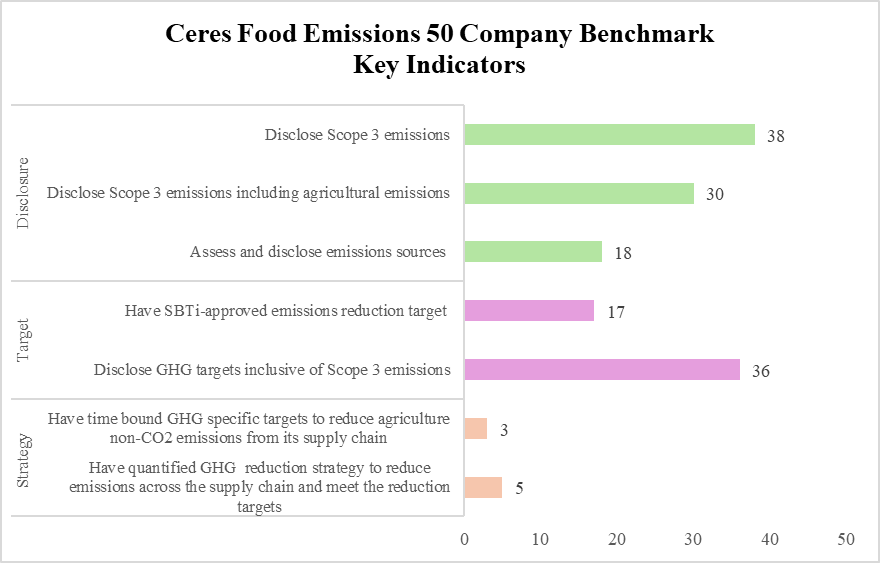
Findings from the data are indicative of a broader structural challenge in the methane mitigation landscape.
Emissions which occur at the upstream level may well be beyond the direct ownership and operational boundaries of food companies. This limits corporate leverage and makes companies vulnerable to reputational and regulatory risk without direct control. Even companies with strong climate commitments must rely on partnerships, supplier contracts, and other voluntary incentives to influence methane outcomes. Thus, expecting companies alone to absorb uncertainty, finance sustainability focused public-good infrastructure, and realign incentives is not a prudent approach.
The central question remains: how do we move from corporate ambition to system-wide adoption? The answer depends on establishing clear roles and responsibilities, specifically defining who will step up and how across five pillars:
absorb the early-stage research, technology, and market risks
bear the upfront and ongoing project costs and support technology implementation
provide favorable policy and regulatory ecosystem
build and operate measurement and verification systems
strengthen institutional and human capacity
Without this clarity, corporate methane action will keep falling short, not for lack of scientific evidence, but because of a systems-level structural and coordination failure.
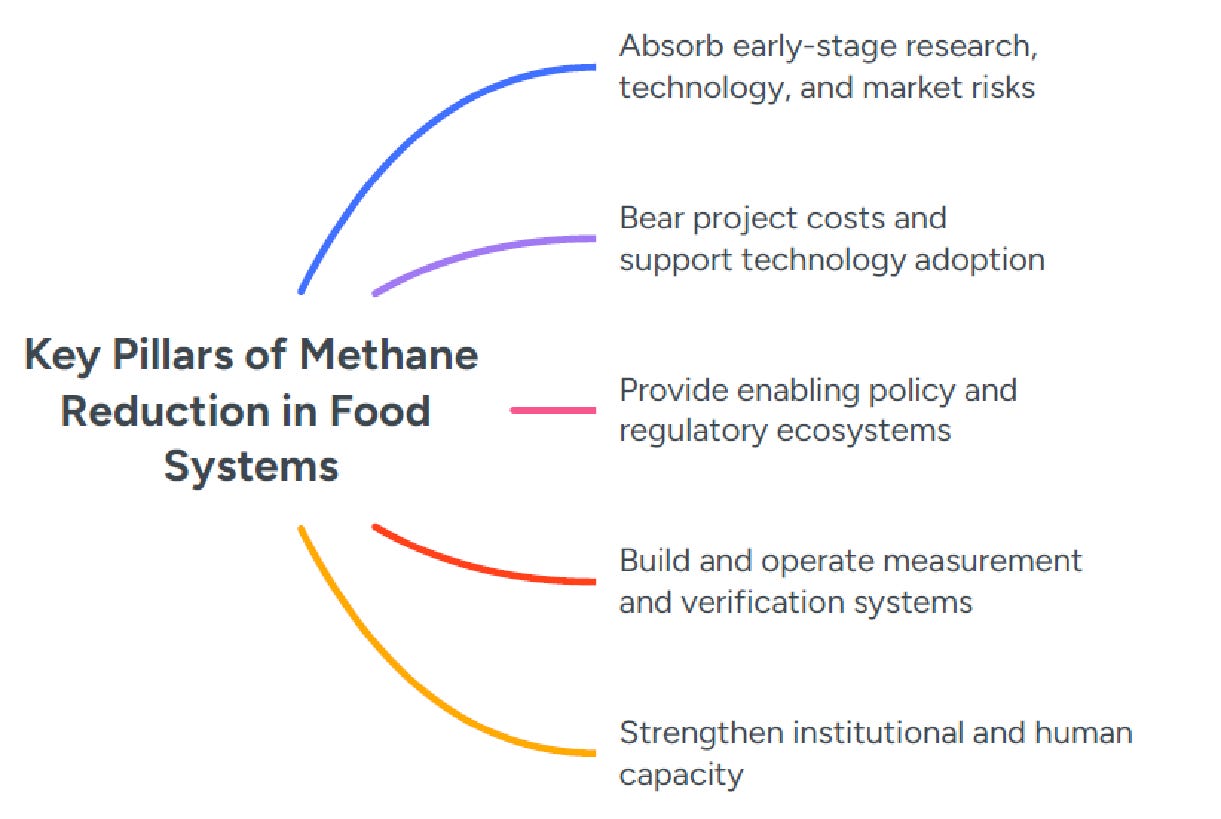
Companies cannot fix an unclear and fragmented landscape alone. Solving a systems-level challenge requires a systems-level response. This guidebook discusses how philanthropy and NGOs are pivotal structural enablers to reduce risk, redistribute risk, and lower transaction costs in ways that promote long term private-sector methane action at scale. Across five pillars — research and development innovation, project costs and technology implementation, policy and regulatory systems, measurement and verification systems, and capacity building — these actors can absorb early uncertainty, coordinate fragmented stakeholders, and build shared mitigation focused outputs and results that markets alone undersupply.
Bridge the Research and Development Gap
The Corporate Challenge:
Economic considerations are central for decision making by food companies. They often operate in markets which are highly competitive and price sensitive. In the absence of strong incentives such as lower input prices, high demand for low-methane products, companies can struggle to justify the commercial case for high risk and early-stage investments with extensive field testing and regulatory approval prior to commercialization. Technology readiness also constrains progress. While a growing range of methane mitigation solutions exists, effectiveness can vary significantly across production systems.
Philanthropy’s Role:
Philanthropy is uniquely positioned to provide non-dilutive capital capable of absorbing scientific and commercial uncertainty. Unlike other funding sources, philanthropic capital tolerates long time horizons, high failure rates, and unclear commercialization pathways. When strategically deployed, it supports foundational research, field trials, and interdisciplinary and multistakeholder collaborations. Global-access IP arrangements further enable the industry to benefit from the innovation, increasing uptake across production systems and improving the climate return on capital.
NGO’s Role:
NGOs serve as coordinators of scientific research, platforms for stakeholder engagement, and fundraisers for innovative solutions. By engaging researchers, philanthropies, academia, startups, governments, and corporate actors around shared research agendas, technology innovations, standardized methodologies, and common metrics, they co-develop knowledge products and accelerate knowledge transfer across production systems.
Case Studies:
The Enteric Fermentation R&D accelerator was set up by the Global Methane Hub in partnership with the Bezos Earth Fund, Gerstner Philanthropies, High Tide Foundation, Gates Foundation, Danone and other partners. What makes this cross-sector collaboration distinctive is the breadth of funding sources, and the rigor embedded in its structure. A Science Oversight Committee (SOC), which draws on technical expertise from various domains including non-profit think tanks such as Spark Climate Solutions, guides the research strategy across seven priority areas including inhibitors, genetics, vaccines, feedstuffs, and rumen microbes. This model allows private sector companies like Danone to access breakthrough research and innovation across diverse livestock systems without bearing the full R&D risk.
Another important initiative involving a consortium is the Greener Cattle Initiative by the Foundation for Food and Agriculture Research (FFAR), which supports research to mitigate enteric methane emissions. What stands out here is the initiative’s funding architecture, which combines an FFAR award and pooled matching funds from Nestlé, Global Methane Hub, JBS USA, Elanco, Genus PLC, and Council on Dairy Cattle Breeding (CDCB), among others. The diversity of this collaboration, with varied actors jointly financing a shared research agenda, speaks directly to the coordination logic at the heart of this pillar.
Support Project Implementation and Technology Adoption
The Corporate Challenge:
Reducing and measuring methane emissions requires investments at the farm level, including anaerobic digesters, manure separators, composting systems, and methane measurement chambers for rice cultivation. Aside from these costs, soft costs including permits, legal fees, environmental assessments, and ongoing operations management can be significant. For global food companies sourcing from diverse regions, understanding and supporting location-specific processes across thousands of suppliers is challenging. Corporate sustainability and procurement teams often lack the capacity and local knowledge to act effectively.
Philanthropy’s Role:
Philanthropic capital is well suited to absorb some of the transaction and equipment costs that are essential for project implementation but do not generate near-term cash flows. Deployed catalytically, it can finance the purchase and installation of farm equipment and inputs, oversee contracting and permit processes, and support the development of monitoring and verification frameworks and digital aggregation platforms.
NGO’s Role:
With strong local networks and established relationships, NGOs are well placed to manage farmer engagement, deploy technology and infrastructure, and oversee project implementation on the ground. They can also aggregate producers, enable financial support for farmers, coordinate activities with local governance, and ensure environmental and social safeguards are met.
Case Studies:
The International Rice and Research Institute (IRRI) work in developing countries highlights how a research institution can bridge the gap between knowledge and on-the-ground adoption. Its partnerships with government ministries, academic and research institutions, and local partners are driving adoption of low-emission rice practices in rice producing countries in Asia. Under a partnership with Bayer Crop Science and others, IRRI provided farmers with a direct seeded rice (DSR) package which included improved rice varieties, machinery, and weed management tools. The value of this model lies in diagnosing specific farm-level barriers including climate risks, water scarcity, and labor constraints, and delivering tailored solutions to address them.
A case study from Thailand illustrates the importance of financial de-risking at the farm level as an incentive for technology adoption. Under recent climate-smart rice initiative implemented in partnership with Deutsche Gesellschaft für Internationale Zusammenarbeit (GIZ), the Bank for Agriculture and Agricultural Cooperatives (BAAC) has introduced climate-smart loan products with preferential interest rates for eligible farmers, alongside support funds allocated in accordance with the scale of technology uptake. By pairing technical assistance with accessible financing, the initiative addresses the inability of smallholder farmers to absorb the upfront cost of transitioning to lower-emission production methods at the farm level.
Leverage Policy and Regulatory Ecosystems
The Corporate Challenge
At the international level, several countries have joined the Global Methane Pledge - participants agree to take voluntary actions to contribute to a collective effort to reduce global methane emissions by at least 30% from 2020 levels by 2030. The pledge recognizes the essential role the private sector, philanthropy, and institutions play in supporting the implementation of the pledge.
For the private sector food companies that are sourcing inputs from diverse areas, national level policy and regulatory environments can add further complexity. Commitments, policies, and regulations may vary across countries and regions. Differing methane reduction approaches, complex regulatory systems, and layered local governance structures can create uncertainty around expectations, support, and compliance risks for companies considering long-term investments. The capital necessary for comprehensive Scope 3 tracking is difficult to secure. Private sector efforts often remain confined to isolated pilot initiatives instead of systemic emission reduction efforts.
Philanthropy’s Role
Beyond derisking corporate investment, philanthropies are well positioned to provide flexible grants that support government efforts to implement Nationally Determined Contributions (NDCs), national climate and resilience building policies, and related methane reduction initiatives. They drive multistakeholder engagement and advocacy efforts to embed methane reduction within national agendas. Through supporting pilot studies in selected regions, philanthropies can develop theories of change, generate data, and provide recommendations that enable government ministries and organizations to build and refine policy and regulatory frameworks supporting methane-related projects. Taken together, these actions send a strong signal to the private sector that adequate government support will be available when making investments and undertaking emission accounting and disclosures.
NGO’s Role
NGOs bring an evidence generation and translation function that is critical at the policy level. Through sector-specific methane assessment studies at the national and local levels, they can present evidence on the status of emissions, mitigation scenarios, and impact. By collating findings from pilot studies conducted by philanthropies and corporate actors, they distill insights into concrete policy recommendations, which are then used to lobby for national agricultural reforms aligned with farmer livelihoods and integrated with resilience building efforts. At the industry level, NGOs also create platforms for leaders to share methane reduction best practices and resources, identify collaboration opportunities, and strengthen accountability against global and national climate commitments.
Case Studies:
A recent Good Food Institute (GFI) engagement in Singapore exemplifies the power of sustained, evidence-based dialogue to shift regulatory outcomes. By collaborating with halal authorities over the years and sharing insights about cultivated meat, GFI contributed to a landmark ruling that cultivated meat can be categorized as halal given certain conditions are met. The broader implication for the private sector is significant: with halal demand being substantial, this ruling opens new consumer markets and creates a clearer incentive for alternative protein companies and retailers to invest in cultivated meats.
The U.S. Food Loss and Waste 2030 Champions group, formed by the U.S. Department of Agriculture (USDA) and U.S. Environmental Protection Agency (EPA) in 2016, illustrates how a government-anchored framework can organize and scale corporate climate action. The group’s target to accelerate national efforts to reduce food loss and waste by 50% by the year 2030 has since catalyzed commitments from over 40 companies to reduce food loss and waste in their own operations. In many instances, these companies receive support from local non-profit organizations and private foundations to recover food waste, divert it from landfills, and use it to address food insecurity. Several companies are also pursuing composting, animal feed, or anaerobic digestion. Some of these companies have also joined the World Resources Institute’s global 10x20x30 initiative where food retailers, providers, and suppliers commit to “Target-Measure-Act” approach through reducing food loss and waste by 50% in their own operations and measuring and publishing inventories. Taken together, this progression from national policy target to corporate commitment to NGO and philanthropy supported implementation reflects exactly the kind of layered coordination this pillar advocates for.
Strengthen the Accountability Layer
The Corporate Challenge:
Building credible and accessible Measurement, Reporting, and Verification (MRV) systems is critical to establish reliable emission baselines, track progress and performance, quantify climate impact, and unlock finance and incentives for farmers and innovators. But methane emissions from food systems are difficult to quantify accurately, as they vary depending on geography, production methods, and biological processes. Many companies rely on emissions factors rather than direct measurement.
In the absence of standardized and low cost MRV, transparency becomes a liability. With growing scrutiny around greenwashing, food companies face accusations of overstating emissions reduction or insufficient third-party verification. At the same time, verifying each ton of methane reduced can be costly and administratively burdensome, driving up transaction costs and slowing action.
Philanthropy’s Role:
Funding the development and deployment of data infrastructure, including high-resolution satellites, methane detectors, and sensors, is well suited to philanthropic capital, as it generates baseline data that benefits the industry as a whole rather than any single actor. Subsidizing measurement tools in this way lowers cost barriers for suppliers directly, while enabling the creation of science-based MRV protocols that steer the field toward direct and verifiable measurement.
NGO’s Role:
NGOs create and manage shared platforms that give food companies access to the same tools and guidebooks, minimizing duplication of effort and ensuring that companies reference comparable language when reporting to global benchmarks. Beyond platform management, NGOs serve as independent third-party verifiers, bringing the credibility needed to ensure emission calculations are robust and reliable.
Case Studies:
The Dairy Methane Action Alliance (DMAA) launched in collaboration with Environmental Defense Fund (EDF), addresses one of the more persistent gaps in corporate climate action — the absence of standardized, accessible guidance on methane accounting and disclosure. By bringing together member food companies through commitments to account for and disclose methane emissions in their supply chains and develop methane action plans, the DMAA creates a collective accountability framework. What anchors this commitment in practice is the open-access guidance the alliance has developed. A key resource developed by the alliance is open access guidebooks on dairy methane accounting and disclosures. These guides provide best practices and detailed stepwise instructions for a company to develop a methane inventory from their GHG inventory and publicly disclose methane emissions in alignment with ESG frameworks. These resources lower the technical barrier for companies, replacing fragmentation with a common standard.
Carbon Mapper, a nonprofit funded by the Bloomberg Philanthropies and others, represents how philanthropic capital can be deployed to build data infrastructure as a public good. Using remote sensing technology to detect and quantify methane emissions at the scale of individual facilities, it makes data publicly accessible across sectors. What makes this case worth examining carefully, however, is what it also reveals about the limits of current technology. Carbon Mapper acknowledges the difficulty of detecting and pinpointing emissions from key agricultural sources like livestock. This gap highlights where the next round of philanthropic investment in MRV infrastructure is most needed.
Build Capacity as an Adoption Lever
The Corporate Challenge
Climate action is often at a slow pace because of the underlying policy environment and human and institutional constraints. For instance, farmers may lack understanding, knowledge, and skills to use the technologies and are unable to receive adequate training support from local cooperatives and extension systems.
Implementation success depends on diagnosing and addressing existing capacity gaps.
Philanthropy’s Role
Philanthropy funds the independent, multi-level diagnostics needed to establish a reliable baseline of capacity needs. This diagnostic work spans three dimensions:
Enabling Environment: Identifying policy gaps and regulatory hurdles at the national and local levels
Organizational Level: Assessing whether state and local organizations such as extension systems and farmer support organizations have the technical, financial, strategic, coordination, and operational capacity to support technology implementation on the ground
Individual Level: Analyzing the technical and behavioral readiness of farmers to adopt the technology
Once the specific barriers have been identified, philanthropies engage with stakeholders to develop a capacity building roadmap. Beyond needs assessment, they also provide financial support to food companies, NGOs, and governments to conduct structured workshops on specialized topics for local actors, using a training-of-trainers approach to ensure sustainable outcomes.
NGO’s Role:
NGOs can operationalize and implement the capacity needs assessment survey funded by philanthropies. As a first step, NGOs work with their local networks to map the relevant actors and players which will be part of the survey. Survey findings then inform key recommendations on addressing capacity gaps across the enabling environment, organizational, and individual levels, which are shared with stakeholders and translated into concrete action items as part of the roadmap. Local NGOs also collaborate with philanthropies and private companies to develop location and context-specific training materials and identify resource persons for technical workshops. Strengthening local institutional mechanisms is an equally important focus. This includes engaging local extension systems and representatives from administrative government units to understand local needs and challenges and build awareness of methane reduction interventions.
Case Studies:
IFPRI’s food system institutional mapping and capacity assessment in Niger is the kind of foundational work that needs more attention in corporate sustainability discussions. By providing key aspects and indicators that can be referenced to design surveys for specific geographies/technologies/climate change goals, it offers a replicable framework for understanding local conditions before committing to interventions. For a global company, this kind of data changes the quality of investment decisions. Rather than directing resources toward hard infrastructure without understanding the enabling conditions, companies can use such assessments to identify capacity gaps that need to be addressed first. Treating this kind of diagnostic as a prerequisite rather than an afterthought is an important perspective shift to ensure investments yield the desired outcomes.
The ‘Supporting Trusted Engagement and Partnership (STEP) up for Agriculture (STEP up for Ag)’ launched by major food companies PepsiCo, Unilever, and others, with catalytic funding from the philanthropic partners (Pepsico Foundation and Platform for Agriculture and Climate Transformation (PACT)) makes a related point through the lens of implementation. Rather than starting with a diagnostic, the program starts with a recognition that the success of food system sustainability efforts rests on local buy-in, and that farmer-led, farmer-facing organizations are critical to ground-level implementation. By strengthening the capacity of these organizations, the program treats trust as a strategic asset. Unilever’s implementation of STEP in the state of Iowa demonstrates this premise in practice by equipping local farmer support groups with training, tools, and funding to scale regenerative agriculture.
The following roadmap outlines how philanthropy and NGOs can provide targeted and sustained support to move food companies from isolated pilots toward systemic methane reduction at scale.
Innovation: Fund the Science that Markets will not
Remove proprietary barriers: Philanthropies must fill the funding gap at the initial phases of research and innovation, where commercial risk is high and private investment is limited. Equally important is what happens to the resulting innovations: global-access provisions should be embedded in philanthropically funded research from the outset, ensuring that advances in feed additives, genetics, and rice cultivation are accessible across diverse production systems rather than locked behind exclusive licensing arrangements that concentrate benefits and limit scale.
Bridge the funding gap for emerging tech: Sustain patient capital through the expensive middle phase of technology development, the point at which promising solutions most commonly stall, to clear the path for private sector engagement once performance is demonstrated.
Technology: Lower Entry Costs for Corporate Action
Absorb the soft costs: Finance key activities that companies struggle to justify internally, such as baseline data collection, feasibility studies, independent field trials, and permits and regulatory approvals.
Support technology adoption: Invest in or enable financial support for mitigation technologies including anaerobic digesters, manure management systems, methane measurement chambers, climate resilient crop varieties, and sensor networks that create the operational foundation on which corporate commitments can be reliably built and verified.
Policy: Integrate Corporate Action with National Commitments and Strategies
Integrate corporate action with national climate agendas: Fund and undertake sector-specific methane assessments that equip government bodies with the evidence needed to formally integrate methane reduction strategies into existing government commitments, such as Nationally Determined Contributions (NDCs), subsidy frameworks, and national agriculture strategies. This alignment turns voluntary corporate efforts into recognized contributions toward national targets.
Build collaboration spaces: Convene multistakeholder platforms for corporations, supply chain actors, and governments, with support from NGOs and philanthropies, to share industry best practices and align baselines, methodologies, and disclosure norms.
Accountability: Treat Data Infrastructure as a Shared Foundation
Standardize measurement tools: Develop high-quality, open-access data infrastructure and common reporting protocols. Shared standards reduce the administrative burden on companies and eliminate the risk of conflicting measurements or reporting inconsistencies.
Utilize independent verification: Engage NGOs as objective third-party evaluators for a robust MRV system. This builds the public and investor trust necessary to unlock large scale climate finance, protects companies from greenwashing claims and creates momentum toward building carbon markets.
Capacity: Invest in Human and Institutional Readiness
Conduct multi-level methane mitigation needs assessment: Fund independent mapping and needs assessment surveys to identify capacity gaps across the enabling environment, organizational structures, and individual readiness. Key insights from this baseline data are essential for designing tailored intervention roadmaps that address specific local barriers to adoption.
Build local expertise to sustain adoption: Prioritize institutional strengthening alongside individual training, supporting local extension systems, cooperatives, administrative bodies, and farmers with the technical knowledge and coordination capacity needed to sustain adoption well beyond the life of any single project.
Methane reduction in food systems requires the right actors stepping in to share the risk, build the infrastructure, and create the conditions for sustainable action.
Have you seen collaboration models that work at scale?
I am currently seeking my next opportunity in project management, advisory, or communications and advocacy, and would welcome conversations with individuals working on food systems transformation, methane mitigation and resilience building, and cross-sector engagement.
Connect with Nandita on LinkedIn or directly at nsrivastava06@gmail.com.