


Self-Host Weekly is sponsored by PikaPods, the instant open source hosting service. Run a large selection of open source apps within seconds from just $1.20/month. Server administration, updates, and backups are all taken care of, leaving you in control of your data. Try it today with $5 free welcome credit!
Privacy, cost, convenience, and flexibility were all common responses from users when asked why they self-host in this year's annual survey. Couple this with the number of new projects marketed as "I grew tired of X so I built Y" and a pattern emerges – the rationale behind self-hosting for many often isn't what it has to offer, but rather what it doesn't have to offer (lack of privacy, hidden costs, walled gardens, etc.).
And while there's nothing inherently wrong with this, I've noticed at times it can take away from some of the crazy and cool things people have created (even if it's occasionally AI slop). I find myself guilty of it, too, which is why so many of the topics covered in this newsletter are tech-adjacent and only loosely related to self-hosting.
However, this week – instead of getting riled up over Jeff Bezos' prediction that cloud computing will replace physical machines – I spent my time diving into IRC (welcome to 1995) and deployed ZNC and The Lounge for a fully-functional bouncer/client deployment. And despite not being able to find active communities to participate in (IRC might actually be dead), I reveled in the process of researching options, deploying apps, troubleshooting errors, and finally making contact with what I'm sure was a server full of bots anyway.
So in an effort to celebrate what self-hosting is rather than what it isn't, below are some updates, launches, and recommendations focused entirely on self-hosted platforms in place of the usual smattering of related topics that most people will have forgotten by Monday:
- Nametag, a personal relationship manager for all the friends self-hosters are notorious for having, launched this past week and filled the void left in many of our lives by Monica (which reminds me – whatever happened to Chandler?)
- Calibre-Web Automated Downloader, a platform for downloading free (and definitely not pirated) books, has been rebranded to Shelfmark
- In their 2025 recap, the team behind qui – a sleek new qBittorrent frontend and multi-instance manager – announced they're working on an *arr replacement (quirr?)
- The developer of BentoPDF addressed a surge in similar projects utilizing its tools under the hood without proper attribution (the project also just hit 10k stars – in less than three months!)
- A wild Forecats appeared – a Home Assistant integration for generating themed pictures of cats representing the day's weather forecast (my favorite Reddit take from the launch post: this is the reason 2 sticks of ram cost as much as a used car)
- NocoDB (low-code database/spreadsheets) finally released dark mode...in a bug fix release?
- Youlag, a novel take on alternative YouTube frontends via FreshRSS plugins, has been making the rounds given a recent batch of updates (definitely worth checking out if you're a YouTube junkie)
- C.A.F.E., a visual automation builder/editor for Home Assistant, made me question why this functionality isn't already built in to the platform
- There's a new mobile music streaming client on the block for Jellyfin and Navidrome named Yuzic (spoiler alert: it's pretty)
- Mattermost recently imposed a 10,000-message limit (that may or may not be avoidable by switching to a different edition?), so someone developed a CLI tool to assist users with making the switch to Matrix
- A newsletter reader recently introduced me to an all-in-one Anytype deployment for self-hosters interested in the Notion-like platform but a bit intimidated by its official deployment process
Happy selfh.st/ing!
Newswire
Cloudflare defies Italy’s Piracy Shield, won’t block websites on 1.1.1.1 DNS
Italy fines Cloudflare 14M euros for not blocking pirate sites on 1.1.1.1 DNS service.
 Jon Brodkin

Stop using MySQL in 2026, it is not true open source
If you care about supporting open source software, and still use MySQL in 2026, you should switch to MariaDB like so many others have already done.\n
 Optimized by OttoOtto Kekäläinen

Raspberry Pi’s new AI HAT adds 8GB of RAM for local LLMs
Today Raspberry Pi launched their new $130 AI HAT+ 2 which includes a Hailo 10H and 8 GB of LPDDR4X RAM. With that, the Hailo 10H is capable of running LLMs entirely standalone, freeing the Pi’s CPU and system RAM for other tasks. The chip runs at a maximum of 3W, with 40 TOPS of INT8 NPU inference performance in addition to the equivalent 26 TOPS INT4 machine vision performance on the earlier AI HAT with Hailo 8.


Partner update: HELTUN removed from Works with Home Assistant
In the interest of transparency, we’re announcing the formal removal of HELTUN from the Works with Home Assistant program.
 Home AssistantMiranda Bishop

A newbie’s guide to self-hosting with YunoHost. Part 3: Let’s install NextCloud
A step-by-step visual guide for self-hosting newbies that shows off how to install NextCloud via the YunoHost system
 Elena RossiniElena Rossini

2025 Summary & Future Plans | Defguard Blog
A look back at Defguard’s achievements in 2025 and a preview of what’s coming in 2026, including the 2.0 release with easier deployment and UI redesign.
 defguardRobert Olejnik

New Container: Steam | Info :: LinuxServer.io
We have released a new container for Steam! This container is for Intel/AMD users initially. Steam is the ultimate destination for playing, discussing, and creating games.


What came first- the CNAME or the A record
A recent change to 1.1.1.1 accidentally altered the order of CNAME records in DNS responses, breaking resolution for some clients. This post explores the technical root cause, examines the source code of affected resolvers, and dives into the inherent ambiguities of the DNS RFCs.
 The Cloudflare BlogSebastiaan Neuteboom

Bandcamp Bans All Music Made with AI
Bandcamp has announced that music and audio that is generated wholly or in substantial part by AI is not permitted on its platform.
 ConsequenceChris Coplan

Content Spotlight
Meet Rackula, a web-based drag-and-drop server rack visualizer. With Rackula, users can easily build, plan, and visualize the layout of a physical server rack from the comfort of a browser. Features include various device types (server, networking, storage, power, KVM, AV, cooling, shelves), front/rear rack planning, various rack sizes, device images, and more.
Rackula can be easily deployed via Docker and doesn't require additional storage as configurations are saved via unique URLs and downloadable ZIP files.
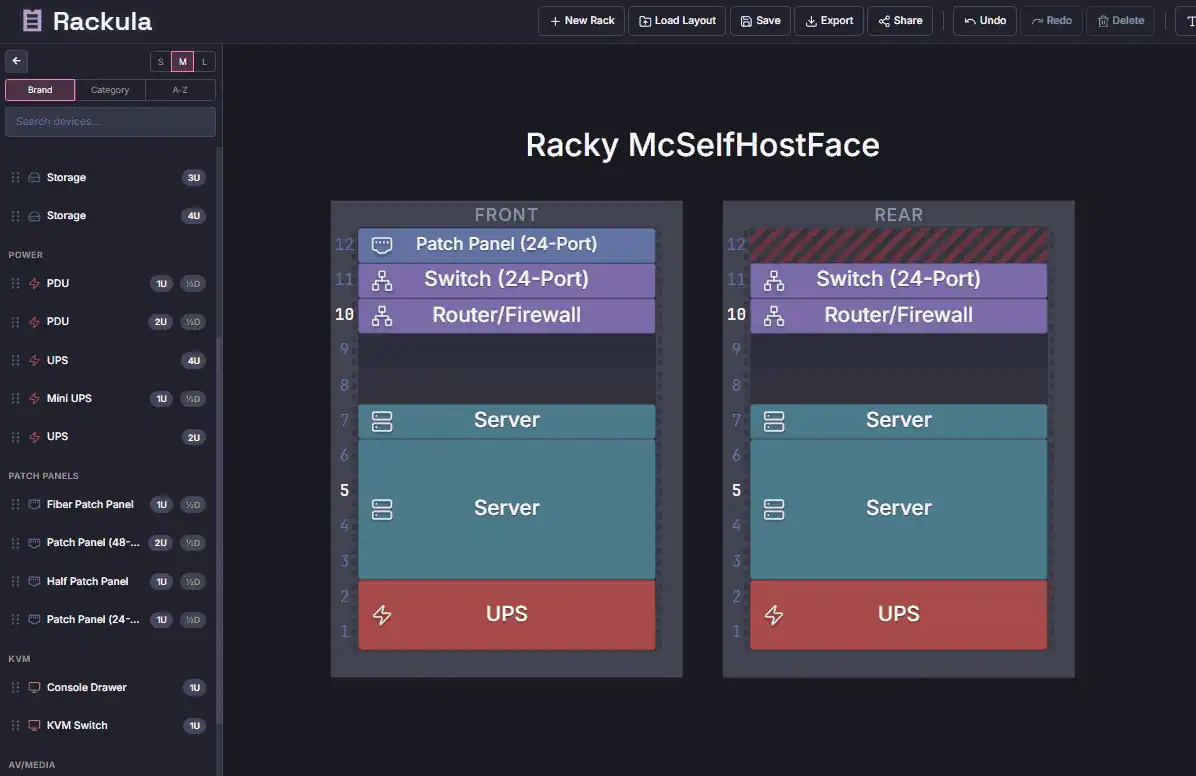
Links: Source Code, Demo
Videos and Podcasts
- Koffan: Ultra-Lightweight Self-Hosted Shopping List App for Docker | DB Tech
- Best Self-Hosted Apps of 2025 | The Top New Containers You Should Know | Servers@Home
- The Scariest Thing in My Homelab Isn’t the Power Bill | SYNACK Time
- Joplin Notes: Open Source Notes Without Lock-In | Lawrence Systems
- Things I Stopped Self-Hosting (And Why Cloud Won in My Home Lab) | VirtualizationHowTo
- How to Install Karaoke Eternal on Unraid (Self-Hosted Karaoke) | AlienTech42
- 5 Things I Wish I Knew Before Self Hosting | Hardware Haven
Command Line Corner
Use diff -u file1 file2 to quickly compare differences between two files:
$ cat example.txt
  self-
  host
  weekly
$ cat example2.txt
  self
  host
  weekly
$ diff -u example.txt example2.txt
  -self-
  +self
  host
  weekly
Click here for an archive of commands shared in past newsletters.
Thanks to following executive sponsors, whose continued support makes this newsletter possible:
I'm always looking for new and existing self-hosted content to share in Self-Host Weekly. Reach out using the button below if you'd like to have your own content featured or have a suggestion for content types you'd like to see featured in future newsletters.