


Self-Host Weekly is sponsored by PikaPods, the instant open source hosting service. Run a large selection of open source apps within seconds from just $1.20/month. Server administration, updates, and backups are all taken care of, leaving you in control of your data. Try it today with $5 free welcome credit!
Happy new year! Despite being a busy week in software development (35+ new project launches in today's newsletter!), I found the news cycle to be a bit slow (I blame Stranger Things and Indiana's CFB dominance).
In lieu of this, enjoy a brief list of resolutions I've made on behalf of the self-hosted community for 2026:
- Projects will no longer be named ending in arr or rr
- Projects will no longer be rebranded as The AI <blank> Platform
- Projects will no longer brand themselves as modern or opinionated
- Users will stop the barrage of AI slop accusations at the first sign of emojis
- Users will stop suggesting Linux as a realistic alternative to Windows for non-technical users
- Users will stop referring to Docker containers as dockers
- Users will stop brown-nosing developers with 'appreciation' posts and begin regularly donating to projects instead
- Dan Brown (of BookStack fame) will finally rename his feed aggregation project to something less generic than RSS
If you missed it, I also published a comprehensive list of (almost) every new project launch covered by this newsletter in 2025, as well as a growing list of self-hosted tools that offer year-in-review-styled statistics:
2025 Wrapped: Self-Hosted Software Launches
A semi-comprehensive list of self-hosted software launches from 2025
 Ethan Sholly

2025 Wrapped: Self-Hosted Year-in-Review Tools
A growing list of tools for visualizing self-hosted metrics in a ‘year-in-review’ style
 selfh.stEthan Sholly

Other Highlights
- A critical MongoDB security vulnerability was found a few days after Christmas (update if you haven't already!)
- Visual Studio Code rebranded itself as the open source AI code editor (they clearly didn't receive the memo above)
- Someone created a Home Assistant integration that allows users to control their automations (turning lights on, etc.) with a Harry Potter Magic Caster Wand
- Maker Management Platform (digital asset manager) is seeking a new maintainer
- A rack-building visualization platform mentioned last week has been renamed from Rackarr to Rackula (they clearly received the memo above)
- I revisited my favorite self-hosted copypasta from 2025 (credit to Reddit user u/No-Raccoon-1993)
Happy selfh.st/ing!
Newswire
MongoDB Server Security Update, December 2025
The following is an update on the security vulnerability identified in December 2025.


Introducing My Self-Hosted Setup
Introduction After years of self-hosting practice, I’ve gradually formed a stable and reliable deployment solution. This article mainly introduces the cloud deployment part, while the on-premises environment is mainly used for backup and learning/testing. The entire architecture follows these core principles: Simplicity First: Avoid over-engineering, use simple solutions when possible Reliability Priority: Stable operation is more important than fancy features Regular Maintenance: Update all services to the latest version every Friday Single-node Deployment: Focus on reliability and fast recovery rather than high availability Daily Backups: Automated backups with multi-location redundancy Fast Recovery: Ensure services can be restored from backups in a short time


New Container: VSCodium-web | Info :: LinuxServer.io
We have released a new container for VSCodium-web! VSCodium-web is a community-driven, freely-licensed binary distribution of the remote host web component of Microsoft’s editor VS Code.


How monetr’s similar transactions work
A technical deep-dive into how monetr detects similar transactions offline and without AI.


How I think about Kubernetes
More than a container orchastrator
 Georgi Arnaudov

A beginner’s guide to Mastodon, the open source Twitter alternative | TechCrunch
Mastodon has almost doubled its userbase since Elon Musk took control of Twitter last month. Here’s what you need to know about the platform.
 TechCrunchAmanda Silberling

Content Spotlight
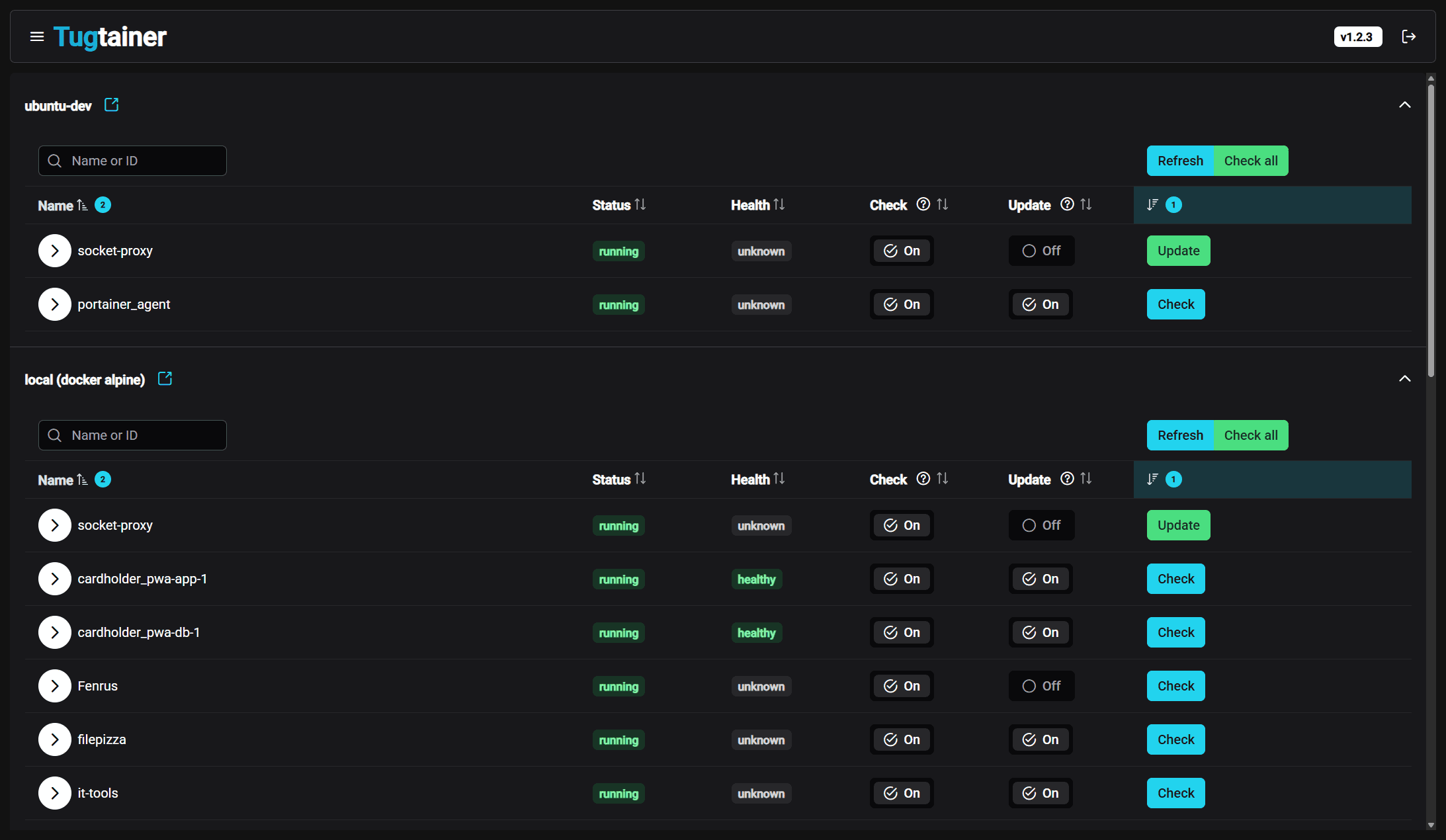
Meet Tugtainer, a self-hosted platform for monitoring and managing Docker image updates. With Tugtainer, users are given a minimal web interface with a list of running containers and the ability to automatically (scheduled) or manually trigger update checks (with the option to only apply them to individual containers). Features include support for remote hosts, socket proxy support, Crontab scheduling, notifications, per-container configuration, private registries, and image pruning.
Tugtainer can be easily deployed via Docker and requires a separate agent when deploying across remote machines.
Links: Source Code
Videos and Podcasts
- UniFi Firewall Defaults Are Too Open: Here’s How to Lock Them Down | Lawrence Systems
- Installing Colanode | TrueNAS Community Edition 2025 | Servers@Home
- Finally, a Portainer-Friendly Way to Deploy NetBox! | SYNACK Time
- Why EVERY Home Needs an Unraid Server in 2026 (Seriously) | AlienTech42
Command Line Corner
Use id -u to display your user's numeric ID from the command line:
$ id -u
  1001
Click here for an archive of commands shared in past newsletters.
Thanks to following executive sponsors, whose continued support makes this newsletter possible:
I'm always looking for new and existing self-hosted content to share in Self-Host Weekly. Reach out using the button below if you'd like to have your own content featured or have a suggestion for content types you'd like to see featured in future newsletters.