









This article was first published in Arabic on 7iber by Reem Almasri - April 21, 2025.
Since opening its offices in Israel in 2013, Google has shown ongoing admiration for the state's role in the global tech scene. Early Google CEO Eric Schmidt has repeatedly praised what he sees as a "miracle", a small country outperforming industrial giants. In 2017, on the tenth anniversary of Google’s R&D center in Israel, Schmidt stated: “Israel succeeds because it doesn’t follow the rules.” A year later, at a Tel Aviv conference, he shared what he called the formula for success: “It begins with extraordinary talent and excellent education. It continues through military service, particularly in Unit 8200, which provides a significant advantage.”
Google’s acquisition of the Israeli company Wiz in March of this year is further evidence of its admiration for what it sees as a tech success story. The $32B deal is the largest in the history of both Google and any Israeli company. Media outlets in the West and in Israel openly celebrated the backgrounds of Wiz’s founders, especially Assaf Rappaport. He served in Unit 8200, the Israeli military’s cyber intelligence unit. This is the same unit behind the development of "Lavender," a program reportedly used by the Israeli military to generate large-scale target lists in Gaza. The system relied on AI to identify individuals based on their proximity to resistance fighters, using intercepted communications from Gazans.
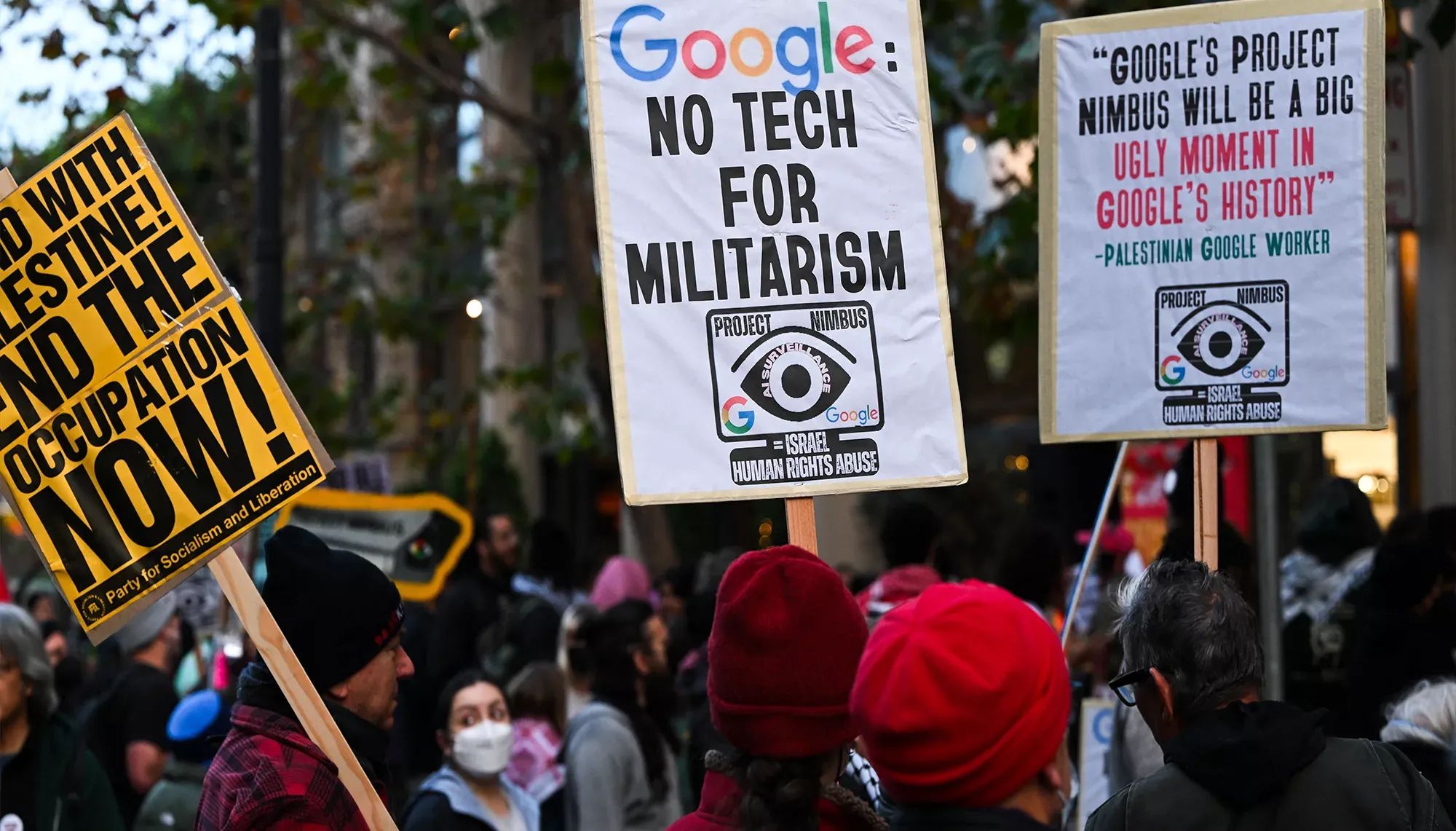
Since Israel launched its genocidal war on Gaza, other collaborations between major Silicon Valley companies and the Israeli war ministry have resurfaced under public scrutiny. The most notable is the "Project Nimbus" contract signed in 2021 between Google, Amazon and the Israeli government, initially worth $1.2B. Through Nimbus, Google provided cloud computing and advanced AI capabilities to the Israeli government that were likely used to operate the "Lavender" program, as indicated by AccessNow, Antony Loewenstein, and The Intercept.
As in previous cases of human rights concerns, Big Tech companies respond with denial and claim no responsibility for how their infrastructure is used by governments. However, a leaked document has revealed that Google understood the risks of “how Israel might use its technology to harm Palestinians”. Examining Google’s acquisition history and investments in Israeli companies reveals an organic, mutually beneficial relationship between the two. This relationship was born from the womb of settler-colonial policies even before the genocide, centered on the mutual need for technological skills and solutions that feed into expansionist and monopolistic agendas.
The role of Silicon Valley in enabling Israeli companies has long been known, with Google’s investment history and the career paths of former Israeli soldiers from Unit 8200 being a clear example. Many of them joined Google after their military service, later founding tech solutions and services that the company adopted. Some eventually became heads of departments within Google, reinforcing a cycle of influence between the Israeli military and the tech industry.
Two Decades of Investment and Acquisition
On the 60th anniversary of the Nakba in 2008, Google’s co-founder Sergey Brin promised to acquire Israeli tech companies. He kept his promise. In 2010, Google began acquiring Israeli startups, purchasing the digital game developer LapPixies for an undisclosed amount, estimated at $15 million. The acquisitions continued, reaching nine, with the most recent being Wiz, an Israeli company that develops cloud cybersecurity services.
It can be said that what Google seeks from Israel is its desire to expand its share in the cloud computing market and compete with the leading companies Microsoft and Amazon in this field. Most of Google’s acquisitions between 2018 and 2025 focused on Israeli companies offering cloud storage services, such as Velostrata, which Google acquired in 2018, and companies like Alooma that focus on cloud storage management, or Elastifile, which Google acquired in 2019. Google also acquired Israeli companies working in the cybersecurity field, with the first acquisition being Siemplify in 2022, which was the first cyber security company that Google acquired outside of the United States. This was followed by Wiz, which offers solutions for automating the detection of cyberattacks on the cloud.
Date of Google acquisition | Company | Year of Establishment | Acquisition Amount | Sector |
2010 | LabPixies | 2006 | $15 million | Entertainment gadgets |
2013 | Waze | 2013 | $1.3 billion | Navigation and GPS services |
2014 | SlickLogin | 2013 | Undisclosed | Sound-based identity verification |
2018 | Velostrata | 2014 | Undisclosed | Cloud migration technology |
2019 | Elastfile | 2014 | $200 million | Cloud migration technology |
2019 | Alooma | 2013 | $150 million | Data integration platform |
2021 | BreezoMeter | 2014 | $200 million | Big data to survey location-based air-quality |
2022 | Siemplify | 2015 | $500 million | Cloud security orchestration, automation and response (SOAR) provide |
2025 | Wiz | 2021 | $32 billion | Cloud security |
Google’s Investments in the Israeli Tech Sector
Google’s involvement in Israel’s emerging tech sector began in 2007 with the establishment of its R&D center in the country. Schmidt, who was then Google’s CEO, stated in 2018 that most of Google’s AI research was being conducted in Israel. Most recently, Google hired dozens of Israeli engineers to develop semiconductors aimed at reducing AI processing costs compared to those of Nvidia.
Google often supports Israeli startups by bringing them into its cloud computing incubators. For instance, out of the 15 startups selected for Google’s "AI-First Accelerator" program, three were Israeli. This program is part of an $8B funding initiative aimed at companies in Europe and Israel. Google often supports these companies with direct investment from Google’s investment funds (CapitalG or GV), or Eric Schmidt’s personal venture fund (Innovation Endeavor). In 2021, for example, CapitalG led a $210 million financing round for Ocra Security, an Israeli company.
That same year, after partnering with the Israeli company Cybereason, Google Cloud invested $50 million dollars into the firm. The goal was to strengthen its ability to provide services for detecting and verifying cyber breaches. Cybereason was founded in 2012 in Tel Aviv by Lior Div, a Unit 8200 veteran who received a Medal of Honor, allegedly for his role in developing the malicious worm "Stuxnet". Stuxnet was the malware that Israel and the United States co-developed and implanted in Iranian nuclear reactors in 2005. Drawing on his experience in the Israeli army, his company developed an intelligence unit to collect and analyze data, much like the military does. Div stated he wanted to use his military skills "to solve the world's problems, not just his country's. Today, his company also provides services and solutions to the American arms manufacturer Lockheed Martin.
Israeli Soldiers Running Google’s Divisions
These investments and acquisitions represent the fruits of a policy implemented by Netanyahu's government in 2017 aimed at establishing Israel as a global leader in leveraging cyberspace as an engine for economic growth, social welfare, and national security, according to the book "Israel and the Cyber Threat" authored by former national security advisors in Israel's war ministry. The authors clarify that service in Units 8200 and C4I of the Israeli army provides soldiers with practical opportunities to hone their skills in analyzing and testing intelligence data using artificial intelligence, with technical competencies unavailable in other markets - placing Israel's army second only to the United States in applying cyber capabilities across its extensive military operations.To illustrate the cloud computing and AI capabilities of these units' graduates, the book notes that the Israeli military collected approximately 10 terabytes of surveillance data daily during 2021 from Gaza and the West Bank, including satellite videos/images, one billion phone calls, two million photos, and half a million emails.
Schmidt's open admiration for Unit 8200 has prompted Israeli media and entrepreneurs to boast about their experience in this unit as a competitive advantage. For instance, Yair Weinberger, founder of Alooma, proudly cites his graduation from the elite "Talpiot" program offered by Unit 8200 to top university students, as do Amos Stern, Garry Fatakhov, and Alon Cohen - founders of Siemplify.
Just as these companies' services become integrated into Google Cloud's products, many of their founder-veterans join Google as division managers post-acquisition. From heading Unit 8200 to founding Siemplify, Amos Stern now serves as the Director of Google Cloud Security, while his co-founder managed Google Cloud Services in Israel from 2022-2025. Similarly, Velostrata founders Issay Ben-Shaul and Adi Degani joined Google for a few years after its 2018 acquisition - the former as the Google (Israel) director, the latter as senior product manager. The pattern holds for Alooma founder Yair Weinberger, who spent three years in Google's software engineering division post-acquisition.
Moreover, since Israel launched its genocidal war against Gaza and the West Bank, numerous Google, Microsoft and Meta employees have returned to Unit 8200 as reservists to develop AI tools processing massive volumes of Arabic-language conversations by monitoring Palestinians' communications across phone and internet networks.
Ultimately, Google and its investment funds aren't alone in Silicon Valley's pursuit of Unit 8200's talent. Between 2019-2023, Israeli startups secured about $32B in funding, over half from U.S. investment funds. The ongoing genocide campaign spanning 18 months has not deterred US merger and acquisition activity targeting Israeli companies. In 2024, the value of exit deals in the Israeli technology sector rose to $13.4B—compared to $7.5B the previous year—60% of which came from US acquirers.
Alongside Google, reports indicate strengthened ties between Microsoft and Israeli military post-genocide, with Microsoft employees training military personnel in AI applications. This reveals the structural relationship between Silicon Valley and Israel - merging Israels’ expansionist settler-colonial policies, with the Silicon Valley’s monopolies, both of them feeding on mass data collection, storage, and AI-driven analysis of user information.
If this article concerns you, check out NoTechForApartheid.com and see how to get involved or learn more.