







Published · 8 min read
An architect? According to Wikipedia, an architect is a person who plans, designs, and oversees the construction of buildings. So, we obviously have derived the role from civil engineering. In parallel, we derived software architecture which refers to the high-level structure of a software system. Over the years, the term has evolved far beyond its structural roots. It now touches on how systems adapt, scale, and serve human and organizational needs.
As you might guess, I donʼt think we need a formal architect role but an architecture. What we truly need are shared principles of design. Clarity, modularity, and communication rather than a gatekeeper. Before starting another dispute, letʼs watch the Matrix Architect Scene.
Cool stuff? Thatʼs well deserved for anybody who built a piece of software. Yup, you got it. I think any working software has some kind of architecture. Every class, API boundary, and deployment choice reflects a set of trade-offs. Intentional or accidental that ultimately define how the system behaves.
Whoa, then everybody is an architect? Well, yes and no. Yes, an architecture needs architect/s. No, I donʼt think we need to define a formal role and call everybody architects. Architecture isn’t a badge. It’s a lens, a way of thinking that connects decisions made today with consequences felt months or years later.
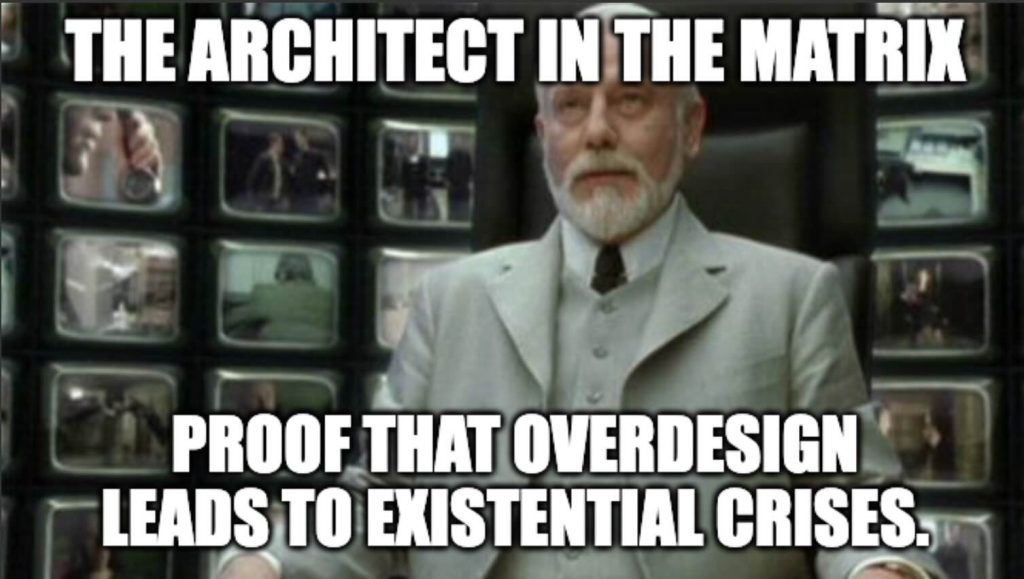
In The Matrix, the Architect represents control, order, and inevitability. Everything is bound by logic and symmetry. In software, we often face the same temptation: to overdesign, to predict every outcome, to eliminate uncertainty. Yet the most resilient systems are not the ones most controlled, but those that can adapt when reality diverges from the plan.
The lesson isn’t that we should imitate the Architect, but that we should challenge him. Real architecture breathes, evolves, and learns from its users. It’s less about drawing blueprints and more about cultivating an environment where structure emerges through iteration and shared understanding.
Going back to civil engineering. An architect designs a building more concerned about aesthetics, artistry and overall shape of construction. A civil engineer concentrates on the structural elements of the design. A builder makes the structure. Thatʼs it. No more definitions.
As you can see, these are well-defined roles and they are somewhat hierarchical. Do you think we have or should have such a hierarchy while developing software systems? Well, no. Software, unlike buildings, is not bound by gravity. It evolves continuously. Code can be refactored, deployed, and destroyed in seconds. The nature of creation here is iterative, not monumental.
Of course, an experienced engineer would have a different perspective than a recent graduate. However, these two engineers would both influence the software system they are building and should contribute to the architecture of the system. Every commit, naming convention, or service boundary adds a fingerprint of its author architecture and becomes a living document of collective decision-making.
If you want to name one of the architects and not the other, do you think that itʼs fair? Nope! So, a formal architect role isnʼt really fit in software development. Software is not a cathedral built once and admired forever; it’s a city that keeps expanding. The best engineers are urban planners as much as builders, balancing beauty, efficiency, and chaos.
If you think we only need a “software architect” title to emphasize seniority level, then I disagree. Most large tech companies already have clear, structured progression paths without formal architect titles. They typically look something like this:
Notice what’s missing: a formal “Architect” title. Because in most of these organizations:
And yet, architecture happens everywhere in those organizations through design reviews, cross-functional discussions, and shared conventions. The absence of a title doesn’t mean the absence of architecture; it means that ownership is distributed, embedded in the culture rather than assigned to an individual.
If we’re not defining architecture by titles, then what defines it? Good architecture isn’t about diagrams or frameworks but it’s about clarity, adaptability, and empathy. It should make change easy, not impossible.
Good architecture:
Great teams build architectures that are living organisms. They grow, adapt, and occasionally shed old skin to stay alive. A system that’s too rigid to change isn’t well designed; it’s merely frozen in time.
The goal of architecture isn’t control. It’s clarity. When everyone on the team understands the system’s purpose and direction, architecture becomes invisible. That’s when you know it’s working.
 Who needs an architect?
Once we strip away titles, we’re left with the real question. How does a team function without a central architect? What changes, what breaks, and what gets better? Let’s explore what truly drives good architecture inside teams.
Letʼs take principal engineers as architects and ask: do we really wait for principal/senior engineers to evaluate each piece of software we build? The short answer is no because they are working on their own projects. Good architecture can’t depend on a single bottleneck. It must emerge through shared responsibility and collective awareness.
Do we really need a proxy between customer and team? Why canʼt we sit all together with the customer and make a decision? I think it should be the team effort to understand fussy requirements and make concrete tasks out of them. Certainly, there will be people who will have more experience and can lead others from time to time but yet we donʼt have to call them architects. They are seasoned engineers. The best systems grow from proximity, not translation. When teams and stakeholders talk directly, architecture aligns with reality, not assumption.
In a team without an architect, do people struggle to write clean and quality code or is the system design phase abandoned? I think a good team should do design reviews first; then code reviews to share knowledge, increase code quality, and hear all voices. Design reviews are where architecture truly lives. It’s a continuous act of negotiation between trade-offs, risks, and constraints. With good communication and good distribution of engineers according to seniority level, quality software can be delivered without a formal role of an architect. When architecture becomes part of everyone’s daily thinking, you gain both consistency and adaptability.
Do we really need a formal architect for leadership and strategy? Well, arenʼt managers supposed to be the leader of the team and decide the strategy? I guess these two aspects are one of the reasons why we have managers. However, strategic technical direction shouldn’t come from management alone. It emerges from engineers who see the patterns beneath the product. Strategy and architecture are two sides of the same compass.
What about technical leadership? Since software development is like craftsmanship, craftsman (senior engineers) should share how to develop well-crafted software. So, we still donʼt need a formal architect role. Mentorship is the backbone of architectural maturity. When seniors teach design thinking, they create many small architects instead of one big one.
I donʼt think we need a separate role for just designing the architecture of a system. In my opinion, every member of the team should take part in architecture discussions and a team should come up with a design. Moreover, the architect role doesnʼt really need to indicate oneʼs seniority level. Architecture is a collective intelligence. An evolving dialogue between experience, creativity, and constraint.
All in all, goodbye architects, letʼs talk architecture. Because architecture is not a person; it’s a practice. And like any good system, it should never stop evolving.
此内容由惯性聚合(RSS阅读器)自动聚合整理,仅供阅读参考。 原文来自 — 版权归原作者所有。