







Published · 5 min read
If you are born and educated in Turkey, you meet Atatürk very early. He is on classroom walls, in textbooks, in ceremonies, in speeches, in national holidays. At first, you don’t really understand the scale of what he did. You learn the dates, the battles, the reforms, the famous lines. You know he founded the republic. You know he was important.
But importance is a strange thing when it is handed to you before you are old enough to understand it. It took me years to appreciate how rare he was. Not just as a soldier, but as a reformer. Not just as a founder, but as someone who tried to drag an exhausted nation into the modern world with science, education, culture, and civic life. The more I think about it, the more I realize how lucky Türkiye was to have him at that exact point in history.
He came at the right time. He saved a nation, then tried to rebuild its mind. I sometimes wonder what would have happened if he had lived five more years. Or ten. What else would have changed? What other reforms would have taken root? What problems would have been stopped before they became permanent?
The uncomfortable part is this: once someone like that leaves, the shoes are almost impossible to fill. That is probably why his words still matter. They are not just patriotic lines we memorize at school. At their best, they are reminders of the standards we keep failing to meet.
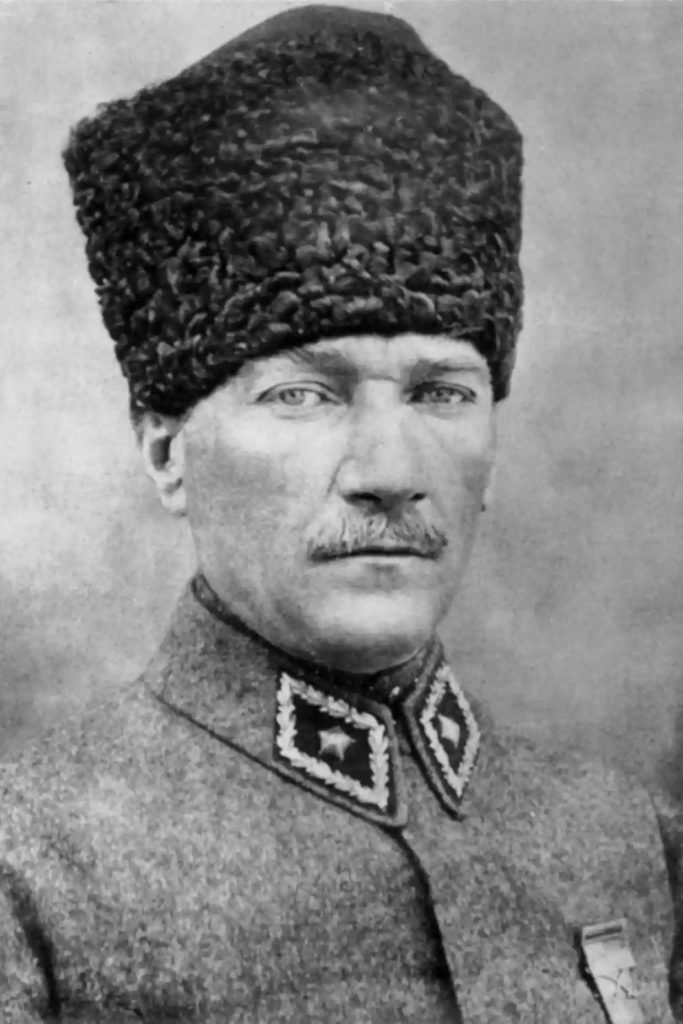 Mustafa Kemal Atatürk
Peace at home, peace in the world.
This is one of those lines that can sound almost too clean until you remember who said it. Atatürk was a soldier. He knew its discipline, its necessity, its stupidity, and its cost. That is why his idea of peace does not feel soft to me. It feels earned.
Many people praise peace because it sounds civilized. Many others praise war because they have never truly paid for one. Atatürk understood both sides better than most. He knew a nation must defend itself when its life is at stake. He also knew that war, when it is not essential.
Peace at home, peace in the world is a warning from someone who knew exactly what war takes from a people.
Everything we see in the world is the creative work of women.
This is another line that would be easy to dismiss as a nice sentence if Atatürk had only said it. But he did not just say it. He pushed women into public life when many countries still treated politics as a male inheritance. Turkish women gained the right to vote and be elected in municipal elections in 1930, and in parliamentary elections in 1934. That was before France, Italy, Belgium, Switzerland, and several other European countries.
That matters. A lot of leaders praise women in speeches. It costs nothing. The real test is whether the legal and social order changes after the speech is over. Atatürk seemed to understand that you cannot build a serious nation while keeping half of it ornamental. If women are educated, visible, and politically present, the country thinks with a fuller mind. If they are pushed aside, the whole society becomes smaller, no matter how loudly it talks about progress.
So this quote does not feel like empty admiration to me. It feels like a principle he tried to put into law.
If one day my words contradict science, choose science.
This is probably one of the most important things Atatürk ever said. A lot of founders, leaders, and revolutionaries want their words to become permanent. They want to be quoted, protected, repeated, almost fossilized. Over time, their ideas turn into scripture, and people start defending the sentence even after reality has moved on.
Atatürk seems to have understood the danger in that. He knew he had limits. He knew his words came from a specific time, under specific pressures, with the knowledge available to him. That is rare. It takes real confidence to tell people not to worship your words when they stop matching the truth.
For me, this is one of the clearest signs of his modern mind. Science was not decoration for him. It was the correction mechanism. The thing that should survive even when leaders, slogans, traditions, and old certainties fail. That is a serious standard. And honestly, we still struggle with it.
Some other quotes I like are as follows:
When we say ignorant, we do not mean those who have not studied in school. The science we mean is knowing the truth. Otherwise, just as the greatest ignorant people can emerge from those who have read, real scholars who see the truth may emerge from those who have never read.
Warfare must be essential and vital. When the nation's life is not exposed to danger, war is a murder.
There are no hopeless situations, there are desperate people. I have never lost hope.
Societies that want to live comfortably without working, getting tired, and producing, are destined to lose first their dignity, then their freedom, then their independence and future.
Our true mentor in life is science.
Ignorance is the greatest enemy to be defeated.
The older I get, the more admiration I have for Atatürk. The man fought wars, founded a republic, changed the legal system, pushed education, defended science, gave women a stronger place in public life, and still had the humility to say that if his words ever contradicted science, we should choose science.
That is not ordinary leadership. That is the kind of greatness a nation may get once, if it is lucky. We were lucky. And perhaps the best way to respect such a great man is not only to quote him, but to understand the standard he left behind.
此内容由惯性聚合(RSS阅读器)自动聚合整理,仅供阅读参考。 原文来自 — 版权归原作者所有。