
惯性聚合 高效追踪和阅读你感兴趣的博客、新闻、科技资讯
阅读原文 在惯性聚合中打开

推荐订阅源

Threat Intelligence Blog | Flashpoint
Exploit-DB.com RSS Feed
The Last Watchdog
The Last Watchdog
K
KPMG report finds enterprise disconnect between AI and its ROI | CIO
T
Troy Hunt's Blog
L
LINUX DO - 最新话题
C
Check Point Blog
T
Threat Research - Cisco Blogs
OSCHINA 社区最新新闻
OSCHINA 社区最新新闻
罗磊的独立博客
V
Vulnerabilities – Threatpost
cs.CV updates on arXiv.org
J
Java Code Geeks
Apple Machine Learning Research
大猫的无限游戏
大猫的无限游戏
S
Security @ Cisco Blogs
IT之家
IT之家
T
The Exploit Database - CXSecurity.com
The GitHub Blog
The GitHub Blog
D
Docker
Engineering at Meta
Engineering at Meta
AWS News Blog
AWS News Blog
S
Security Affairs
U
Unit 42
P
Palo Alto Networks Blog
V
Visual Studio Blog
Y
Y Combinator Blog
D
DataBreaches.Net
Forbes - Security
Forbes - Security
阮一峰的网络日志
阮一峰的网络日志
美团技术团队
Security Latest
Security Latest
aimingoo的专栏
aimingoo的专栏
Simon Willison's Weblog
A
Arctic Wolf
博客园_首页
钛媒体:引领未来商业与生活新知
钛媒体:引领未来商业与生活新知
H
Hacker News: Front Page
博客园 - 司徒正美
博客园 - Franky
宝玉的分享
宝玉的分享
TaoSecurity Blog
TaoSecurity Blog
Latest news
Latest news
Scott Helme
Scott Helme
MongoDB | Blog
MongoDB | Blog
量子位
cs.AI updates on arXiv.org
C
Cisco Blogs
P
Privacy International News Feed
Application and Cybersecurity Blog

Yusuf Aytas

When Code Is Cheap, Does Quality Still Matter? Why Crouching Tiger, Hidden Dragon Is a Masterpiece Why We Ignore Advice The Mirror Is Part of the Machine When Too Many Maps Overlap on One Person The Work Runs on Different Maps Your Work Introduces You Trial By Fire The Dude Why Headcount Math Lies Capacity Is the Roadmap The Roadmap Is Not the System Torres del Paine W Trek Escaping Status Theater Incentives Drive Everything Scaling Culture Without Dilution What Good Looks Like Why Airport Security Feels Random Why Politics Appear How to Work with Me The Janus Protocol Multi-Horizon Delivery Framework What Good Execution Looks Like Managing Your Manager Why Kingdom of Heaven’s Director’s Cut Is Better AI Broke Interviews Most of What We Call Progress Managers Have Been Vibe Coding All Along Stop Wasting Brainpower Why Over-Engineering Happens Prisoner's Dilemma Climbing No More The Weekly Win Mevlana Candy Brewing Turkish Tea Onboarding Your Engineering Manager Technical Deep Dives Yapay Zekâ Çağında Bilgisayar Mühendisliği Building Remote Teams From Idea to Launch in 2 Weeks Reflecting on Software Engineering Handbook Representing the Business New Manager Survival Guide Take Self Reviews Seriously Chasing Real Respect The Invisible Difference Learning the Johari Window Management is a Lonely Place Simple Task Management AI Balance in Work PIP Manager Insights Engineering Manager Interview Preparation Work-Life Balance as a Manager Bridging the Management Disconnect Tech Hiring Bubble Bursts Traits for EMs Simple Acts of Recognition Matter The Question I Ask Every New Report The Reality of an Employer's Market Bridging Ideals and Reality Hiring Red Flags Why The Godfather Is So Damn Good Subteam Tenets No Fluff Please Losing a Top Performer Balancing Act of Reliability Building Trust in Engineering Teams Ideal Number of Direct Reports Overriding a People Leader’s Decision From Misperception to Promotion Perception vs Perspective Setting Goals From Engineer to Manager Getting Delegation Right Interviewing Your Future Boss Celebrating Our Book in Iceland Operational Skills Needed On Writing Software Engineering Handbook Charlie Munger Quotes Working with Dependencies From Las Vegas to Canyons Navigating Layoffs Handling Competitive Dynamics A Weekend Getaway to Malta Engineering Health Essentials Should Dev Managers Code? Confronting the Life on Pause Winning Eleven Kindness is A Choice Bireysel Katılımcılar ve Yöneticiler Leading from Where You Are The Subtle Art of Listening Coding in Leadership The Power of Consistency The Making of a Leader The Path to Leadership Embracing TikTok Talent Sourcing Journey Leading Self Managing Teams Cracking Coding Bottlenecks
Leetcode Hard
Yusuf Aytas · 2020-06-19 · via Yusuf Aytas

Published · 3 min read

Over the years, I’ve been on both sides of the interview table. To become better at conducting interviews and preparing for my own, I spent time solving and reviewing coding problems. I ended up solving a bunch of problems just for fun. I did some before AWS interview in 2013. After that, I completed a bunch of leetcode problems including hard ones. Practicing makes it easier to solve problems and reading the solutions of other people improves the perspective. When you stare at enough of these puzzles, you start seeing patterns that aren’t obvious to the untrained eye.

After solving some, you realize hard problems require combining multiple approaches such as dynamic programming, sorting, and searching. At a first glance, there's a chance you can think through a solution for a hard problem immediately. Nevertheless, I don't feel like this would be the case if you didn't study such problems for a long time. Therefore, I see no benefit whatsoever in asking such questions during an interview for the reasons I will discuss in this post.
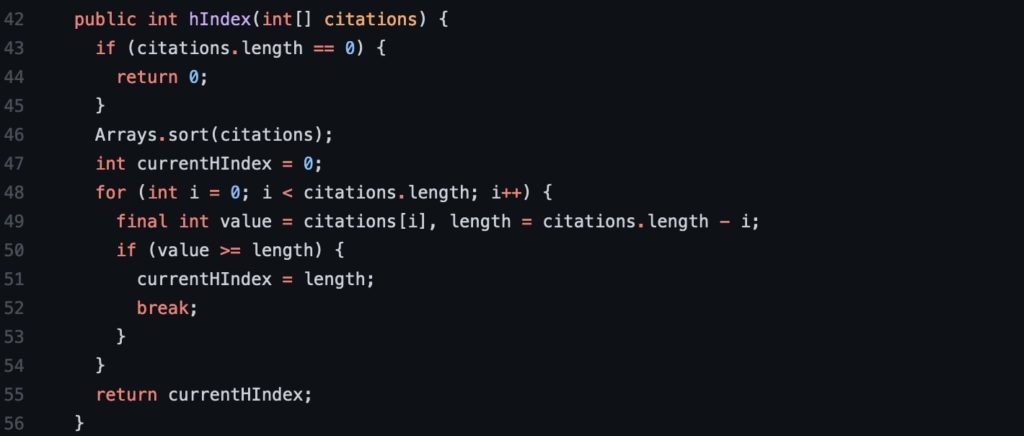
LeetCode H-Index exampleLeetCode H-Index example

The reason we conduct interviews is to see whether a candidate solves a given problem with some help and direction. But here’s where things start to fall apart: the interview experience is not a contest arena. While solving the problem we would like to see how the candidate communicates and explains his/her approach. If we ask a hard question, we lose many of these. It's highly likely that the candidate would be completely lost with the question. When people are lost, it's harder to give feedback or direction. I’ve seen candidates freeze not because they lacked skill, but because they didn’t know what kind of answer the interviewer wanted. Moreover, the candidate might go silent to think about a solution to the problem. We want them to communicate but a hard problem would take more time for someone to come up with a solution. In the end, we can't see how a candidate approaches the problem or communicates. Thus, we lose a big data point.

In a technical interview, we also want to see how the candidate code. We would like to know whether they can use standard functions or modules for the solution. Moreover, we would like to see how the candidate applies language-specific conventions. When we ask a hard question, it's possible that the candidate would rush and couldn't focus on writing good code. If they can't figure out a solution, they won't be able to write any code. Hence, we again lose many data points simply because it's hard to solve the problem and write good code with a limited amount of time.

In consequence, I don't see any benefit of asking a hard question to a candidate. If the goal is to assess thinking, why design a test that silences thought? I've never asked once and I'm not planning to ask anyone. At this point, I'm also skeptical about companies which ask such questions. Do you want to hire engineers who write good code or do you want to hire algorithm champions? There's a chance someone can be both but I would like to concentrate on the former. Real engineering is about clarity, collaboration, and the courage to ask the right questions. I don't think we get that out of hard problems.