


Published · 6 min read
Executing update statements on a production database is always a big challenge. It’s one of those tasks that looks deceptively simple until something breaks in ways you didn’t imagine. I have seen three different prominent incidents due to update problems. In each one of the incidents, multiple factors lead to the incident. Human error, missing safeguards, and time pressure often compound in subtle ways.
I remember once we wanted to update the production database during an upgrade. Somehow, we lost both the main database and its backup. The only thing that survived was a backup of the backup that AWS had preserved. I got paged for it in the middle of the night, completely baffled, only to realize later that we had never actually tested how our backups worked.
We could have avoided these problems by a couple of preventive actions and a bit of engineering rigor. A few disciplined steps before, during, and after execution can make the difference between a clean deployment and a production fire.
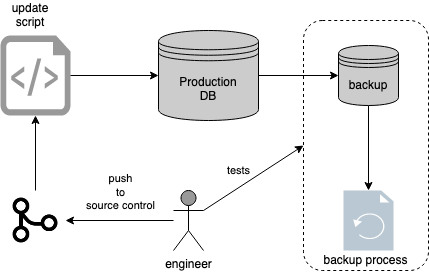 Database update process
One of the causes for update statement incidents is overconfidence or lack of meaningful process. Engineers can take it for granted that they figured out how to do the update. Confidence is good, but production doesn’t reward assumptions. It only rewards preparation. Nevertheless, updates may work 99 times. At one last time, it might fail and fail miserably. And when it fails, it often fails in ways that ripple across systems, alerts, and dashboards all at once. Murphy's Law.
"Anything that can go wrong will go wrong."
Hence, it's better to be prepared and put together a process to avoid such nightmares. It’s not paranoia; it’s resilience.Here is a gentle procedure.
Treat every update as if it could destroy production because it simply can.
There are a couple of things that we could do to avoid such update problems. Here are some rules I use for production databases. These are the habits that separate calm midnight pages from chaotic ones.
Even a well-written query can go wrong in production. Locks, replication lag, triggers, and timing can turn a “harmless” update into a nightmare. The key is to run slowly, validate constantly, and never assume success until after COMMIT.
We can expect engineers to do the right thing. Nevertheless, experience keeps proving that even the best intentions can go sideways under pressure. One might forget a step or get distracted. We need to be ready to deal with such scenarios. The goal isn’t to eliminate failure. Our goal is to make recovery fast, predictable, and painless.
Here are the things we could do.
Incidents will happen. What defines a strong engineering culture isn’t the absence of failure but the calm, structured response when it arrives. Backups, runbooks, and tested recovery paths turn panic into procedure.
Here’s a quick checklist for updates:
Simple. Boring. Life-saving.
There’s no such thing as a harmless update in production. Every query, no matter how small, touches history, revenue, or trust. When you treat it with the respect it deserves, you build systems and habits that last.
Most production fires aren’t caused by bad intent, but by missing humility. I know it very well because I’ve done it myself. Slow down, double-check, and assume nothing. It’s the quiet discipline that keeps everything else running.
此内容由惯性聚合(RSS阅读器)自动聚合整理,仅供阅读参考。 原文来自 — 版权归原作者所有。