


Published · 11 min read
Some time ago, I attended a course and became a certified Scrum Master. It wasn’t a huge deal. I was already doing the job. But as time went on and I gained more experience, my view of agile frameworks began to change. I started applying slimmer, simpler approaches, and the more I reflected on the frameworks themselves, the more I noticed their weaknesses.
In this post, I want to unpack why agile frameworks often fail to deliver on their promise and why it might be time to move beyond them.
Estimates!!! How do we even define them? In days, hours, complexity, or some other strange measurement? Estimates are just controversial. From my own experience, I know that estimates never work. Itʼs impossible to estimate something that is being built for the first time. We never build the same feature twice. Even if you build the same thing again, it wonʼt truly be the same because you’ve learned something new along the way. Also, even if you are good at estimating, there can be distractions and blockers.
The problem isn’t that estimates have no value. Well, the management still needs them to plan budgets and timelines. The real problem is how they’re treated as truth rather than approximation. Teams spend more time debating numbers than understanding the problem. In reality, estimates give comfort to management, not clarity to engineers. I know. I manage. Every hour spent justifying a timeline is an hour not spent improving the product.
Instead of chasing accuracy, we should aim for alignment. Deliver small, working increments, measure outcomes, and adjust. That way, predictability comes from progress.
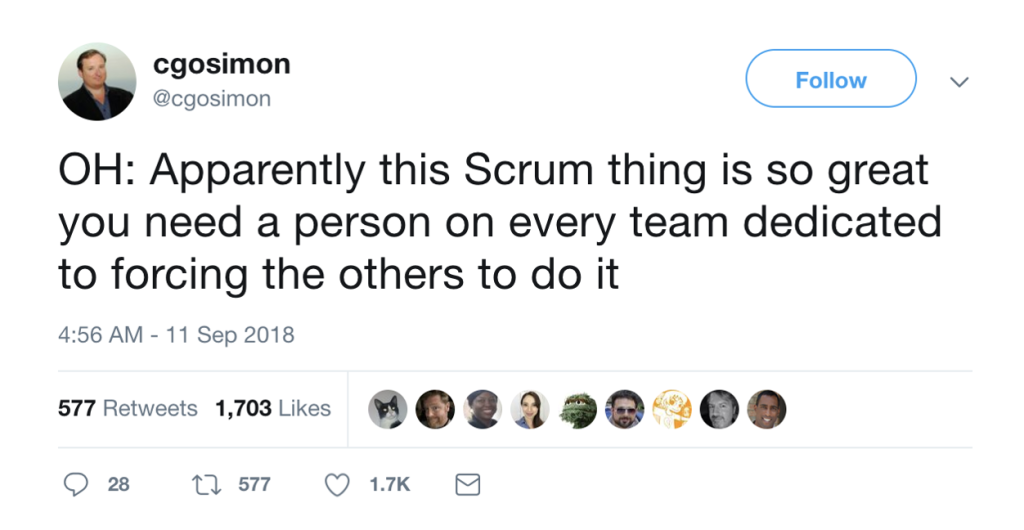 Scrum master forcing everyone to do Scrum meme
Standups! Often, you might realize you donʼt really care about the other personʼs project. On the contrary, if you care about someoneʼs project, you might already know the status since you are interested in that project. So, having standups might be a total loss of time. This becomes a bigger burden when you have a remote team in different time zones.
I personally hate the word “standup.” It sounds like a ritual designed to sound agile. What we actually need is a sync. A quick, focused check-in between the few people who truly depend on each other’s work. You don’t need the entire team sitting through status updates that add no value. If a meeting doesn’t help unblock, align, or make a decision, it shouldn’t exist. Everything else can be async.
Product owners hinder engineers’ contribution to the product because they decide on most of the critical parts and leave little room for engineers. Note that some of the great products we use today are actually engineering-driven products.
The intent behind the role makes sense. Someone has to represent the customer and prioritize work. But somewhere along the way, the role turned into a gatekeeper instead of a bridge. Product owners often act like they own the roadmap, not realizing that engineers are also problem solvers, not just executors.
The best products come from collaboration, not control. When engineers have context, freedom, and ownership, they make smarter decisions than any ticketing system ever could.
For each sprint, engineers are asked to deliver certain tasks and business people keep asking more and more from engineers. Constant pressure restricts the freedom of engineers and doesnʼt give any room to any innovation. Nevertheless, some of the good projects are done when the engineers are free and have time to do some side projects.
The irony is that sprints were meant to create focus. Not anxiety. But in practice, they’ve turned into short, repeating deadlines that leave no space to breathe or explore. Every sprint becomes a mini crunch cycle, and the focus shifts from solving problems to closing tickets.
Innovation doesn’t happen under a stopwatch. When engineers are trusted to manage their own pace and curiosity, they often deliver better, cleaner solutions than what any rigid schedule could produce.
Timeboxing everything creates technical debt in the long term. It isnʼt just one task but one after another, each creating new debt because thereʼs no time to refactor since we need to deliver fast.
The idea of timeboxing sounds disciplined until it becomes dogma. When every task is squeezed into an artificial deadline, quality becomes optional. Over time, those small compromises pile up into a mountain of tech debt that no one budgets time to clean. Speed without sustainability isn’t agility. It’s just sprinting toward a big crash. Sometimes the most productive thing you can do is stop, refactor, and make room for future work to flow faster.
Agile frameworks are management-focused. That’s not necessarily a bad thing. Some level of micro-management is useful when done quietly and with purpose. What’s harmful is when it’s performed in public, turning guidance into judgment.
I’ve seen managers use agile ceremonies as a stage to correct, pressure, or question people in front of everyone. That kills trust and motivation instantly. As a manager, I avoid that nonsense. Conversations about performance or blockers should happen privately, with respect. Agility should empower, not expose. The goal isn’t to control people; it’s to create enough clarity that control becomes unnecessary.
Frameworks assume every engineer works the same way. Teams do the planning together and assign an estimate to a task as a team. Nevertheless, the person who gets the task might struggle to deliver on time. Maybe heʼs a new member of the team, or perhaps he doesnʼt have experience in that particular area. Since heʼs supposed to deliver on time, he’ll be under pressure and stress.
This “one-size-fits-all” mindset ignores human variance. Skills, context, focus, and even mood differ from person to person. Agile frameworks flatten that reality for the sake of uniformity. What looks fair on paper often feels unfair in practice. Good management recognizes these differences and adapts around them. It’s not about lowering the bar, but about understanding who needs help, who needs space, and who’s quietly over-delivering. Agility should amplify individual strengths, not erase them.
Thereʼs literally bureaucracy in agile software development. In order to get anything done, you create a task, add it to the sprint backlog, then evaluate it and decide whether you should do it or not. Some teams even go far beyond and ask for a ticket just to change a label on a button.
Creating a ticket isn’t the problem. It’s often necessary for visibility and traceability. The problem starts when every simple change requires layers of validation and discussion that add no real benefit. Checking with a PM or manager for minor prioritization decisions slows teams down more than it helps them align.
Processes should exist to enable flow, not interrupt it. If the overhead of coordination outweighs the work itself, you’ve built a process that serves the system, not the product.
Frameworks bring unnecessary complexity. Although developers might not see it, the frameworks are actually complex. We don’t see the complexity because we’ve learned it. Think about it. On one hand, you have roles like scrum master, product owner, even facilitator. On the other hand, you have new processes, new terminology, and so on. If this was so simple, why do we have a ton of courses or training on the subject?
The irony is that frameworks designed to simplify delivery often create another layer of abstraction to manage. Teams spend more time maintaining the process than improving the product. You shouldn’t need a certification to learn how to build software collaboratively.
Agility was supposed to remove barriers, not rebrand them. When a process becomes so complex that it requires constant explanation, it stops being agile and starts being architecture of meetings, not systems.
One of the biggest shortcomings of agile frameworks is dealing with dependencies. Imagine you depend on another team to build a feature and they don’t even apply the agile framework — how do you even estimate against that? Or, you expected the database to be set up for your team, and it wasn’t delivered on time.
Agile assumes independence, but in real organizations, teams are deeply interconnected. The more dependencies you have, the less your local agility matters. Frameworks rarely account for that. They optimize the small circle while ignoring the larger system.
Cross-team dependencies turn every sprint into a waiting game. Until the surrounding system is streamlined, no framework will fix the bottleneck. True agility requires reducing dependency, not just managing around it.
Frameworks reject catastrophes. Imagine everything was awesome for the week, and then you got paged for a catastrophic error. How do you prepare for that? How do you take such problems into account? How do you log it?
Most frameworks are designed for predictable work, not chaos. They assume stability. The plan survives reality. But real systems fail, and failure doesn’t wait for sprint boundaries. When a major incident hits, no backlog or velocity metric helps you recover faster.
Engineering can't avoid chaos. You need to absorb it gracefully. A resilient team leaves room for the unexpected. Be it hotfixes, outages, experiments, whatever it takes to keep learning and shipping. If your process can’t flex when things break, it is not agile. It’s fragile.
Some of the methodologies work great in theory, but there’s no way to actually tell that this is the best way to do it. Although you can measure, the measurements you have are compatible with the agile frameworks — so, the outcome will be somewhat expected. Well, you can argue about teams that successfully adopted it, but there are a ton of people who failed to do so as well. If you google it, you’ll be surprised how many articles you’d find on how not to fail.
That’s the catch. The frameworks prove themselves with their own metrics. They define success in terms of compliance, not outcomes. Velocity up? Must be working. But is the product better? Is the customer happier? Is the team less burned out? Those answers rarely make it into the report.
In theory, agile is about adaptation; in practice, it’s about adherence. The moment we measure process health instead of product impact, we’ve already drifted from what agile was meant to be.
A great team may not need agile frameworks. Would it really matter what sort of methodology you use when you follow agile principles? Maybe all success cases for agile frameworks were successful because the team was expected to be successful anyway.
The truth is, strong teams succeed because of culture, not ceremony. Good communication, ownership, and trust outperform any prescribed process. When people know what they’re building and why, the framework becomes secondary.
Agile doesn’t create great teams. It amplifies whatever’s already there. If the foundation is weak, no methodology will fix it. But if the foundation is strong, you can throw out half the rules and still deliver better than most.
All in all, I think there are many reasons why agile frameworks aren’t good enough. They create a new level of complexity with limited benefit. We have been through some of these problems and maybe suffered from agile frameworks. Perhaps it’s time for a change.
Agile started as a rebellion against the heavyweight process. Now it’s become one. We don’t need another layer of rituals to prove we’re agile; we need the space to think, build, and deliver real value. The frameworks tried to make creativity predictable and in doing so, they made it slower.
Maybe it’s time to drop the playbook and return to principles. Small teams, short feedback loops, trust, and ownership. That’s what actually works. Everything else is theater.
此内容由惯性聚合(RSS阅读器)自动聚合整理,仅供阅读参考。 原文来自 — 版权归原作者所有。