









Published · 6 min read
As a software engineering instructor, I’ve taught a diverse group of master’s students with varying technical backgrounds. Not everyone comes in with the same level of expertise. Some have industry experience, some come from completely different fields, and some are writing real code for the first time. I’ve found that catering to the needs of all students requires a different approach. I had to simplify. The more I taught, the better I became at simplifying concepts and reducing unnecessary jargon. I’m still improving, but I’m objectively much better than I used to be.
I also try to keep everything relevant to today’s world and current events, because students engage more when the material reflects the technologies and challenges they’ll actually face. This becomes even more important because it is hard to connect engineering concepts to real world software when you don't have a technical background. Even then, I think it makes a difference. In the end, this mix of simplification, relevance, and adaptability is what has helped me reach students across all backgrounds.
Here are the strategies that have worked for me.
I know my classes don't have all technical people. So, I start by simply asking who has computer science background, then engineering. This gives me a good understanding of my audience. I proceed with some of the basics first. I start with the basics, covering fundamental programming functions, variables, and more. This approach ensures that all students, regardless of their technical background, can understand the material.
In addition, I want them to think about a software problem and solve it with business context in mind. I encourage them to think about what their core business is and what it is not, so they can use the right services when designing their software. This helps them become more effective software engineers in the long run and equips them with the skills needed to tackle complex issues they may encounter in their future careers.
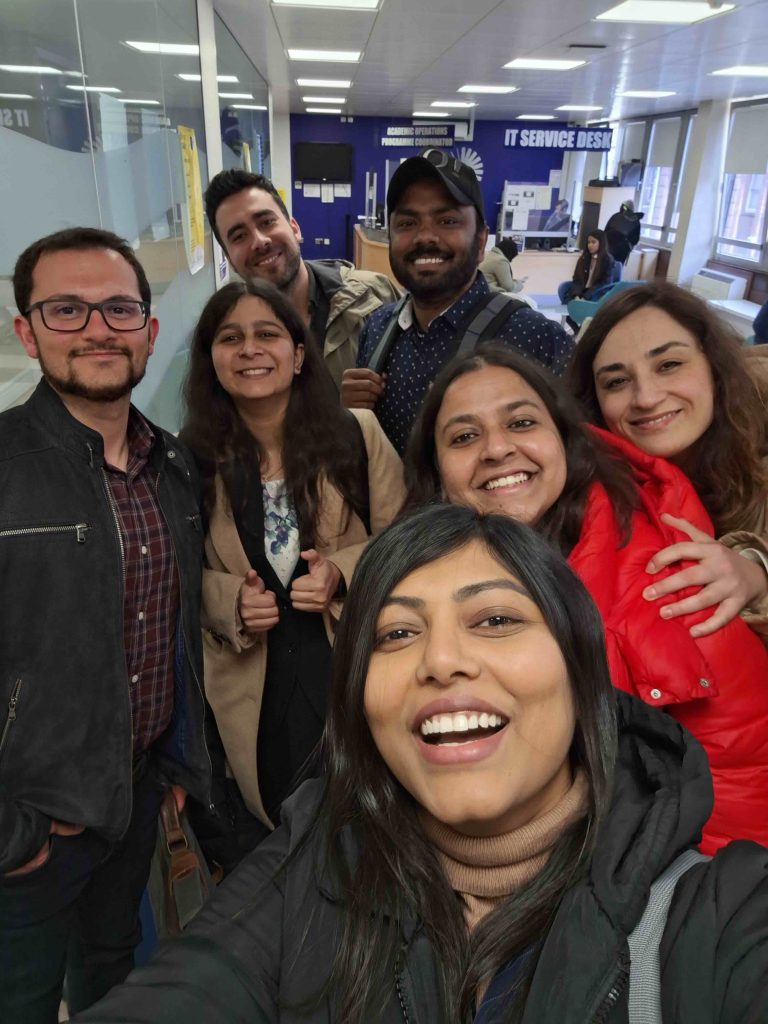 Yusuf Aytas with students in dublin business school
Software engineering concepts can be challenging to grasp, especially for students without a technical background. To make the concepts more tangible, I use real-world examples that students can relate to. When discussing object-oriented programming, I use examples such as a car or a school to help students understand concepts like inheritance. These analogies give students an immediate mental model, something they can visualize before diving into actual code.
Additionally, I try to incorporate examples from everyday life when discussing various programming paradigms. For instance, I use a restaurant ordering system to demonstrate client-server architecture. This approach helps students see the practical applications of the concepts they are learning. I think the real-world framing bridges the gap between theory and intuition. It's really essentially because it goes from theory to "get it" phase.
Everyone learns differently, so I use a variety of teaching methods, including diagrams and open discussions, to engage all students. I pause and ask my students if they have any questions. I even joke that if they don’t ask, I will. It always helps create both engagement and some fun. As a result, my students share their thoughts and ideas with the group, which fosters a collaborative learning environment and allows them to learn from one another’s experiences and perspectives. I actually learn a lot from these conversations, because so many people have so many different viewpoints, especially during open-ended design discussions.
I also make the class more engaging by asking them to think like a startup. This mindset pushes them to be resourceful, question assumptions, and approach problems with a builder’s mentality rather than waiting for instructions. You need to come up with an idea that not only works but is as unique as possible and you also need to make money with it. Most engineers lack business savviness, so this helps them early on think about value propositions. Blending different styles keeps students involved and helps them absorb the material more naturally.
I firmly believe that project-based learning is an excellent way to engage students and provide practical experience. In my classes, students form groups and work on real-world projects of their choosing, the startup idea, applying the concepts they’ve learned. This approach not only gives students hands-on experience but also encourages teamwork and collaboration, which are essential skills for successful careers in software engineering.
By guiding students through the entire software development process, from ideation to implementation, I help them understand the real challenges of building functional software. They need to decide what to design themselves, what to buy, what to reuse, and how to think about SLAs, SLOs, and everything that affects a real system. It’s all iteration, feedback, and adjustment.
Throughout the project, I encourage students to think like a startup. This fosters an entrepreneurial mindset that teaches ownership, accountability, and the ability to deliver under uncertainty. No lecture alone can give them that.
Students don’t learn at the same pace, and pretending otherwise only slows everyone down. Some pick things up quickly and want more depth, while others need more time with the fundamentals. To support both groups, I point them to practical resources they can use outside class. LeetCode, Hello Interview, books, videos, and solid online courses. These resources keep fast learners challenged and give others a way to reinforce the basics without falling behind.
I also want them to think about the real world: interviews, getting a job, building confidence, and preparing for the expectations of the industry. So I ask them to explore interview-style problems, look at real job requirements, and understand what companies actually look for. These are some habits and thought processes that make someone employable.
Finally, I ask students to read a few concepts before each class. When they walk in with even a minimal understanding of the topic, the session becomes a discussion rather than a lecture. Prepared students ask better questions, and better questions lift the whole class.
Teaching software engineering to a diverse group of students presents real challenges, but with the right approaches, it becomes incredibly rewarding. By combining fundamentals, real-world examples, varied teaching styles, and project-based learning, I’ve been able to create an environment that engages students and helps them succeed. It’s a continuous learning process for me as well. Each cohort teaches me something new about how people learn and how I can teach better.
At the end of the day, the goal is simple. Help students build the skills, confidence, and mindset they need to grow into effective software engineers. If I can give them that foundation, the rest naturally follows.
此内容由惯性聚合(RSS阅读器)自动聚合整理,仅供阅读参考。 原文来自 — 版权归原作者所有。