


Published · 6 min read
A project can be obviously important, technically sound, budgeted, and still go nowhere. I don’t mean slowness. I mean the weird kind of stalled where everyone involved can point to work, meetings, approvals, and progress, yet nothing actually moves.
I no longer start by asking whether the team lacked skill or effort. A lot of the time, the problem is much less flattering to the organization than that. They were using the wrong map or they didn’t know they needed a map.
The constraint map is the org chart. It shows who manages whom, who owns the budget, and who carries formal accountability when something blows up. That is useful. It still does not tell you how work actually moves.
Execution runs through other maps: expertise, trust, memory, and influence. When those line up with the org chart, the place feels sane. When they do not, you get friction, phantom vetoes, repeated mistakes, and people reading performance through the wrong lens.
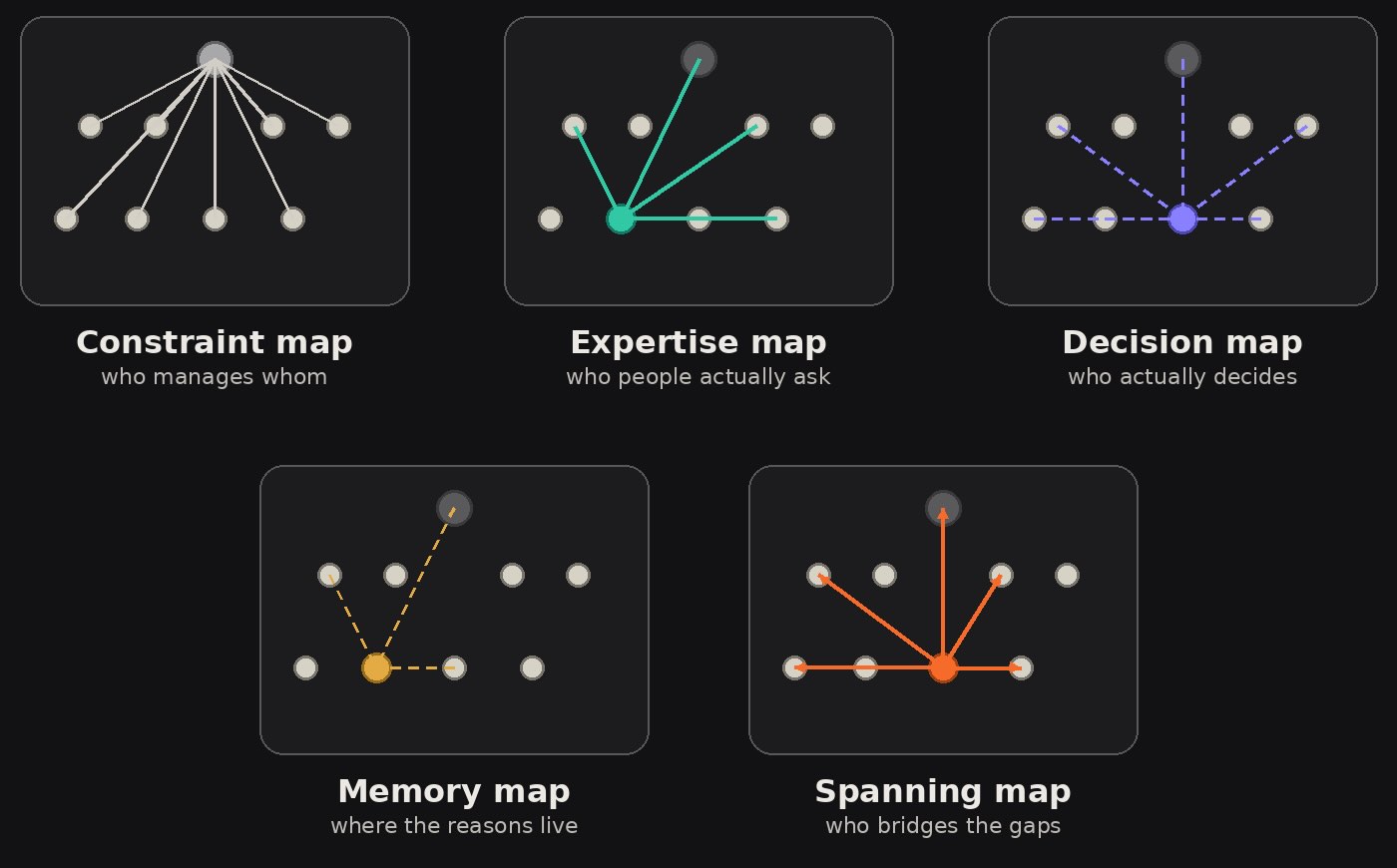 The Five Maps Behind Execution
The expertise map says who people actually ask when the system gets into trouble. In a healthy company, you can usually find the right expert without too much pain. In a messy one, expertise is locally visible and globally hidden. One team knows who their person is. Another team has no idea that person exists.
This one causes some of the ugliest confusion because it looks like approval on paper but behaves like politics in practice. In some rooms, the person with the most actual power says the least. Everyone else just glances at them before landing the plane.
If you push work through the formal line without securing the real buy-in path first, the initiative will stall, get revisited, die in committee, or get vetoed for reasons nobody can explain in one sentence.
I remember a time where one of the sibling orgs had a no-deploy rule on Fridays. No exceptions, no escalation path, just a hard stop. I remember thinking it was overcautious the first time I ran into it. We needed them to deploy a fix. It was small. The weekend was two days of unnecessary exposure. I pushed back and someone older than me in the org said no, flatly, and didn't explain it.
Six months later I found out why. A Friday deploy eighteen months before I joined had taken down an integration over a long weekend. The oncall engineer was unreachable. The person who understood that part of the system was at a wedding with no signal. By Monday they had lost three days of integration volume. The rule was the memory.
The memory map is where the reasons live. In the people who were there when the rule got made. When they leave, the rule stays but the reason goes with them. What's left looks like caution. To someone new, it looks like bureaucracy. The difference between those two readings is invisible until you remove the wrong thing.
And then there are the people who span boundaries. They are the ones translating between teams that should theoretically be able to coordinate through process alone. In practice, they carry context across the gaps.
They explain the infrastructure constraint to the product. They explain the customer problem to engineering. They know who to call, who not to surprise, and which team is already overloaded even though the official plan assumes otherwise. These people are the nervous system of the organization.
What makes them hard to replace is not their relationships. They know things about Team A that Team A has never thought to write down, because Team A assumes everyone already knows it. When a spanner leaves, both sides of the gap still exist. The process still exists. The handoff still happens. But the translation stops, and for a while nobody can tell why things keep getting misread.
Put those maps together and you get the real organization in execution. A lot of institutional dysfunction is just the distance between them.
When expertise, decision rights, memory, and coordination paths are scattered across different people, work slows down in ways the org chart cannot explain. It also creates a familiar kind of fragility: a few people end up carrying several maps at once. They become human routers for context, trust, and judgment. The place can keep moving like that for a while. It is still structural debt.
The first instinct is to move fast. Don't. The formal structure is the only map you have at the start. So you use it. Otherwise six months later you have done real work that landed nowhere because you kept handing things to the right title instead of the right person.
Watch before you route. Not what people say in meetings but what they react to, what they defer on, who they glance at before they agree. The decision map is never written down but it leaves traces constantly. The person who pauses before answering a simple question either doesn't know or is choosing their words carefully. Both are worth noting. The one who speaks last and briefly, and after whom the room moves, note that too.
Before you disturb anything, ask why it's where it is. The ugly workaround, the review that feels ceremonial, the fragile handoff nobody has cleaned up. Remember someone paid for those the first time. Assume the reason exists before you assume it doesn't.
For managers, the problem is different and more urgent. When the same two or three people are the ones holding it all together, the system looks like it's working. It isn't. It's holding. The job is to make what those people carry legible before it walks out the door. Write down the why, not just the what. If one person leaving would make the place feel mysterious again, it was never as solid as it looked.
Some organizations keep running because these maps stay hidden. That ambiguity does not just protect the system. It protects the people who are weak inside it. It lets mediocre managers look competent because the people under them quietly absorb the damage, reroute around bad judgment, and keep the obvious failures from surfacing. From a distance, it looks like leadership. Up close, it is compensation.
Make those maps visible and you make the real organization visible too. Who actually decides. Who actually knows. Who has been carrying the place without the title. That is why this work gets political so quickly. The fog is doing work for someone. Map it carefully. You may not like what becomes visible. Neither will the people who have been benefiting from the blur.
此内容由惯性聚合(RSS阅读器)自动聚合整理,仅供阅读参考。 原文来自 — 版权归原作者所有。