


惯性聚合 高效追踪和阅读你感兴趣的博客、新闻、科技资讯
阅读原文 在惯性聚合中打开

推荐订阅源

S
Schneier on Security
P
Proofpoint News Feed
Apple Machine Learning Research
WordPress大学
WordPress大学
博客园 - Franky
V
V2EX
爱范儿
爱范儿
J
Java Code Geeks
小众软件
小众软件
Last Week in AI
Last Week in AI
The Cloudflare Blog
让小产品的独立变现更简单 - ezindie.com
Hugging Face - Blog
Hugging Face - Blog
T
The Blog of Author Tim Ferriss
酷 壳 – CoolShell
酷 壳 – CoolShell
The Register - Security
GbyAI
GbyAI
Vercel News
Vercel News
Y
Y Combinator Blog
腾讯CDC
F
Fortinet All Blogs
I
InfoQ
N
Netflix TechBlog - Medium
B
Blog RSS Feed
D
Docker
OSCHINA 社区最新新闻
OSCHINA 社区最新新闻
量子位
博客园 - 司徒正美
阮一峰的网络日志
阮一峰的网络日志
The GitHub Blog
The GitHub Blog
Microsoft Security Blog
V
Visual Studio Blog
博客园 - 三生石上(FineUI控件)
宝玉的分享
宝玉的分享
Blog — PlanetScale
Blog — PlanetScale
H
Help Net Security
云风的 BLOG
云风的 BLOG
A
About on SuperTechFans
Scott Helme
Scott Helme
T
Tor Project blog
U
Unit 42
Google Online Security Blog
PCI Perspectives
PCI Perspectives
钛媒体:引领未来商业与生活新知
钛媒体:引领未来商业与生活新知
NISL@THU
NISL@THU
D
Darknet – Hacking Tools, Hacker News & Cyber Security
aimingoo的专栏
aimingoo的专栏
cs.CV updates on arXiv.org
Stack Overflow Blog
Stack Overflow Blog
Security Archives - TechRepublic

Yusuf Aytas

When Code Is Cheap, Does Quality Still Matter? Why Crouching Tiger, Hidden Dragon Is a Masterpiece Why We Ignore Advice The Mirror Is Part of the Machine When Too Many Maps Overlap on One Person The Work Runs on Different Maps Your Work Introduces You Trial By Fire The Dude Why Headcount Math Lies Capacity Is the Roadmap The Roadmap Is Not the System Torres del Paine W Trek Escaping Status Theater Incentives Drive Everything Scaling Culture Without Dilution What Good Looks Like Why Airport Security Feels Random Why Politics Appear How to Work with Me The Janus Protocol Multi-Horizon Delivery Framework What Good Execution Looks Like Managing Your Manager Why Kingdom of Heaven’s Director’s Cut Is Better AI Broke Interviews Most of What We Call Progress Managers Have Been Vibe Coding All Along Stop Wasting Brainpower Why Over-Engineering Happens Prisoner's Dilemma Climbing No More The Weekly Win Mevlana Candy Brewing Turkish Tea Onboarding Your Engineering Manager Technical Deep Dives Yapay Zekâ Çağında Bilgisayar Mühendisliği Building Remote Teams From Idea to Launch in 2 Weeks Reflecting on Software Engineering Handbook Representing the Business New Manager Survival Guide Take Self Reviews Seriously Chasing Real Respect The Invisible Difference Learning the Johari Window Management is a Lonely Place Simple Task Management AI Balance in Work PIP Manager Insights Engineering Manager Interview Preparation Work-Life Balance as a Manager Bridging the Management Disconnect Tech Hiring Bubble Bursts Traits for EMs Simple Acts of Recognition Matter The Question I Ask Every New Report The Reality of an Employer's Market Bridging Ideals and Reality Hiring Red Flags Why The Godfather Is So Damn Good Subteam Tenets No Fluff Please Losing a Top Performer Balancing Act of Reliability Building Trust in Engineering Teams Ideal Number of Direct Reports Overriding a People Leader’s Decision From Misperception to Promotion Perception vs Perspective Setting Goals From Engineer to Manager Getting Delegation Right Interviewing Your Future Boss Celebrating Our Book in Iceland Operational Skills Needed On Writing Software Engineering Handbook Charlie Munger Quotes Working with Dependencies From Las Vegas to Canyons Navigating Layoffs Handling Competitive Dynamics A Weekend Getaway to Malta Engineering Health Essentials Should Dev Managers Code? Confronting the Life on Pause Winning Eleven Kindness is A Choice Bireysel Katılımcılar ve Yöneticiler Leading from Where You Are The Subtle Art of Listening Coding in Leadership The Power of Consistency The Making of a Leader The Path to Leadership Embracing TikTok Talent Sourcing Journey Leading Self Managing Teams Cracking Coding Bottlenecks
Scrum, Kanban, or just Agile
Yusuf Aytas · 2016-03-17 · via Yusuf Aytas

Published · 5 min read

Before going deep in the subject, I would like to emphasize that this post is completely personal. You miBefore going deep into the subject, I would like to emphasize that this post is completely personal and based purely on my own experience. You might agree or disagree, and that’s perfectly fine. You might even have really good experiences applying these agile frameworks in your own teams.

Nevertheless, personally, I donʼt think they provide much value in most real-world settings. Over time, I’ve seen how the frameworks often grow heavier than the problems they try to solve. What begins as a philosophy of agility sometimes ends up buried under ceremonies, roles, and rigid checklists.

In this post, I want to share why I feel that way and what simpler, more effective approaches have worked better in my experience.

Agile software development cycleAgile software development cycle

Agile Software Development

Agile Manifesto vs. Frameworks

First things first, Kanban, Scrum aren't equal to agile manifesto. They are agile software development frameworks. The Agile Manifesto (http://agilemanifesto.org/) is simple, clean, and doesn't enforce any methods. Letʼs remember the Agile Manifesto.

Individuals and interactions over processes and tools
Working software over comprehensive documentation
Customer collaboration over contract negotiation
Responding to change over following a plan

As you can see, itʼs up to you how to apply the Agile Manifesto because itʼs open-ended. The manifesto follows the KISS (Keep It Simple, Stupid) principle. However, frameworks derived from agile principles donʼt always follow KISS.

In my experience, they can make your life even more complicated than it was before. They introduce new roles, new methods, and new discussions. From now on, Iʼll go through examples to highlight why I donʼt see much value in applying these frameworks.

Example #1: Planning Poker

Assumption: Estimates done through days to complete a task.

  • Why somebody else estimates my task?
    • Amount of time spent for a task is personal
      • One might lack some technical/domain ability
      • People works different number of hours
      • Wrong estimates can decrease one's morale
    • Team can't know every piece of software produced
  • Estimates never include disasters
    • Stop the world and fix bugs occur occasionally
    • Refactorings

So, estimating task completion as a group doesn't provide much value and most probably is great loss of time. A planning poker might probably take half of the day but you can deliver a small feature or a bug at that time span. I'll admit that planning poker is a fun activity and can be useful for those who joined the team recently.

Example #2: Meetings

A typical scrum team has between five and nine people. In an ideal world where everyone works for the same project, scrum team makes sense. Nonetheless, that's not the case for most of the teams I've seen. Hence, team meetings becomes problematic because there is no focus.

  • Teams are expected to carry more than one project and most probably many projects.
    • Status updates from different projects doesn't catch attention
    • One project can dominate the others
    • Roles, come on! They become useless in one man projects

On the other hand, meetings can provide information exchange and general view of the team. They are needed but probably not everyday. Most importantly, meetings focussed on individual projects are much more effective.

Example #3: Roles

Roles are important part of agile frameworks and they aren't easy to learn and practice. Furthermore, they are strict so they restrict freedom of developers.

  • Learning and applying roles are costly
    • Learning each role would take at least a day
    • Deciding on whose's who can be a challenge
    • Companies pay a lot to trainers
    • You don't get certified for every role even after a training
  • Loss of Freedom
    • Direct interaction to customer is lost since we have product owner
    • Scrum master can be bossy

Clear roles and structure might be good for some organisations and might be a hindrance for others.

Alternatives That Follow KISS

I've just gone over 3 examples; however, one might come up with many others. I think it's worth to discuss an alternative to these frameworks. Thus, I'll suggest two simple methods which you might be familiar already. I believe these two methods follow KISS principle.

Method #1: Task Board

A board to visualise what's going on currently. It might be a software tool or it might be just physical post-its. There might be estimates or not on individual tasks.
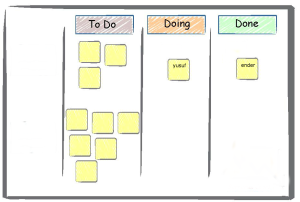
Task board exampleTask board example

Method #2: Task Priority

A task priority is weighted sum of customers becoming happy/unhappy divided by number of days to spend on. I'll give an example to visualize.

Example:

  • Customer #1: 2, Customer #2: 3, Customer #3: 90
  • Customer #3 wants Task #2
  • Customer #1 and #2 want Task #1
  • Task #1 takes 2 days, Task #2 takes 3 days

Priority for Task #1 = (2 + 3) / 2 = 2.5
Priority for Task #2 = 90 / 3 = 30

So, we first work on Task#2 and than Task#1. Note that, bugs probably has more weight because fixing broken software is more important.

That's it. Nothing more. These two methods don't tell you or enforce you to conform certain rules. They are just focussed on delivering value and visualizing status of software that's worked on. Anything more than this stuff can be specific to teams or projects.