


Published · 8 min read
Engineering roles exist whether you define them or not. In some teams, ownership is explicit. People know who drives incident management, who keeps an eye on risk, who pushes on developer experience, who cares about cost before it turns into a surprise. In other teams, those responsibilities float around informally. Somebody responsible picks them up for a while, usually on top of their actual job, until they get busy, lose interest, or leave.
That can work for a small team. I have seen it work, for a while. Then the team grows, the system gets messier, and the cracks start showing up in expensive places. A security issue sits around too long. Incident follow-ups lose momentum. Compliance becomes something everyone assumes somebody else is handling. Costs creep up quietly. By the time the problem becomes visible, it is usually because something already failed.
Clear ownership helps long before that point. It gives people room to lead beyond their title. It makes gaps obvious. It creates continuity when people move on. It also makes the organization easier to reason about, because responsibilities are attached to names instead of good intentions. That is one of the foundations of a healthy engineering culture.
This is how I think about the core roles and responsibilities an engineering organization should define as it scales. The exact shape will vary, but the need for clear ownership usually does not.
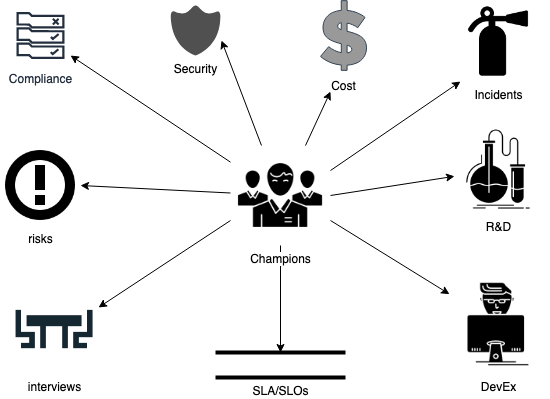 Engineering roles and responsibilities
Risk management is identifying, assessing, and controlling risk to the organization. While running services and systems, teams have to evaluate risks regularly. Risks involve using end-of-life software to brittle deployment pipelines. Beyond the technical layer, it also includes process and cultural risks. For example, unclear ownership, lack of observability, or dependency on tribal knowledge. Teams have to address some risks immediately and can postpone others. Champions can keep track of these risks and flag them as the organization moves.
Embedding risk management into everyday work helps prevent firefighting later. By aligning it with engineering principles, teams can turn risk reviews into opportunities for reliability and growth. In my experience, risk champions work best when they collaborate closely with those leading incident management, ensuring lessons learned translate into long-term improvement.
As engineering organizations grow, the visibility and predictability of cost become more important. Organizing resources and understanding your expenses can help you to invest in the right technology and cut costs from others. Modern teams often overlook cost as a core engineering metric. Nonetheless, cloud efficiency, resource utilization, and even CI/CD usage directly impact the bottom line. Whatʼs more, building accountability for cost improves self-awareness. Teams can proactively do cost management and bring it into discussions. Cost management champions would help to optimize spending and savings.
A structured cost culture doesn’t mean penny-pinching; it means aligning spending with value. Linking this with developer experience initiatives helps teams balance speed with efficiency. In larger organizations, this role often ties into SLA and KPI ownership, ensuring reliability targets are met without runaway expenses.
Every organization faces incidents. There’s no stopping that. Nevertheless, champions can standardize the incident process and help teams with debriefing. Champions can collate learnings and present them to the rest of the organization. A consistent approach to incident management not only reduces downtime but also strengthens trust between teams.
Champions can do a few good things, such as following up on Jira tracking, ensuring incidents are cleared, formatting and labeling them, scheduling, and handling a bunch of other tasks. These might seem small, but they can be very effective. Sometimes, a little nudge is all the teams need.
Growing pains come with many interviews. Champions can work on various problems to ask the candidates. They can train engineers to come up to speed with interviewing. They can shadow engineers to give feedback and improve their interviewing skills.
Strong interviewing practices shape the long-term culture of an engineering organization. It’s not just about hiring talent. It’s about ensuring the process reflects your team’s values, expectations, and technical bar. Champions can collaborate with those leading developer experience to create fair, consistent, and scalable interview processes.
For example, defining structured rubrics and maintaining a shared interview question bank reduces bias and ensures that each candidate’s experience contributes to continuous improvement.
Most big organizations have a dedicated security team or organization. The security group provides guidance and manages security activities. Nevertheless, each team/organization complies with the security teamʼs suggestions or asks. Champions can make sure the team/s follows this set of recommendations and rules. They can inform the organization about vulnerabilities and mitigations.
Security works best as part of everyday engineering. Champions can build it in early through code reviews, dependency management, library upgrades, patch management, vulnerability scans. They can also review configurations, monitor open issues, and promote secure coding habits. Working with compliance and risk champions keeps a steady feedback loop that strengthens system integrity and trust.
Compliance standards set a baseline for organizations. Depending on the nature of the business, the organization has to follow a set of rules. Examples of compliance are SOX for financial record-keeping activities and GDPR for data protection and privacy in the European Union. Champions can help the organization to have a holistic view of compliances and talk to the regulatory authorities and stakeholders like the legal team.
Strong compliance is about building trust through consistent, well-documented work. When engineering teams treat compliance as part of system design, it naturally aligns with operational excellence. Champions can collaborate with security and cost management teams to make sure policies are enforceable and practical.
In practice, this means setting up automated compliance checks in CI/CD pipelines, maintaining infrastructure-as-code baselines, tracking access reviews, managing data retention policies, running GDPR validation scripts, and keeping dependency and license scans up to date. By integrating these tasks into daily workflows, teams stay proactive and reduce the last-minute rush before audits.
Each organization manages many systems and services. Managing expectations for these services require a proper definition of SLI, SLO and SLAs. Champions can help teams with defining these metrics. They can also ensure each system and service has one and track them in a org wide dashboard.
Champions can collaborate with incident and cost management teams to balance reliability targets against budget and capacity. By reviewing metrics like SLOs, SLIs, MTTD, and MTTR, they can identify blind spots. For example, services that meet their SLA on paper but still frustrate users. How do you know? They can help define error budgets, track recovery patterns, and promote data visibility across teams. One team might look okay but what about the entire organization. Turning these insights into ongoing feedback loops builds a culture where reliability decisions are grounded in real data, not assumptions.
Some of the solutions for software development would be ready either through a service or an open-source. Nevertheless, there are times when the solution doesnʼt exist or needs significant work to meet the organizationʼs needs. Champions can identify these gaps and manage research and development activities. It might be hard to find out prevalent needs for multiple teams. Champions can figure it out by looking over multiple domains and teams holistically.
R&D champions act as the bridge between innovation and practicality. Encouraging engineers to dedicate part of their time to exploration. Be it hack days, internal proposals, or open-source contributions. This cultivates creativity and future-proofs the organization.
Good developer experience unlocks engineering talentʼs potential. Inefficiencies in developer experience result in loss of productivity. Medium to large organizations implement several different developer tooling for engineering. Champions can stay up to date with these tools and inform others in the team about new improvements, updates, and deprecations.
Developer experience is the multiplier of every other role. It determines how easily engineers can build, deploy, and learn. By collaborating with R&D and incident management champions, DX leads can turn friction into feedback loops that directly improve reliability and innovation.
Defining engineering roles is about making invisible work visible. When ownership is clear, problems surface earlier, knowledge transfers more naturally, and engineers grow into leaders without waiting for permission.
The roles outlined here aren't a finished product. They're a starting point. As your organization scales, some will merge, some will split, and new ones will emerge that no one anticipated. What matters isn't the structure itself but the habit of revisiting it. Asking who owns what, where the gaps are, and whether the people in those roles have what they need to succeed.
The organizations that get this right don't just run more reliably. They build the kind of trust where engineers feel safe raising risks early, speaking up about costs, and owning failures without fear. That psychological safety is the quiet dividend of good organizational design. Start with one role. Assign it deliberately. See what surfaces. The clarity tends to be contagious.
此内容由惯性聚合(RSS阅读器)自动聚合整理,仅供阅读参考。 原文来自 — 版权归原作者所有。