

惯性聚合 高效追踪和阅读你感兴趣的博客、新闻、科技资讯
阅读原文 在惯性聚合中打开

推荐订阅源

C
CXSECURITY Database RSS Feed - CXSecurity.com
V2EX - 技术
V2EX - 技术
美团技术团队
NISL@THU
NISL@THU
C
CERT Recently Published Vulnerability Notes
Google DeepMind News
Cyber Security Advisories - MS-ISAC
MyScale Blog
MyScale Blog
C
Cybersecurity and Infrastructure Security Agency CISA
W
WeLiveSecurity
博客园 - 聂微东
Hacker News - Newest:
Hacker News - Newest: "LLM"
H
Help Net Security
GbyAI
GbyAI
G
GRAHAM CLULEY
The Last Watchdog
The Last Watchdog
U
Unit 42
罗磊的独立博客
B
Blog RSS Feed
K
Kaspersky official blog
宝玉的分享
宝玉的分享
Blog — PlanetScale
Blog — PlanetScale
Know Your Adversary
Know Your Adversary
IT之家
IT之家
www.infosecurity-magazine.com
Y
Y Combinator Blog
S
Secure Thoughts
P
Privacy & Cybersecurity Law Blog
S
Schneier on Security
Last Week in AI
Last Week in AI
Hacker News: Ask HN
Hacker News: Ask HN
L
LINUX DO - 热门话题
雷峰网
雷峰网
Martin Fowler
Martin Fowler
Recent Commits to openclaw:main
N
Netflix TechBlog - Medium
T
Tor Project blog
The GitHub Blog
The GitHub Blog
The Hacker News
The Hacker News
F
Fortinet All Blogs
Webroot Blog
Webroot Blog
Spread Privacy
Spread Privacy
Cloudbric
Cloudbric
freeCodeCamp Programming Tutorials: Python, JavaScript, Git & More
Schneier on Security
人人都是产品经理
人人都是产品经理
P
Privacy International News Feed
cs.CL updates on arXiv.org
T
The Exploit Database - CXSecurity.com
Microsoft Security Blog

Yusuf Aytas

When Code Is Cheap, Does Quality Still Matter? Why Crouching Tiger, Hidden Dragon Is a Masterpiece Why We Ignore Advice The Mirror Is Part of the Machine When Too Many Maps Overlap on One Person The Work Runs on Different Maps Your Work Introduces You Trial By Fire The Dude Why Headcount Math Lies Capacity Is the Roadmap The Roadmap Is Not the System Torres del Paine W Trek Escaping Status Theater Incentives Drive Everything Scaling Culture Without Dilution What Good Looks Like Why Airport Security Feels Random Why Politics Appear How to Work with Me The Janus Protocol Multi-Horizon Delivery Framework What Good Execution Looks Like Managing Your Manager Why Kingdom of Heaven’s Director’s Cut Is Better AI Broke Interviews Most of What We Call Progress Managers Have Been Vibe Coding All Along Stop Wasting Brainpower Why Over-Engineering Happens Prisoner's Dilemma Climbing No More The Weekly Win Mevlana Candy Brewing Turkish Tea Onboarding Your Engineering Manager Technical Deep Dives Yapay Zekâ Çağında Bilgisayar Mühendisliği Building Remote Teams From Idea to Launch in 2 Weeks Reflecting on Software Engineering Handbook Representing the Business New Manager Survival Guide Take Self Reviews Seriously Chasing Real Respect The Invisible Difference Management is a Lonely Place Simple Task Management AI Balance in Work PIP Manager Insights Engineering Manager Interview Preparation Work-Life Balance as a Manager Bridging the Management Disconnect Tech Hiring Bubble Bursts Traits for EMs Simple Acts of Recognition Matter The Question I Ask Every New Report The Reality of an Employer's Market Bridging Ideals and Reality Hiring Red Flags Why The Godfather Is So Damn Good Subteam Tenets No Fluff Please Losing a Top Performer Balancing Act of Reliability Building Trust in Engineering Teams Ideal Number of Direct Reports Overriding a People Leader’s Decision From Misperception to Promotion Perception vs Perspective Setting Goals From Engineer to Manager Getting Delegation Right Interviewing Your Future Boss Celebrating Our Book in Iceland Operational Skills Needed On Writing Software Engineering Handbook Charlie Munger Quotes Working with Dependencies From Las Vegas to Canyons Navigating Layoffs Handling Competitive Dynamics A Weekend Getaway to Malta Engineering Health Essentials Should Dev Managers Code? Confronting the Life on Pause Winning Eleven Kindness is A Choice Bireysel Katılımcılar ve Yöneticiler Leading from Where You Are The Subtle Art of Listening Coding in Leadership The Power of Consistency The Making of a Leader The Path to Leadership Embracing TikTok Talent Sourcing Journey Leading Self Managing Teams Cracking Coding Bottlenecks Quick Reflexes in Decision Making
Learning the Johari Window
Yusuf Aytas · 2025-04-04 · via Yusuf Aytas

Published · 4 min read

When I wrote this piece on setting goals, I focused on the practical side: clarity, motivation, breaking down complexity. But here’s the thing. Even the clearest goal doesn't mean much if you don’t understand who you are. It’s beyond MBTI kind of stuff. I’m referring to a closer look at yourself.

That’s where the Johari Window comes in. It’s a model from the 1950s that still slaps today. Basically, it splits your self-awareness into four boxes:

  • Open Area: What you and others know about you.
  • Blind Spot: What others know about you that you don’t.
  • Hidden Area: What you know but keep to yourself.
  • Unknown Area: What no one knows about you — yet.

You might be wondering, “Why the hell does this matter for goals?” Let me explain.
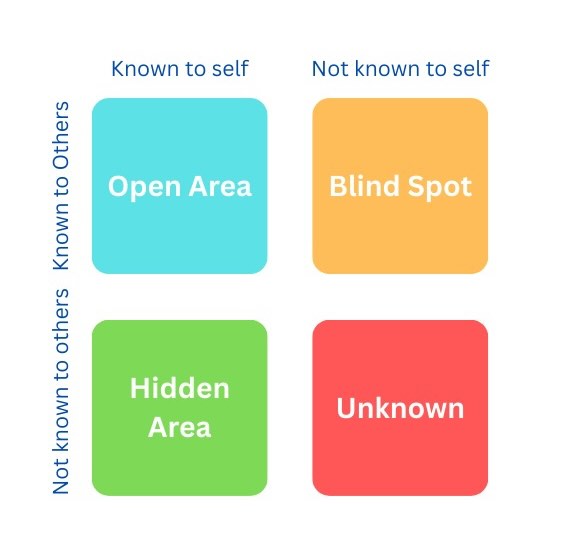
Johari WindowJohari Window

When Self-Awareness Meets Goal Setting

1. Open Area

This is your comfort zone. It’s  your go-to zone when setting goals. You already know these strengths or weaknesses. People have probably confirmed them.

Example: I knew I wanted to write more, and I’ve always been decent at expressing ideas. Hence, 20 blog posts a year. Measurable. Clear. Public.

Cool. But don’t stop there.

2. Blind Spot

This is what you miss but guess what everyone else sees. This one stings. There are things you’re not great at. Things you don’t even realize but your colleagues, friends, or teams do.

If someone tells you, “Hey, you interrupt a lot,” and your first reaction is “No, I don’t,” that’s your cue. You’ve just stepped into your Blind Spot.

Goal tip: Ask for feedback. Not the sugar-coated “you’re doing great” type. Constructive feedback. Then use that to shape better, more uncomfortable goals.

3. Hidden Area

These are the stuff you bury. These are things you know about yourself but don’t talk about. Maybe it’s a fear. Maybe it’s ambition you think people will mock. Maybe it’s a creative side you haven’t shared.

I’ll admit it: For the longest time, I didn’t talk about wanting to work on making video content. I started some but I’m really shying away. Not because I didn’t care but because it didn’t “fit.”.

Goal tip: Turn your secrets into experiments. What if your hidden side is where your best work lives?

4. Unknown Area

This is an uncharted territory for you or anyone else. No one knows this stuff including yourself. You find it only by doing. That’s why some goals should feel weird, slightly ridiculous, maybe even “not you.”

I once asked someone on my team to run a workshop. They were terrified. Turns out, they're insanely good communicators. They just hadn’t discovered that part yet.

Goal tip: Set one “wtf” goal per year. Something that feels out of character. Just to see what you find.

So, What Now?

Here’s how I’d mix Johari into your next goal-setting sprint:

Johari QuadrantExample Goal
Open AreaWrite 2 blog posts a month on engineering leadership.
Blind SpotAsk 3 peers what I can improve in meetings and act on it.
Hidden AreaShare a creative side project publicly.
Unknown AreaTry something I’ve never done before. Host a podcast, take an acting class, whatever.

This framework makes your goal-setting not just effective but also honest. The best goals aren’t about what you know. They’re about who you might become.

We all love to plan. That’s a big lie, isn’t it? But we need to do it for self improvement. Self discovery is the hard part. That’s also where the magic is. The Johari Window won’t make you invincible. But it will make your reflection a little clearer. Perhaps, you can have a whole lot bolder goals.