


Published · 13 min read
Managers change more often than you realize, especially when a company is growing or downsizing. New roles, new org charts, new reporting lines. Other times, you’re shopping around and you find yourself interviewing your future boss and trying to read between the lines. Ultimately, you will have a new manager in one way or another. Sometimes you end up reporting to someone far more seasoned than you. Other times, your new manager is technically junior to you.
Regardless of the scenario, the same questions should be in the back of your mind: How do I get my job done under this person? You should try to understand their expectations. You should try to observe their leadership style. You collect small data points. Be it how quickly they reply, what stresses them, what they prioritise, what they ignore. And beneath all of this is a skill most people never formally learn. Managing your manager.
First things first, this isn't manipulating. It’s not politicking either. But understanding how to work with the human who controls your priorities, your visibility, your workload, your autonomy, and sometimes your sanity. This post is about that. My goal is to provide practical guidance on strategic upward influence: how managers think, how influence really works, how to communicate upward effectively, how to prevent surprises, and how to build a relationship where you and your manager become true partners in execution.
 Managing your manager
What comes to your mind when you think of it? It isn’t about your manager. It’s not always agreeing with them. Or trying to control them. At its core, managing up is the practical skill of making it easier for your manager to do their job. Hence, you can do yours with more clarity, autonomy, and momentum.
It starts with a simple mindset shift. Instead of depending on your manager for direction, you take responsibility for shaping how the relationship works.
A clear example of this came from one of my mentees. She found herself reporting to a manager who was constantly busy. She had multiple projects she wanted to run by him and several problems she hoped he could weigh in. Every conversation left both of them stressed and often behind their schedule.
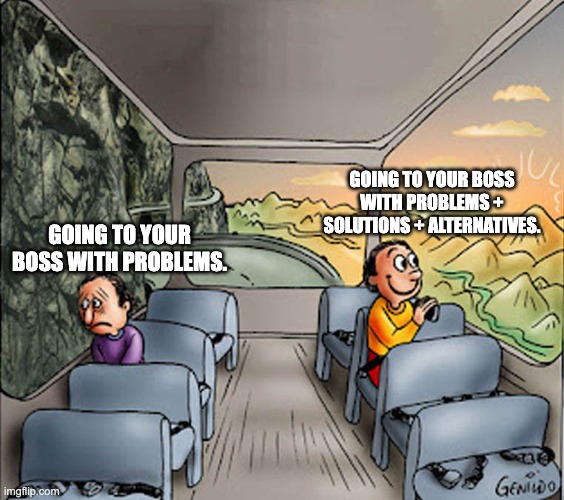
I suggested a different approach. Rather than going to him with open-ended questions, she began going to him with the problem, her proposed solution, and one or two alternatives. With this change in place, a few things immediately took effect.
This is what managing up looks like in practice. I know it sounds cliche but it’s about alignment, reducing friction, building a relationship where both of you operate effectively. When you manage up well, you create momentum and clarity for yourself and in doing so, you make the partnership stronger.
Now that we all understand what managing up is, the next step is understanding the environment your manager operates in. I believe most friction between employees and managers doesn’t come from personality clashes. If both parties are reasonably professional, it comes from not fully grasping the pressures, responsibilities, and constraints your manager is dealing with behind the scenes. They are lonely in their own thoughts. The closer you get to your manager, which happens with time, you can know more about their world.
Managers, regardless of seniority, spend most of their time balancing four responsibilities:
When you look at your manager’s behaviour through these lenses, everything becomes easier to interpret. The next time your manager asks a question, think about these. Generally speaking, here are a few rules you can go by.
The key insight is simple though. Your manager’s behaviour is often a reaction to their own pressures. If they feel anxious, overloaded, or blindsided, they tighten control. If they trust you, they loosen that control and give you autonomy. Do not take this personally.
This is why managing up works. Every time you bring clarity, structure, solutions, or proactive communication, you’re directly reducing your manager’s cognitive load and risk exposure. And when you do that consistently, they naturally respond with more trust and more freedom.
So the question shifts from:
*“Why is my manager acting like this?”*to
“What pressure is driving this behaviour, and how can I help reduce it?”
That’s pretty much the foundation of upward influence. You want to understand the system your manager operates in, and position yourself as someone who stabilises that system rather than destabilises it. When you operate from that mindset, everything downstream, communication, decisions, escalation, autonomy improves dramatically.
Alright, now we also understand our manager’s operating context, the next is to learn how to influence them in the right way. Influencing has decades of organizational behavior research mapping out how people persuade upward, which strategies work best, and which ones damage trust. I added a few good reads at the end, take a look. When you understand these patterns, managing up becomes far more predictable and far less personal.
The most widely used framework breaks influence into a set of tactics. Some are soft. Some are hard. Some are collaborative. Some are risky. Obviously, our goal isn’t to use all of them. We want to use the right tactic for the right moment. Let’s walk through the most relevant ones together.
I believe this is the most effective and widely used influence strategy, especially in engineering. Your manager, being a past engineer, is probably a rational being. Thus, use facts, logic, and clear reasoning to make your case.
Managers, especially overloaded ones, respond well to structured thinking because it reduces their cognitive load. Rationality works best when you:
With this in place, you avoid emotional escalation, and build trust faster than anything else.
When you are co-creating, you are asking them for their input to shape the solution together. This actually works both upwards and downwards. If you include people in your solutioning process, they simply feel more ownership. You still lead the thinking, but your manager feels involved in the creation. This increases their buy-in and reduces future resistance. It works especially well when you need:
Put simply, everyone supports what they help build.
This is often misunderstood. You aren’t trying to manipulate, you just recognize their work. I honestly have a hard time doing this. Maybe, you, too. Somehow, I need to learn it better. You appreciate work done by your direct report but not your manager? Yeah, I should do that, too. We should simply:
The problem is people often think this is flattery or masking negative information. When you use it ethically, it creates relational ease. When you use it poorly, it becomes the politician's failure mode. You simply become someone who tells the manager only what they want to hear, which destroys trust long-term. So the rule is simple: be warm, but never dishonest.
Exchange is transactional. Here are a few examples.
It works when your manager has something you need and you have something they value.
Use it consciously and sparingly. It’s effective, but purely transactional relationships don’t scale.
Assertiveness is sometimes necessary, especially in crisis or when stakes are high, but it carries risk. You can say something like “This has been pending for two weeks. I need a decision by the end of day to stay on track.” This is direct, time bound and clear. Nonetheless, it can back fire if you use it a lot. In time, it damages long-term influence. You should use it like a fire extinguisher. Emergency only.
This is an interesting one. You need to gather support from peers or stakeholders before approaching your manager but you need to understand their perspective. Note that this becomes less effective as you high up. It’s useful when you need to show:
Cross-team alignment
Broad agreement
Operational consensus
If you do this wrong, your manager might feel like you’re doing something behind their back. So they can become defensive. I suggest talking about what you’re going to do subtly. Then, use it to strengthen ideas, not to corner your manager.
This is absolutely a last resort. I’ve never done this even once. This is when you go above your manager to get a decision made. Before doing it, think three times and ask a friend. You should only do this when:
Remember: when you escalate, your manager’s manager has to override your manager’s decision. That never feels good, and if done carelessly, it will damage the relationship. You also need absolute confidence that your manager’s manager is trustworthy and aligned with you. If not, escalation can backfire badly.
Even with the right influence tactics, managing up only works when you adjust your approach to the kind of manager you have. If you are here, you might have already noticed that not all managers, especially new ones, operate the same way. There’s no one size fits all solution. Well, we are all humans with different personalities.
As you become a manager or leader, you probably understand, part of the drill is to manage dynamics. And that starts with recognizing what kind of manager is in front of you. There are three broad archetypes you’ll encounter: the Micromanager, the Hands-Off Manager, and the Senior Executive. Each requires a different strategy.
Micromanagers aren’t controlling because they enjoy it. They micromanage because they’re anxious, uncertain, or afraid of surprises. And sometimes they are insecure. Their behaviour is a reaction to a perceived loss of control. This happens a lot when someone becomes a manager of managers for the first time. They don’t know how to let it go.
Micromanagement decreases as trust increases. So your strategy is simple. Reduce their anxiety, increase their trust and gain their respect. Here’s what works.
When a micromanager sees consistency, transparency, and predictability, they should loosen their grip. Note that PIP related micromanagement is an entirely different story.
A hands-off manager isn’t necessarily disengaged. Often they’re juggling too many responsibilities, operating at a strategic layer, or simply prefer autonomy-first leadership.
This style sounds ideal in theory until you realise you’re operating without direction. Here’s what works.
Hands-off managers reward people who self-manage. The more you show you can run without guidance, the more they treat you like a peer rather than a subordinate.
This is a category of its own. Senior leaders operate under extreme time constraints, broad scope, and massive uncertainty. They think in outcomes, risk, and resource allocation never in step-by-step detail. The rule here is simple: Say less, mean more.
Executives don’t want lengthy explanations or deep dives. They want clarity, speed, and decision-ready information. Here’s what works.
If you can compress complexity into clarity, they will trust you immediately.
Managing up isn’t a trick, a hack, or a political maneuver. It’s a professional competency. It’s something that becomes more important the further you progress in your career. Most people assume their success depends on having a “good manager.” There’s truth to that. But the reality is slightly different. Your success depends on how effectively you work with the manager you have.
When you understand your manager’s pressures, adapt to their style, communicate with clarity, and bring structured solutions instead of open-ended problems, three things happen:
Managing up is ultimately about creating a partnership, not a dependency. It’s about reducing friction, preventing surprises, and aligning your work with the broader system your manager operates in.
Talking Up: Study of Upward Influence Strategies
How To Manage Up - Lessons From Scaling Teams at Credit Karma & Lyft
此内容由惯性聚合(RSS阅读器)自动聚合整理,仅供阅读参考。 原文来自 — 版权归原作者所有。