








Published · 10 min read
Amazon’s decision to cut 15% of its managers likely comes from a closer look at ratios. Were there too many managers with only 2-3 direct reports? That’s entirely possible. From my time at AWS, I didn’t see this much in engineering, so I doubt those teams will feel it as hard. But other departments with too many managers overseeing too few people were probably more bloated. It’s similar to what Meta's doing in its "Year of Efficiency," flattening structures and cutting unnecessary roles to make teams leaner and more agile.
It’s likely Amazon found departments with bloated management structures where managers oversee just a couple of direct reports. That’s inefficient, especially at Amazon’s scale. If some areas had too many middle managers doing very little oversight, then trimming the fat makes sense. But, of course, it depends on which part of the company you’re looking at.
In any event, this brings us to a good question: What’s the ideal number of direct reports for a manager in engineering? You don’t have to wait for an answer. I have my magic number: seven. Well, obviously, it can’t be just one number, so let’s explore span of control, why seven and what data says.
Span of control is basically how many people a manager directly manages. If it is a narrow span, like fewer than five people, it is when a manager needs to be hands on, coding and contributing. You are able to spend more time mentoring, guiding, and really digging into the details of each team member’s work. This level of closeness can be useful in very technical environments. Nevertheless, there is a downside. It might be too narrow. You might end up micromanaging or dealing with too many layers of management. It obviously can make everything move slower than it needs to.
On the other hand, a wide span of control over ten people means fewer layers and faster decision making. Nonetheless, it can overwhelm the manager. It becomes harder to stay present for individuals, and harder to maintain consistent quality across the team. It is like trying to keep up with too many spinning plates. The wider the span, the more a manager relies on structure, clarity, and established processes rather than personal involvement. In engineering teams, the sweet spot tends to be around five to nine reports in my experience.
This range creates a balance where the manager is not spread too thin, yet still close enough to the work to influence direction, culture, and quality. It is the surface area where leadership effort produces the highest return.
Seven strikes the right balance. From my experience and what I have seen, when a manager has about seven direct reports, they have enough bandwidth to give attention to each team member while also staying involved in higher level strategic tasks. It keeps you close enough to the work without pulling you into every detail. When you dip below that, like two or three reports, the manager is not really managing. They are more of a peer or, worse, micromanaging. On the other hand, managing more than ten or twelve people starts stretching the manager too thin, making it hard to build meaningful relationships with people, give proper feedback, or dive deep into the work.
Seven also creates a natural rhythm. The team is large enough to feel like a real unit, but small enough that you actually know what everyone is doing and what they need. In my experience, this size allows problems to surface early and wins to spread faster.
It also gives the manager space to think, plan, and work on the broader system around the team, rather than spending all their energy reacting to immediate needs. This balance is difficult to maintain with fewer or significantly more direct reports.
Seven direct reports strike an optimal balance because of practical time management constraints. Consider the following simple formula to illustrate this. To determine the optimal number of direct reports for a manager, let us consider the total time required within a standard forty hour workweek.
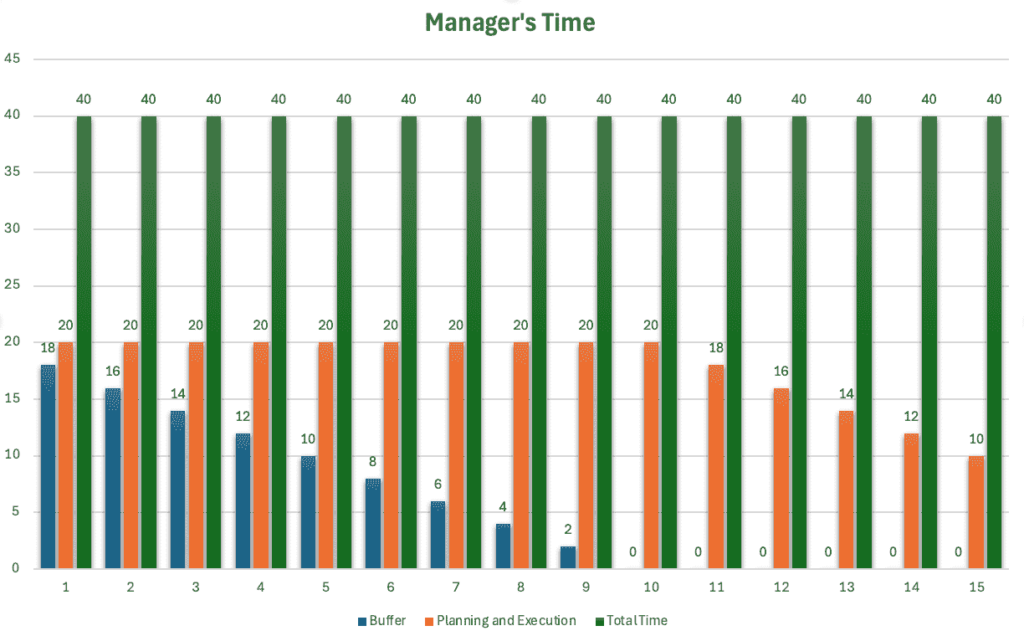 Amount of time an engineering manager can have vs number of direct reports.
This time is devoted to ensuring smooth operation within the team and effective collaboration with other parts of the organization. It includes:
This period focuses on higher-level responsibilities that drive the team's success and contribute to organizational goals.
To avoid overextending, the total time should not exceed a 40-hour workweek:
Solving for N:
While technically up to 10 direct reports fit within the time constraint, this leaves no buffer for unforeseen issues or in-depth engagement.
Therefore, seven direct reports provide a sweet spot:
This balance minimizes the risks of micromanagement associated with too few reports and the overextension that comes with too many, making seven the optimal number.
I believe an effective manager regardless of the hierarchy typically spends around at least 20 hours per week on responsibilities beyond direct report interactions. This is why managing approximately seven direct reports is optimal. It allows managers to effectively balance providing support to their team with fulfilling broader organizational duties.
The data around span of control shows that the sweet spot for effective management typically falls between 7-9 direct reports. Quantum Workplace analyzed over 20,000 managers and found that engagement peaked with 8-9 reports. Managers with this span of control can maintain meaningful relationships with their teams without becoming overwhelmed by administrative duties. Too few direct reports (fewer than 5) leads to micromanagement, while managing more than 10 increases the risk of burnout and inefficiency.
Similarly, McKinsey highlights that in complex, dynamic environments like engineering, this range is optimal. They suggest that more intricate work requires closer oversight, making 7-9 reports ideal for balancing leadership and project management.
From my experience, there’s really no one-size-fits-all approach to span of control. I know I just said 7 is the magic number, but hey, it depends! The reality is, it’s about context. If the manager’s more experienced, they can juggle more direct reports because they know how to delegate effectively and keep things moving. But if their team is full of juniors, the manager’s going to need a smaller span to really coach and develop them properly.
And let’s be real. If the manager is still hands-on, like contributing code or being involved in day-to-day execution, they’re going to need a smaller team. On the other hand, if they’re more focused on strategy and high-level decision-making, they can take on more people. It also depends on the type of work. Teams working on high-collaboration projects need more attention, while teams running more independent streams can get away with having a bigger span. So yeah, seven might be the sweet spot in some cases, but there’s definitely no hard rule here!
Alright, I’ll admit it. Seven is my magic number, but it’s not some universal law. Every manager and every team is different. I might swear by seven, but the reality is that no number works for everyone. There are a ton of variables that play into the ideal span of control, from the manager’s experience, to how self-sufficient the team is, to the kind of work they’re tackling. So yeah, while I’ll keep claiming seven is perfect, even I know it’s just a guideline. Don’t be afraid to call my bullshit. Just make sure you’re looking at your own context and needs before locking in that number!
此内容由惯性聚合(RSS阅读器)自动聚合整理,仅供阅读参考。 原文来自 — 版权归原作者所有。