







Published · 7 min read
The other day, I caught myself giving advice again. I do that a lot. Probably too much. While I was talking, something hit me. I have been told the right thing many times in my career, and in life, and I still did not follow it. They were right. I just did not listen.
My first boss in a three-person startup gave me career advice, but also real practical life advice. I ignored most of it. I thought I was different. Things would work out differently for me. I was wrong.
The problem with advice is not really correctness. A lot of advice is correct. The problem is that correctness without experience often feels like a nice sentence.
I think a lot of advice fails because we confuse agreement with usability. Most advice is given in a calm state. Of course you should not overcommit. Of course you should talk to users first. Of course you should take care of your health. The advice makes sense.
Nonetheless, the moment where advice becomes useful is usually messier. You are tired, embarrassed, pressured, hopeful, afraid, or already invested. Saying no costs you something. Changing direction means admitting you were wrong. The easier path is right there.
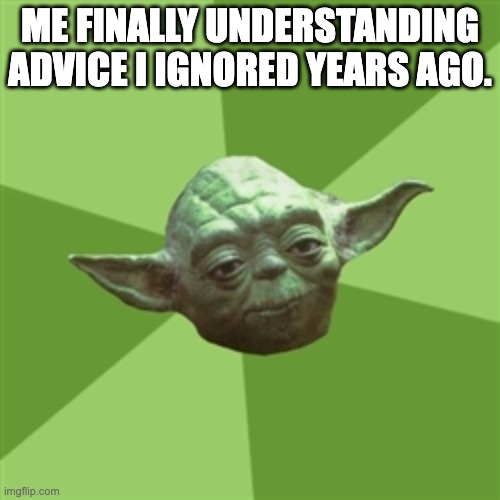 Why We Ignore Advice Meme
The other problem is that advice has to fight your existing beliefs. We already have a story in our head. Our version feels richer because we know the hidden details, the pressure, the fear, the hope, and all the little exceptions.
That is why “Yes, but…” is where most good advice dies. I have done a lot of projects in the past only to fail. One idea I carried for too long was that if I made a good product, it would sell itself. I heard the advice about talking to users before building. I understood it. Still, I thought our product was different.
Then came OffJar. We built the thing. I avoided finding enough people who had the problem, cared about it now, and would actually use what we made. Building felt like progress. Talking to users felt like a waste of time. So I picked the work that let me feel competent. That is the dangerous part. It does not feel like ignoring advice. It feels like adapting it to your special case. Most of the time, the special case is bullshit.
Advice often arrives as a threat to the self. Even when nobody means it that way, the recipient hears: your current way is wrong. Once that lands, resistance starts before reflection does.
“You need to stop doing this” is a verdict. It may be completely accurate, but it puts the other person in a corner, and cornered people do not reflect. They defend. “I made the same mistake, and here is what it cost me” carries almost the same information, but it gives the person more room. They are being shown the shape of a mistake before they have to claim it.
The instinct is to protect someone from the failure you can already see coming. The problem is that delivery can collapse the distance between “I see a risk” and “you are doing this wrong.” The person on the receiving end feels the accusation, even when you meant the warning.
I find this interesting because useful advice does not always need to be softer. Sometimes it needs more room around it. Hard truths can help, but only when they do not make someone protect their ego before they can inspect the idea.
Then there is the weight missing from the sentence. People often take years of mistakes, pain, and correction, and compress all of it into one clean line of advice. By the time they say it, the lesson feels obvious to them. They know what it costs. The listener does not. So the advice arrives looking light, even though it was paid for heavily.
I remember one of my professors saying that if you truly understand a topic, you should be able to write a book, a paper, and a paragraph on it. Only then can you claim you have it. I liked it immediately. Filed it away as a smart thing a smart person said. That is usually the sign that nothing useful is about to happen.
At the time, I heard it as a clever sentence about learning. Later, it became useful at work, when I had to write executive updates on different topics. An executive update has to carry enough depth to be trusted, but not so much detail that the point disappears. You need to know what to include, what to leave out, what context matters, what risk needs visibility, and what would only create noise.
That is where my professor’s advice became useful. I finally understood that the book, the paper, and the paragraph are not just different lengths. They are different tests of control over the same idea. The book proves you can explore it. The paper proves you can structure it. The paragraph proves you know what survives compression.
Most advice-givers, including myself, hand over the conclusion without the context that produced it. "Do not overcommit" is a good example. I said it many times to managers and engineers. People still overcommitted. Looking back, I think I framed it too shallow.
A more useful version goes something like this. I used to overcommit because I trusted my ability to push through complexity. The plan always looked manageable in my head. The known work was clear, and I assumed the unknowns would get solved along the way. Then the hidden work showed up. One small integration exposed a bigger gap. One missing owner slowed the whole thing down. Now I try to separate confidence from commitment. I can believe something is possible without pretending the path is already understood.
You can see why the mistake was tempting, where the cost appeared, and what actually changed after it hurt. That has a much better chance of landing than tossing out the clean conclusion and hoping it turns into wisdom on its own.
I think some lessons are not transferable at full strength. You can warn someone. You can show the pattern. You can share the scar. But they may still need to hit the wall themselves. Not because they are stubborn, but because the advice is pointing at an experience they have not had yet. You cannot shortcut someone into a context they have not lived.
That is how I feel about the life advice I got from my first boss. I had to fall a few times before I understood it. The dude was right. Annoyingly right. I came to the same conclusions much later and had that painful moment of recognition. He had already given me a lot of what I needed. I just did not have the context to receive it.
Now I understand the gravity of what he said. Back then, it was advice. Later, it became evidence.
I still give advice, probably too much. I am trying to be less attached to whether someone follows it immediately, because that might be the wrong measure in the first place. Some advice is not accepted when it is given. It becomes useful later, when life creates the missing context and the person can finally see the shape of the thing you were pointing at.
So these days I care more about leaving a useful marker, not just the conclusion, but the situation that taught it, the mistake that made it expensive, the signal I ignored, the cost I paid, and the adjustment I made after.
Correct advice is cheap. The expensive part is being patient enough to let someone reach the same conclusion on their own timeline, not yours.
此内容由惯性聚合(RSS阅读器)自动聚合整理,仅供阅读参考。 原文来自 — 版权归原作者所有。