


Published · 8 min read
It was another lazy Sunday. And I like them at this point. You start to appreciate them more and more. I let YouTube’s algorithm land me on a few chess videos. Later, it pushed me straight into a scene from Kingdom of Heaven. It’s just beautiful. Hard to resist. The visuals, the atmosphere, the quotes.
Long story short, I watched the director's cut end to end. Yeah, I know. Not the first time. Definitely not the last. And here’s an interesting thing. If you've only seen the theatrical cut, you probably weren’t impressed. I don’t blame you. It’s shallow and half the story is missing. Honestly, it doesn’t have the same taste as the director’s cut. Let's first see the scene which lead me to the full movie.
So what exactly makes the director’s cut so much better? Being an engineer, I can’t help using the 5 Whys technique to break it down.
Because the theatrical cut was trimmed way too much. I’m not talking about small cosmetic cuts. Someone took a chainsaw and cut it in half. When you watch a theatrical cut, you sense that something is missing, that characters act erratically, that the story leaps around. And it isn’t your imagination. It’s the result of removing:
When you strip all that out, the film looks out of depth. But that leads us to the next question.
Because the studio wanted a shorter, more commercial movie even if that meant destroying its internal logic. I think the most infamous removal was the entire arc involving Sibylla’s son, a future king slowly succumbing to leprosy. This was a cornerstone of the emotional, political, and moral tension of the story. In the director’s cut, you see her son showing early signs of leprosy. She makes the decision to poison her own son. It all makes sense. But let’s keep going. Ask the next why?
Because without motivation, you only have actions. Don’t get me wrong, I like actions. They were beautiful and cinematic. However, when characters act without understandable motivations, they feel fake. In the director’s cut, you see a why behind every choice:
But we’re not done yet.
Because the theatrical version removed the very scenes that made them human, relatable, or believable. In the theatrical cut, he comes across like a medieval superman. A blacksmith who suddenly leads armies, defeats knights, solves sieges and somehow becomes the conscience of Jerusalem.
Nonetheless, with director’s cut, you see Balian’s history as a trained soldier, his trauma of his wife’s suicide, his relationship with Godfrey and his lineage, the French village politics and the moral guidance from The Hospitaler.
Now we arrive at the final, deepest question.
Because the director’s cut finally reflects a better moral and thematic vision. The theatrical cut is just a sequence of events. In the director's cut, you see a full blown story.
And after so many rewatches, I can confidently say: the director’s cut is the only version that feels complete.
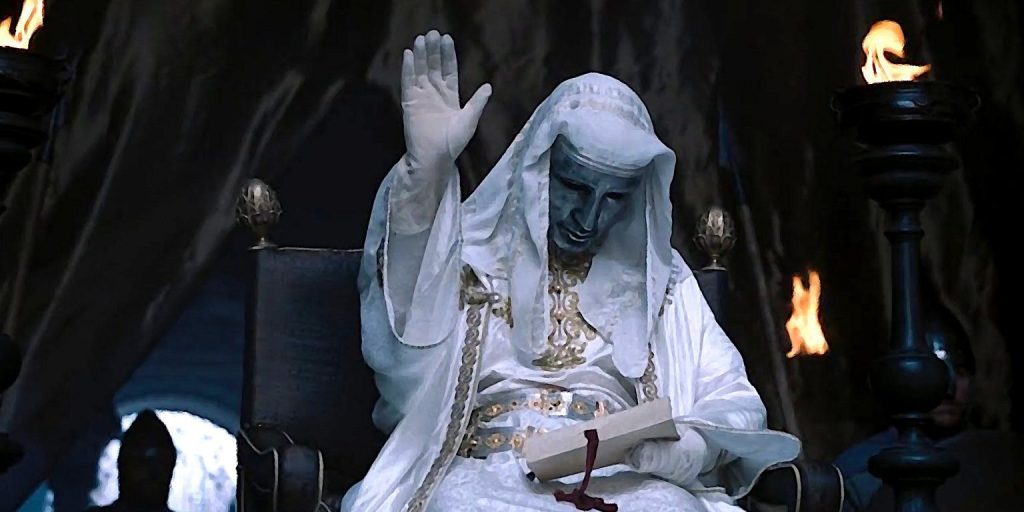 King Baldwin IV in Kingdom of Heaven
One of the reasons I keep rewatching this film besides the story is the dialogue. Here are my favorites.
At the end of the movie, Balian asks Saladin what the city of Jerusalem is worth. Saladin pauses, looks at him, and answers:
Nothing.
He turns, walks a few steps toward his camp then stops, looks back over his shoulder, and with a smile says:
Everything.
I love this one because it captures the entire film’s philosophy in two words. On a practical level, Jerusalem isn't all that useful place. It’s not a port, it has no natural resources, and aside from sitting on a hill, it isn’t even especially strategic. By every military and economic metric, the city is “nothing.”
But spiritually? Culturally? Symbolically? It is everything. To three faiths, to millions of people, to entire civilizations defined by what the city represents.
Another quote that always stays with me is King Baldwin’s speech to Balian. I love this one because Baldwin cuts through all excuses. He reminds Balian and us that no matter what power structures surround us, no matter what pressures or expectations come from kings, fathers, or entire nations, we are ultimately responsible for our own choices.
When I was sixteen, I won a great victory. I felt in that moment I would live to be a hundred. Now I know I shall not see thirty. None of us know our end, really, or what hand will guide us there. A king may move a man, a father may claim a son, but that man can also move himself, and only then does that man truly begin his own game. Remember that howsoever you are played or by whom, your soul is in your keeping alone, even though those who presume to play you be kings or men of power. When you stand before God, you cannot say, ‘But I was told by others to do thus,’ or that virtue was not convenient at the time. This will not suffice. Remember that.
It’s a speech about accountability, conscience, and moral ownership. You can be moved on the chessboard by people far more powerful than you, but only when you choose your own direction does your life actually begin.
This line from Imad always came to me as interesting the first time I heard it, but it didn’t fully make sense until the end of the film. At first, it just sounds okay. But once everything plays out, you realize how profound it actually is.
Your quality will be known among your enemies, before ever you meet them.
Imad says this long before Balian defends Jerusalem, long before Balian proves himself as a leader, a strategist, and a man of conscience. Somehow, Imad sees something in him not just skill, but character. And that is what makes the line hit so hard on rewatch. Because when everything is said and done, Balian’s “quality” truly does become known among his enemies. They literally talk about him after the first day of siege.
One of the most powerful lines in the entire film comes from The Hospitaler. This is a man who stands somewhere between faith and philosophy, always calm, always watching, always guiding.
I put no stock in religion. By the word religion, I have seen the lunacy of fanatics of every denomination be called the will of God. Holiness is in right action, and courage on behalf of those who cannot defend themselves, and goodness. What God desires is here(head) and here(heart) and what you decide to do every day, you will be a good man or not.
I love this one because it cuts straight through the noise of the Crusades. All the banners, all the fanaticism, all the people claiming they kill in the name of God and distills morality down to something brutally simple:
Every rewatch of the director’s cut reminds me why this film stays with me. It feels richer, deeper, and far more coherent than the theatrical version ever did. The restored scenes give the story its missing heart, and the characters suddenly feel human instead of symbolic. Each time I return to it, I find another layer, a line that hits differently, a moment that reveals more than I remembered. For a movie I’ve watched so many times, it still has the ability to surprise me. That alone says everything about why this is the version worth choosing.
此内容由惯性聚合(RSS阅读器)自动聚合整理,仅供阅读参考。 原文来自 — 版权归原作者所有。