What is MongoDB and How Does It Work? | Sealos Blog
Sealos·2025-05-29·via Sealos Blog
MongoDB has established itself as the leading NoSQL document database, revolutionizing how organizations store and manage data in today's application-driven landscape. This comprehensive guide explains everything you need to know about MongoDB, from basic concepts to advanced deployment strategies.
MongoDB is an open-source NoSQL document database designed to handle modern application data with flexibility, scalability, and performance. Originally developed by 10gen (now MongoDB Inc.) in 2007, MongoDB has rapidly become the industry standard for building applications that require flexible data models, horizontal scaling, and real-time analytics.
At its core, MongoDB stores data in flexible, JSON-like documents, meaning fields can vary from document to document and data structure can be changed over time. It provides a distributed database platform that can handle massive amounts of data while maintaining high performance across distributed systems.
Why MongoDB Matters
In today's application-driven digital environment, organizations need to:
Store and retrieve complex, nested data structures efficiently
Scale database operations horizontally across multiple servers
Adapt data models quickly as application requirements evolve
Support real-time analytics and aggregation workloads
Enable rapid application development with flexible schemas
MongoDB addresses these needs by providing a document-oriented database that works seamlessly with modern programming languages and development frameworks. Its combination of flexibility, performance, and scalability has made it the database of choice for modern applications.
Organizations deploying MongoDB at scale often benefit from managed database platforms that handle operational complexity while preserving the flexibility and performance characteristics that make MongoDB attractive for modern development workflows.
To understand MongoDB's significance, it's important to recognize the evolution of database approaches:
Relational Database Era: Structured data in rigid tables with ACID properties
Object-Relational Era: Attempts to bridge object-oriented programming and relational storage
Web Scale Era: Need for horizontal scaling beyond single-server limitations
NoSQL Era: MongoDB emerged as a flexible solution for diverse data types
Multi-Model Era: Modern applications requiring multiple data models and real-time processing
MongoDB built upon decades of database research and real-world web-scale experience to create a solution that balances flexibility, performance, and operational simplicity, making enterprise-grade document storage capabilities available to organizations of all sizes.
MongoDB is built around fundamental design principles that guide its implementation and development:
Flexibility: MongoDB supports dynamic schemas and nested data structures, allowing applications to evolve without rigid constraints or complex migrations.
Scalability: The platform is designed to scale horizontally through sharding, handling massive data volumes and high throughput requirements across distributed clusters.
Performance: MongoDB provides native indexing, in-memory processing, and query optimization that deliver excellent performance across diverse workloads.
The Document Model
One of MongoDB's key strengths is its document-oriented approach that stores data in BSON (Binary JSON) format. This approach ensures:
Natural mapping to programming language objects
Support for nested structures and arrays
Schema flexibility without sacrificing query capabilities
Rich data types including dates, numbers, and binary data
A MongoDB deployment consists of several interconnected components working together to provide database services:
MongoDB Cluster Architecture
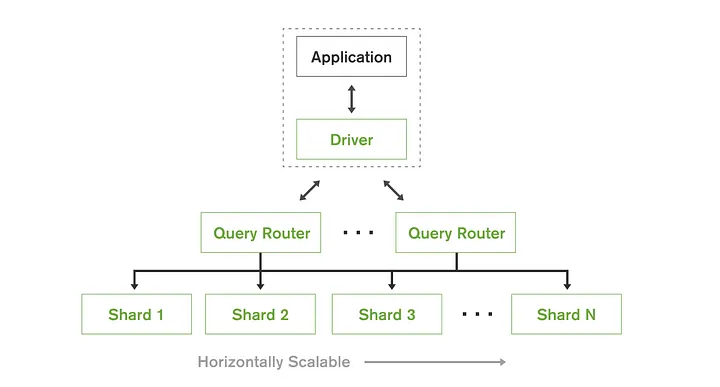
The MongoDB cluster architecture is designed with distributed data management in mind, featuring multiple layers of functionality:
Storage Layer: Individual MongoDB instances that store and serve data
Replica Set Layer: Provides high availability through data replication
Sharding Layer: Enables horizontal scaling across multiple replica sets
Query Layer: Handles query routing and optimization across the cluster
Core Components
MongoDB's distributed architecture includes several key components:
Mongod: The primary database process that handles data requests and management
Collections: Groups of documents, similar to tables in relational databases
Documents: Individual records stored in BSON format
Replica Sets: Groups of mongod instances that maintain the same data set
Shards: Horizontal partitions of data across multiple replica sets
Config Servers: Store metadata and configuration settings for sharded clusters
Query Processing Flow
MongoDB processes queries through several stages:
Query Parsing: Analyzes query syntax and creates execution plans
Index Selection: Determines optimal indexes for query execution
Data Retrieval: Fetches documents from storage or memory
Result Processing: Applies projections, sorts, and aggregations
Result Return: Sends formatted results back to the client
MongoDB Architecture
Databases and Collections
Databases in MongoDB are containers that hold collections, indexes, and other database objects.
Collections are groups of documents that don't enforce a schema, allowing flexible data structures within the same collection.
Example collection creation:
Documents and Fields
Documents are the basic unit of data in MongoDB, stored in BSON format with flexible structure.
Fields can contain various data types including strings, numbers, dates, arrays, and nested documents.
Indexes and Query Optimization
Indexes improve query performance by creating efficient access paths to data:
Single Field Index: Index on a single field
Compound Index: Index on multiple fields
Multikey Index: Index on array fields
Text Index: Full-text search capabilities
Geospatial Index: Location-based queries
Query Optimization uses the explain() method to analyze query performance.
Aggregation Framework
Aggregation Pipeline provides powerful data processing and analysis capabilities:
$match: Filter documents
$group: Group documents and perform calculations
$sort: Sort documents
$project: Reshape documents
$lookup: Join collections
Schema Validation
Schema Validation allows optional enforcement of document structure:
MongoDB uses a flexible document model that adapts to application needs:
Document Structure
Each MongoDB document consists of:
_id Field: Unique identifier for the document (automatically generated if not provided)
Field Names: String identifiers for data elements
Field Values: Data of various BSON types
Nested Documents: Documents within documents for complex structures
Arrays: Ordered lists of values or documents
Data Modeling Patterns
Embedding: Store related data in a single document for atomic updates
Referencing: Link documents using references for normalized data
Hybrid: Combine embedding and referencing based on access patterns
Bucketing: Group time-series data into buckets for efficient storage
Schema Design Considerations
Read vs Write Patterns: Optimize structure for primary operations
Data Growth: Plan for document and collection size growth
Database Roles: Use built-in and custom roles for access management
SSL/TLS Configuration: Encrypt all network communications
Network Security
Bind IP: Restrict network interfaces MongoDB listens on
Firewall Rules: Control network access to MongoDB ports
VPN/Private Networks: Isolate MongoDB traffic from public networks
Encryption at Rest: Encrypt stored data using WiredTiger encryption
Example security configuration:
Compliance and Governance
Data Privacy Regulations: GDPR, CCPA compliance through field-level encryption
Audit Logging: Track database access and modifications
Data Retention: Implement automated data lifecycle policies
Schema Governance: Control schema changes and validation rules
MongoDB supports various deployment patterns to meet different requirements:
Single Instance Deployment
Traditional single-server deployment suitable for:
Development and testing environments
Small applications with limited scale requirements
Scenarios where simplicity is prioritized
Replica Set Deployment
High availability deployment with multiple copies of data:
Improved read performance through read scaling
Automatic failover for high availability
Data protection through multiple copies
Zero-downtime maintenance operations
Sharded Cluster Deployment
Horizontal scaling deployment for large datasets:
Distribute data across multiple servers
Scale beyond single-server limitations
Handle massive read and write workloads
Geographic data distribution
Cloud Deployment
Deploy MongoDB on cloud platforms:
Sealos transforms MongoDB deployment from a complex infrastructure challenge into a simple, streamlined operation. By leveraging the cloud-native platform of Sealos built on Kubernetes, organizations can deploy production-ready MongoDB clusters that benefit from enterprise-grade management features without the operational overhead.
Benefits of Managed MongoDB on Sealos
Kubernetes-Native Architecture: Sealos runs MongoDB clusters natively on Kubernetes, providing all the benefits of container orchestration including automatic pod scheduling, health monitoring, and self-healing capabilities. This ensures your MongoDB instances are always running optimally with automatic recovery from failures.
Automated Scaling: Sealos automatically adjusts your MongoDB cluster resources based on storage and performance requirements. During peak application usage periods, compute and storage capacity scales up seamlessly through Kubernetes horizontal pod autoscaling, while scaling down during low-traffic periods to optimize costs. This dynamic scaling ensures consistent performance without manual intervention or over-provisioning.
High Availability and Fault Tolerance: Sealos implements MongoDB replica sets using Kubernetes deployment strategies, ensuring your database remains available even during infrastructure failures. Automatic primary election, member recovery, and cross-zone replication maintain service continuity with minimal data loss through Kubernetes StatefulSets and persistent volumes.
Simplified Backup and Recovery: The platform provides easy-to-configure backup solutions leveraging Kubernetes persistent volume snapshots and automated backup scheduling. Point-in-time recovery capabilities allow you to restore your MongoDB cluster state to any specific moment, while incremental backups minimize storage costs and recovery time objectives.
Automated Operations Management: The platform handles MongoDB upgrades, security patches, configuration optimization, and cluster maintenance automatically through Kubernetes operators. Advanced monitoring detects performance issues and automatically applies optimizations for query performance, index usage, and resource utilization using Kubernetes-native monitoring and alerting.
One-Click Deployment Process: Deploy production-ready MongoDB clusters in minutes rather than hours required for traditional infrastructure setup. The platform handles replica set configuration, user authentication, security hardening, network configuration, and Kubernetes service mesh integration automatically.
Kubernetes Benefits for MongoDB
Running MongoDB on the Sealos Kubernetes platform provides additional advantages:
Resource Efficiency: Kubernetes bin-packing algorithms optimize resource utilization across your cluster
Rolling Updates: Seamless MongoDB version upgrades without downtime using Kubernetes rolling deployment strategies
Service Discovery: Automatic service registration and discovery for MongoDB replica set members and clients
Load Balancing: Built-in load balancing for MongoDB client connections through Kubernetes services
Configuration Management: Kubernetes ConfigMaps and Secrets for secure configuration and credential management
Horizontal Pod Autoscaling: Automatic scaling based on CPU, memory, or custom metrics like connection count
For organizations seeking MongoDB's flexibility with cloud-native convenience, Sealos provides the perfect balance of performance and operational simplicity, allowing teams to focus on building applications rather than managing complex Kubernetes and MongoDB infrastructure.
CRUD Operations
MongoDB provides intuitive methods for data manipulation:
Advanced Querying
MongoDB supports sophisticated query patterns:
Aggregation Pipeline
Powerful data processing and analytics:
Comprehensive monitoring is essential for maintaining optimal MongoDB performance:
Key Metrics
Query Performance: Execution times, documents examined, index usage
Database Metrics: CPU usage, memory utilization, disk I/O patterns
Replica Set Health: Lag time, oplog size, member status
Connection Metrics: Active connections, connection pool usage
Document Size Limits: Break large documents into smaller ones, use references
Schema Evolution: Plan for schema changes, use schema validation sparingly
Relationship Modeling: Choose between embedding and referencing based on access patterns
Index Bloat: Monitor index usage, remove unused indexes, optimize compound indexes
MongoDB continues to evolve with several emerging trends and improvements:
Serverless Architecture: MongoDB Atlas Serverless for auto-scaling applications
Multi-Cloud Support: Enhanced deployment options across cloud providers
Edge Computing: Lightweight MongoDB deployments for edge applications
AI/ML Integration: Built-in machine learning capabilities and vector search
Enhanced Security: Advanced encryption, audit capabilities, and compliance features
Installation Options
MongoDB Community Server: Free, open-source version with core features
MongoDB Enterprise: Commercial version with advanced security and management features
Docker Containers: Containerized MongoDB for development and testing
Cloud Services: Managed MongoDB services for production use
Learning Path
Document Database Fundamentals: Understand NoSQL concepts and document modeling
MongoDB Core Concepts: Learn collections, documents, queries, and indexes
Data Modeling: Master embedding vs referencing and schema design patterns
Performance Optimization: Study indexing strategies and query optimization
Production Operations: Learn replication, sharding, and operational best practices
First Application Steps
Install MongoDB: Choose appropriate installation method for your environment
Design Data Model: Plan document structure and relationships
Create Database Schema: Set up collections and initial indexes
Implement CRUD Operations: Build application data access layer
Monitor Performance: Deploy monitoring tools and establish performance baselines
Development Best Practices
MongoDB has proven itself as a robust, flexible, and scalable document database that continues to power modern applications across industries and scales. Its combination of schema flexibility, horizontal scalability, and comprehensive features makes it an excellent choice for organizations seeking a dependable foundation for their data management needs.
Whether you're building web applications, mobile backends, real-time analytics platforms, or content management systems, MongoDB provides the tools and capabilities needed to store and process data effectively. Its active development community, extensive documentation, and broad ecosystem support ensure that MongoDB remains a forward-looking choice for modern applications.
By understanding MongoDB's architecture, capabilities, and best practices, developers and database administrators can leverage its full potential to build applications that are not only functional but also performant, scalable, and maintainable. The combination of MongoDB's proven flexibility with modern deployment platforms creates opportunities for organizations to innovate while maintaining the data consistency and performance their users expect.
For organizations looking to deploy MongoDB with simplified management and enterprise-grade infrastructure, Sealos offers streamlined database hosting solutions that combine MongoDB's power with Kubernetes orchestration and cloud-native convenience and scalability.







 MongoDB Architecture