What is Apache Kafka and How Does It Work? | Sealos Blog
Sealos·2025-05-30·via Sealos Blog
Apache Kafka has established itself as the de facto standard for event streaming and real-time data processing, revolutionizing how organizations handle data flows in today's event-driven landscape. This comprehensive guide explains everything you need to know about Kafka, from basic concepts to advanced implementation strategies.
Apache Kafka is an open-source distributed streaming platform designed to handle real-time data feeds with high throughput, fault tolerance, and scalability. Originally developed by LinkedIn in 2010 and later donated to the Apache Software Foundation, Kafka has rapidly become the industry standard for building real-time streaming data pipelines and applications.
At its core, Kafka provides a distributed commit log service that allows applications to publish and subscribe to streams of records. It acts as a highly scalable message broker that can handle millions of messages per second while maintaining durability and fault tolerance across distributed systems.
Why Kafka Matters
In today's data-driven digital environment, organizations need to:
Process real-time data streams efficiently and reliably
Build event-driven architectures that respond to changes instantly
Scale data processing to handle massive volumes of information
Ensure data durability and fault tolerance across distributed systems
Enable microservices communication through reliable messaging
Kafka addresses these needs by providing a unified platform for handling all real-time data feeds in an organization. Its combination of high throughput, low latency, and fault tolerance has made it the backbone of modern data architectures.
When implementing Kafka in production environments, many organizations complement their streaming infrastructure with managed database solutions to ensure reliable data persistence and analytics capabilities for their event-driven architectures.
To understand Kafka's significance, it's important to recognize the evolution of data processing approaches:
Batch Processing Era: Data processed in large batches at scheduled intervals with high latency
Request-Response Era: Synchronous communication patterns with tight coupling between services
Message Queue Era: Asynchronous messaging with traditional brokers having throughput limitations
Event Streaming Era: Kafka emerged as a scalable solution for continuous data streams
Event-Driven Architecture Era: Modern applications built around events and real-time processing
Kafka built upon decades of distributed systems research and real-world experience at scale to create a solution that balances performance, reliability, and operational simplicity, making enterprise-grade streaming capabilities available to organizations of all sizes.
Kafka is built around fundamental design principles that guide its implementation and development:
Durability: Kafka implements robust data persistence with configurable replication, ensuring your data streams remain available and recoverable even during failures or system outages.
Scalability: The platform is designed to scale horizontally across multiple brokers, handling massive throughput requirements while maintaining low latency for real-time processing needs.
Fault Tolerance: Kafka provides automatic failover, data replication, and self-healing capabilities that ensure continuous operation even when individual components fail.
The Event Log Model
One of Kafka's key strengths is its commit log design that treats all data as an immutable sequence of events. This approach ensures:
Strong ordering guarantees within partitions
Replay capability for reprocessing historical data
Event sourcing patterns for building stateful applications
Audit trails and compliance through immutable event history
A Kafka deployment consists of several interconnected components working together to provide streaming services:
Kafka Cluster Architecture
The Kafka cluster architecture is designed with distributed processing in mind, featuring multiple layers of abstraction:
Broker Layer: Individual Kafka servers that store and serve data
Partition Layer: Horizontal scaling units that distribute topics across brokers
Replication Layer: Ensures data durability through configurable replication factors
Coordination Layer: Uses Apache ZooKeeper (or KRaft) for cluster coordination and metadata management
Core Components
Kafka's distributed architecture includes several key components:
Brokers: Individual Kafka servers that form the cluster and handle client requests
Topics: Categories or feeds of messages that organize data streams
Partitions: Ordered, immutable sequence of records within a topic
Producers: Applications that publish data to Kafka topics
Consumers: Applications that subscribe to topics and process the data
Consumer Groups: Logical grouping of consumers for parallel processing
Message Processing Flow
Kafka processes messages through several stages:
Message Publishing: Producers send records to specific topics and partitions
Storage: Brokers persist messages to disk with configurable retention policies
Replication: Data is replicated across multiple brokers for fault tolerance
Consumption: Consumers read messages from partitions at their own pace
Offset Management: Consumer progress is tracked through partition offsets
Kafka Architecture
Topics and Partitions
Topics in Kafka are categories that organize related messages, similar to database tables or message queues.
Partitions are ordered, immutable sequences of records within a topic that enable horizontal scaling and parallel processing.
Example topic configuration:
Producers and Consumers
Producers publish messages to Kafka topics with configurable delivery semantics:
At-most-once: Messages may be lost but never duplicated
At-least-once: Messages are never lost but may be duplicated
Exactly-once: Messages are delivered exactly once (requires additional configuration)
Consumers subscribe to topics and process messages, supporting both push and pull models for data consumption.
Consumer Groups and Partitioning
Consumer Groups enable parallel processing by distributing partitions among multiple consumer instances within the same group.
Partition Assignment ensures that each partition is consumed by exactly one consumer within a group, enabling horizontal scaling of message processing.
Schemas and Serialization
Schema Registry provides centralized schema management for message formats:
Avro: Binary serialization format with schema evolution support
JSON Schema: Human-readable format with structure validation
Protobuf: Efficient binary format with strong typing
Serializers and Deserializers handle conversion between application objects and byte arrays for network transmission.
Offsets and Retention
Offsets track consumer progress through partition logs, enabling replay and parallel processing.
Retention Policies control how long messages are stored:
Time-based: Delete messages older than specified time
Size-based: Delete oldest messages when size limit is reached
Compaction: Keep only the latest value for each key
Kafka uses an event-driven data model based on immutable event logs:
Message Structure
Each Kafka message consists of:
Key: Optional identifier for message routing and compaction
Value: The actual message payload or event data
Timestamp: When the message was produced or ingested
Headers: Optional metadata key-value pairs
Partition: The partition where the message is stored
Offset: Unique position within the partition
Event Patterns
Event Notification: Notify other services when something happens
Event-Carried State Transfer: Include state changes in events
Event Sourcing: Store all state changes as a sequence of events
CQRS: Separate read and write models using event streams
Stream Processing Concepts
Stateless Processing: Transform events without maintaining state
Stateful Processing: Aggregate or join events using local state
Windowing: Group events by time or count for batch processing
Stream-Table Duality: Convert between streams and tables
Kafka provides numerous mechanisms for optimizing performance:
Throughput Optimization
Batch Size: Configure optimal batch sizes for producers and consumers
Compression: Use algorithms like Snappy, LZ4, or GZIP to reduce network overhead
Partitioning Strategy: Distribute load evenly across partitions
Hardware Optimization: Optimize disk I/O, network, and memory configuration
Configuration Tuning
Key configuration parameters for performance optimization:
Sticky Partitioning: Optimize batching by preferring the same partition
Example custom partitioner:
Backup and Recovery
Kafka offers multiple backup and recovery strategies:
Cross-Cluster Replication: Mirror data to secondary clusters
Snapshot Backups: Point-in-time cluster state backups
Log Shipping: Stream transaction logs to backup systems
Disaster Recovery: Automated failover to backup clusters
Securing Kafka requires a comprehensive approach:
SASL Authentication: Support for PLAIN, SCRAM-SHA-256, GSSAPI/Kerberos, and OAUTHBEARER
SSL/TLS: Encrypt client-broker and inter-broker communication
Access Control Lists (ACLs): Control topic, consumer group, and cluster operations
Principal Mapping: Map authenticated principals to internal user names
Network Security
Encryption in Transit: TLS encryption for all network communication
Encryption at Rest: Encrypt stored data using filesystem or hardware encryption
Network Segmentation: Isolate Kafka clusters using firewalls and VPNs
Inter-Broker Authentication: Mutual authentication between cluster nodes
Example security configuration:
Compliance and Governance
Data Privacy Regulations: GDPR, CCPA compliance through data masking and deletion
Audit Logging: Comprehensive access and operation logging
Data Lineage: Track data flow and transformations
Schema Governance: Control schema evolution and compatibility
Kafka supports various deployment patterns to meet different requirements:
Single Cluster Deployment
Traditional single-cluster deployment suitable for:
Development and testing environments
Small to medium-scale applications
Scenarios where simplicity is prioritized
Multi-Cluster Deployment
Distributed deployment across multiple clusters for:
Geographic data distribution and latency reduction
Disaster recovery and high availability
Compliance with data residency requirements
Workload isolation and resource optimization
Kafka Connect Integration
Kafka Connect provides a framework for connecting external systems:
Source connectors: Import data from databases, files, and APIs
Sink connectors: Export data to databases, data warehouses, and storage systems
Transform data in-flight using Single Message Transforms (SMTs)
Kubernetes Deployment
Deploy Kafka on Kubernetes using operators:
Sealos transforms Kafka deployment from a complex infrastructure challenge into a simple, streamlined operation. By leveraging cloud-native platform of Sealos built on Kubernetes, organizations can deploy production-ready Kafka clusters that benefit from enterprise-grade management features without the operational overhead.
Benefits of Managed Kafka on Sealos
Kubernetes-Native Architecture: Sealos runs Kafka clusters natively on Kubernetes, providing all the benefits of container orchestration including automatic pod scheduling, health monitoring, and self-healing capabilities. This ensures your Kafka brokers are always running optimally with automatic recovery from failures.
Automated Scaling: Sealos automatically adjusts your Kafka cluster resources based on throughput and storage requirements. During peak data processing periods, broker capacity scales up seamlessly through Kubernetes horizontal pod autoscaling, while scaling down during low-traffic periods to optimize costs. This dynamic scaling ensures consistent performance without manual intervention or over-provisioning.
High Availability and Fault Tolerance: Sealos implements optimized deployment strategies for Kafka clusters using Kubernetes deployment strategies, ensuring your streaming platform remains available even during infrastructure failures. Automatic broker replacement, partition rebalancing, and cross-zone replication maintain service continuity with minimal data loss through Kubernetes StatefulSets and persistent volumes.
Simplified Backup and Recovery: The platform provides easy-to-configure backup solutions leveraging Kubernetes persistent volume snapshots and automated backup scheduling. Point-in-time recovery capabilities allow you to restore your Kafka cluster state to any specific moment, while incremental backups minimize storage costs and recovery time objectives.
Automated Operations Management: The platform handles broker upgrades, security patches, configuration optimization, and cluster maintenance automatically through Kubernetes operators. Advanced monitoring detects performance issues and automatically applies optimizations for throughput, latency, and resource utilization using Kubernetes-native monitoring and alerting.
One-Click Deployment Process: Deploy production-ready Kafka clusters in minutes rather than days required for traditional infrastructure setup. The platform handles ZooKeeper coordination, broker discovery, security hardening, network configuration, and Kubernetes service mesh integration automatically.
Kubernetes Benefits for Kafka
Running Kafka on the Kubernetes platform of Sealos providing additional advantages:
Resource Efficiency: Kubernetes bin-packing algorithms optimize resource utilization across your cluster
Rolling Updates: Seamless Kafka version upgrades without downtime using Kubernetes rolling deployment strategies
Service Discovery: Automatic service registration and discovery for Kafka brokers and clients
Load Balancing: Built-in load balancing for Kafka client connections through Kubernetes services
Configuration Management: Kubernetes ConfigMaps and Secrets for secure configuration and credential management
Horizontal Pod Autoscaling: Automatic scaling based on CPU, memory, or custom metrics like consumer lag
For organizations seeking Kafka's streaming power with cloud-native convenience, Sealos provides the perfect balance of performance and operational simplicity, allowing teams to focus on building event-driven applications rather than managing complex Kubernetes and Kafka infrastructure.
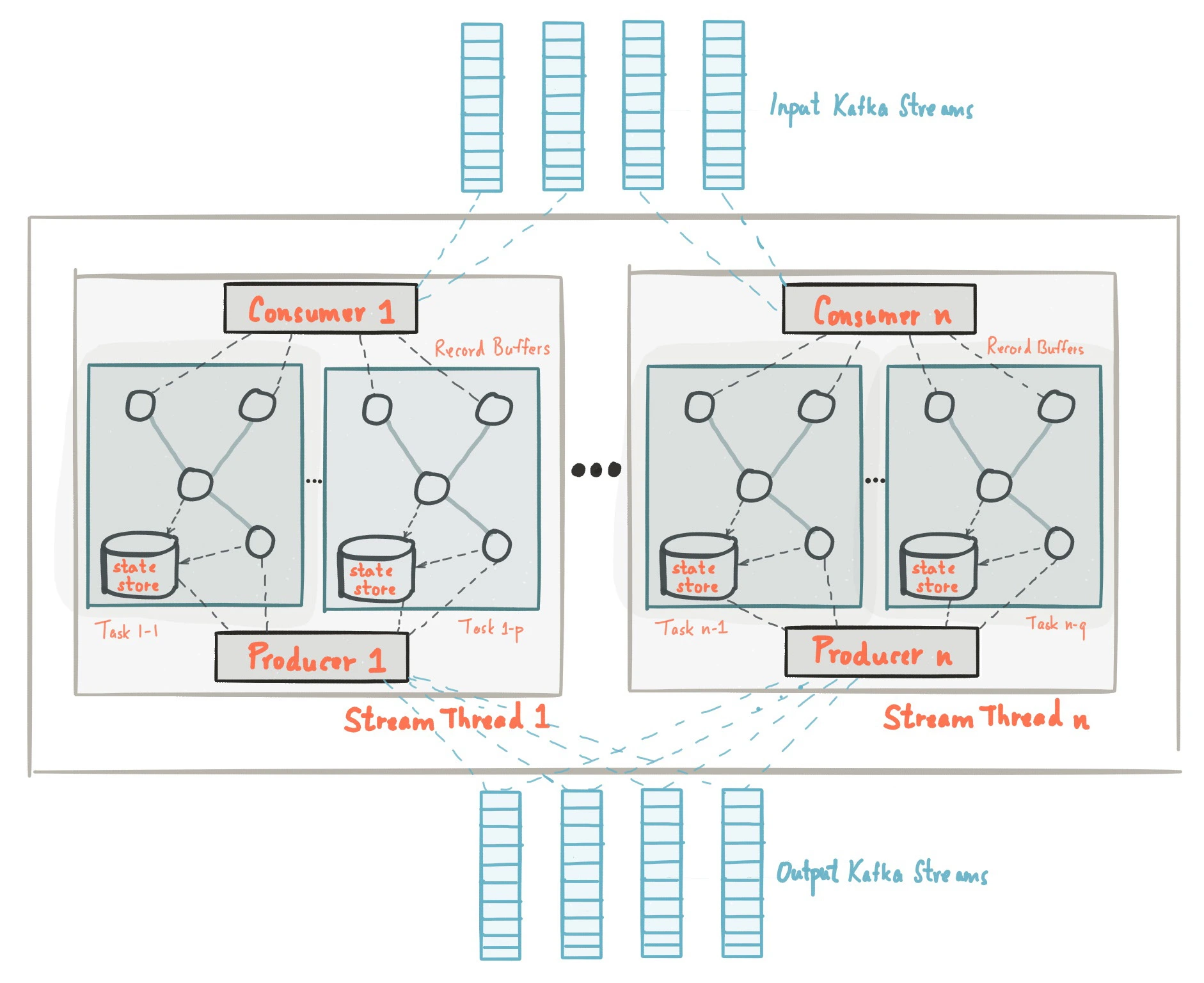
Kafka Streams
Kafka Streams is a client library for building real-time streaming applications:
Stream Processing Topology: Define data flow graphs with sources, processors, and sinks
State Stores: Maintain local state for aggregations and joins
Windowing: Process events in time-based or session-based windows
Fault Tolerance: Automatic recovery and state restoration
Example Kafka Streams application:
ksqlDB
ksqlDB provides SQL interface for stream processing:
Streaming SQL: Query streaming data using familiar SQL syntax
Materialized Views: Create real-time tables from streaming data
REST API: HTTP interface for queries and administration
Connectors Integration: Built-in integration with Kafka Connect
External Stream Processors
Popular external streaming frameworks that integrate with Kafka:
Apache Flink: Low-latency stream processing with advanced windowing
Apache Spark Streaming: Micro-batch processing for large-scale analytics
Apache Storm: Real-time computation system for continuous processing
Akka Streams: Reactive streaming toolkit for JVM applications
Comprehensive monitoring is essential for maintaining optimal Kafka performance:
Key Metrics
Throughput Metrics: Messages per second, bytes per second per topic/partition
Latency Metrics: End-to-end latency, producer/consumer response times
Consumer Lag: How far behind consumers are from the latest messages
Broker Health: CPU, memory, disk usage, and network I/O per broker
Message Ordering: Use single partitions for strict ordering requirements
Duplicate Processing: Implement idempotent consumers and exactly-once semantics
Data Loss: Configure appropriate acknowledgment levels and replication factors
Schema Compatibility: Enforce schema evolution rules and testing
Kafka continues to evolve with several emerging trends and improvements:
KRaft (Kafka Raft): Removing ZooKeeper dependency for simplified operations
Cloud-Native Features: Enhanced integration with cloud platforms and Kubernetes
Stream Processing Evolution: Improved real-time analytics and machine learning integration
Security Enhancements: Advanced encryption, authentication, and authorization mechanisms
Operational Improvements: Better monitoring, management, and automated operations
Installation Options
Apache Kafka: Open-source distribution with all core features
Docker Containers: Containerized Kafka for development and testing
Kubernetes Operators: Deploy Kafka on Kubernetes with operators like Strimzi
Cloud Services: Managed Kafka services for production use
Learning Path
Event Streaming Fundamentals: Understand publish-subscribe patterns and event-driven architectures
Kafka Core Concepts: Learn topics, partitions, producers, and consumers
Stream Processing: Explore Kafka Streams and ksqlDB for real-time processing
Production Operations: Study monitoring, scaling, and operational best practices
First Streaming Steps
Install Kafka: Choose appropriate installation method for your environment
Design Event Schema: Plan event structure and schema evolution strategy
Implement Producers: Build applications that publish events to Kafka
Build Consumers: Create applications that process events from topics
Monitor Performance: Deploy monitoring tools and establish performance baselines
Development Best Practices
Apache Kafka has proven itself as a robust, scalable, and reliable streaming platform that continues to power real-time applications across industries and scales. Its combination of high throughput, fault tolerance, and comprehensive ecosystem makes it an excellent choice for organizations seeking a dependable foundation for their event-driven architectures.
Whether you're building real-time analytics platforms, implementing microservices communication, or processing IoT data streams, Kafka provides the tools and capabilities needed to handle data flows effectively. Its active development community, extensive documentation, and broad ecosystem support ensure that Kafka remains a forward-looking choice for modern applications.
By understanding Kafka's architecture, capabilities, and best practices, developers and platform engineers can leverage its full potential to build applications that are not only functional but also performant, scalable, and maintainable. The combination of Kafka's proven reliability with modern deployment platforms creates opportunities for organizations to innovate while maintaining the data consistency and performance their users expect.
For organizations looking to deploy Kafka with simplified management and enterprise-grade infrastructure, Sealos offers streamlined streaming platform solutions that combine Kafka's power with Kubernetes orchestration and cloud-native convenience and scalability.









 Kafka Architecture