MySQL has established itself as one of the most widely used relational database management systems (RDBMS) in the world, powering millions of applications from small websites to enterprise-scale platforms. This comprehensive guide explains everything you need to know about MySQL, from fundamental concepts to advanced deployment strategies.
MySQL is an open-source relational database management system (RDBMS) that uses Structured Query Language (SQL) for accessing and managing data. Originally developed by MySQL AB in 1995 and now owned by Oracle Corporation, MySQL has become the backbone of countless web applications, powering some of the world's largest websites including Facebook, Twitter, YouTube, and Wikipedia.
At its core, MySQL provides a robust, scalable, and reliable platform for storing, organizing, and retrieving structured data. It follows the ACID (Atomicity, Consistency, Isolation, Durability) properties that ensure data integrity and reliability even in the face of system failures, power outages, or other unexpected events.
Why MySQL Matters
In today's data-driven digital environment, organizations need to:
Store and retrieve data efficiently and reliably
Scale database operations to handle growing workloads
Ensure data integrity and consistency across transactions
Implement robust security measures for sensitive information
Maintain high availability and disaster recovery capabilities
MySQL addresses these needs by providing a mature, feature-rich database platform that works seamlessly across different operating systems, programming languages, and deployment environments. Its combination of performance, reliability, and ease of use has made it the database of choice for developers and organizations worldwide.
For teams looking to focus on application development rather than database administration, managed database solutions offer MySQL hosting with automated maintenance, scaling, and monitoring capabilities.
To understand MySQL's significance, it's important to recognize the evolution of data storage solutions:
Flat File Era: Data stored in simple text files with limited querying capabilities
Hierarchical and Network Databases: Early structured databases with complex navigation requirements
Relational Database Era: Introduction of SQL and relational models for flexible data relationships
Open Source Database Era: MySQL emerged as a free, powerful alternative to expensive proprietary solutions
Cloud and Distributed Era: Modern MySQL deployments leverage cloud infrastructure and distributed architectures
MySQL built upon decades of database research and real-world experience to create a solution that balances performance, reliability, and accessibility, making enterprise-grade database capabilities available to organizations of all sizes.
MySQL is built around fundamental design principles that guide its implementation and development:
Reliability: MySQL implements robust ACID compliance, transaction support, and data integrity mechanisms to ensure your data remains consistent and recoverable even in adverse conditions.
Performance: The database engine is optimized for speed with features like query optimization, indexing strategies, and caching mechanisms that deliver excellent performance across diverse workloads.
Flexibility: MySQL supports multiple storage engines, allowing users to choose the best approach for their specific use case, whether prioritizing speed, data integrity, or specialized functionality.
The SQL Standard
One of MySQL's key strengths is its adherence to SQL standards while providing useful extensions and optimizations. This approach ensures:
Portability across different database systems
Familiar syntax for developers and database administrators
Compatibility with a vast ecosystem of tools and frameworks
Standardized query optimization and execution
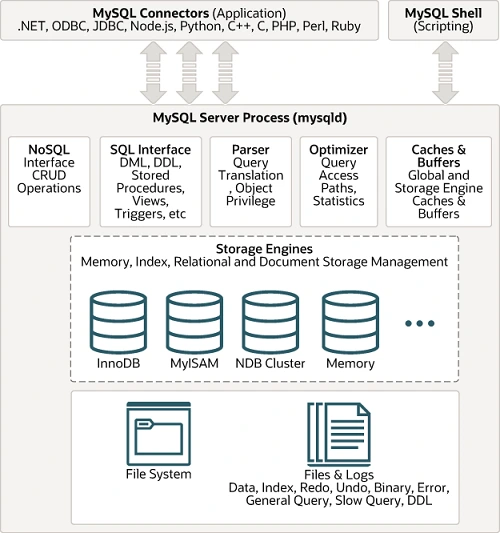
A MySQL deployment consists of several interconnected components working together to provide database services:
MySQL Server Architecture
The MySQL server architecture is designed in layers, each handling specific aspects of database operations:
Connection Layer: Manages client connections, authentication, and security
SQL Layer: Parses SQL statements, optimizes queries, and manages caching
Storage Engine Layer: Handles data storage, retrieval, and transaction management
File System Layer: Manages physical data files, logs, and indexes
Storage Engines
MySQL's pluggable storage engine architecture allows different engines to be used for different tables within the same database:
InnoDB: The default storage engine offering ACID compliance, foreign key support, and crash recovery
MyISAM: Fast storage engine optimized for read-heavy workloads
Memory (HEAP): Stores data in RAM for extremely fast access
Archive: Compressed storage for archival data
CSV: Stores data in comma-separated values format
Federated: Accesses data from remote MySQL servers
Query Processing
MySQL processes queries through several stages:
Connection Handling: Establishes and manages client connections
Query Parsing: Analyzes SQL syntax and creates parse trees
Query Optimization: Determines the most efficient execution plan
Query Execution: Executes the optimized plan and returns results
Result Caching: Stores frequently accessed results for improved performance
MySQL Architecture
Databases and Tables
Databases in MySQL are containers that hold related tables, views, stored procedures, and other database objects.
Tables are the fundamental data storage structures organized in rows and columns, where each table represents an entity and columns define attributes.
Example table creation:
Indexes and Keys
Indexes improve query performance by creating efficient access paths to data:
Primary Key: Unique identifier for each row
Unique Index: Ensures uniqueness across specified columns
Composite Index: Covers multiple columns for complex queries
Full-Text Index: Enables text search capabilities
Foreign Keys establish relationships between tables and enforce referential integrity.
Views and Stored Procedures
Views provide virtual tables that simplify complex queries and enhance security by controlling data access.
Stored Procedures are pre-compiled SQL programs that encapsulate business logic and improve performance through reduced network traffic.
Triggers and Events
Triggers automatically execute code in response to specific database events like INSERT, UPDATE, or DELETE operations.
Events are scheduled tasks that run at specified times or intervals, useful for maintenance operations and data processing.
Users and Privileges
MySQL implements a comprehensive security model with:
User accounts with authentication credentials
Role-based access control
Granular privileges at database, table, and column levels
SSL/TLS encryption for secure connections
MySQL uses a relational data model based on mathematical set theory and predicate logic:
MyISAM Features: Fast SELECT operations, table-level locking, compact storage
Memory Features: RAM-based storage for temporary data
Archive Features: Compressed storage for historical data
Partitioning
MySQL supports table partitioning for managing large datasets:
Range Partitioning: Partition based on column value ranges
List Partitioning: Partition based on discrete column values
Hash Partitioning: Distribute data using hash functions
Key Partitioning: Partition using MySQL's internal hash function
Example partitioning:
Backup and Recovery
MySQL offers multiple backup and recovery strategies:
Logical Backups: Using mysqldump for portable SQL dumps
Physical Backups: Copying data files directly
Point-in-Time Recovery: Using binary logs for precise recovery
Incremental Backups: Backing up only changed data
Sealos transforms MySQL deployment from a complex infrastructure challenge into a simple, one-click operation. By leveraging the cloud-native platform of Sealos, organizations can deploy production-ready MySQL instances that benefit from enterprise-grade management features without the operational overhead.
Benefits of Managed MySQL on Sealos
Automated Scaling: Sealos automatically adjusts your MySQL resources based on actual usage patterns. During peak traffic periods, CPU and memory allocation scales up seamlessly, while scaling down during quiet periods to optimize costs. This dynamic scaling ensures consistent performance without manual intervention or over-provisioning.
High Availability and Redundancy: Sealos implements multi-zone deployment strategies for MySQL instances, ensuring your database remains available even during infrastructure failures. Automatic failover mechanisms detect issues within seconds and redirect traffic to healthy replicas, maintaining service continuity with minimal downtime.
Automated Backup Management: The platform handles backup scheduling, retention policies, and disaster recovery automatically. Point-in-time recovery capabilities allow you to restore your database to any specific moment, while incremental backups minimize storage costs and recovery time objectives.
Simplified Deployment Process: Deploy MySQL on Sealos in minutes rather than hours or days required for traditional infrastructure setup. The platform handles security hardening, network configuration, SSL certificate management, and performance optimization automatically.
For organizations seeking MySQL's reliability with cloud-native convenience, Sealos provides the perfect balance of power and simplicity, allowing teams to focus on application development rather than database administration.
Securing MySQL requires a comprehensive approach:
Strong Password Policies: Enforce complex passwords and regular changes
Principle of Least Privilege: Grant only necessary permissions
Account Management: Regular review and cleanup of user accounts
SSL/TLS Encryption: Encrypt connections between clients and servers
Database Security
SQL Injection Prevention: Use prepared statements and input validation
Data Encryption: Encrypt sensitive data at rest and in transit
Audit Logging: Track database access and modifications
Network Security: Firewall rules and network segmentation
Example security configuration:
Compliance and Governance
Data Privacy Regulations: GDPR, CCPA compliance measures
Industry Standards: SOC 2, ISO 27001 compliance
Data Retention Policies: Automated data lifecycle management
Access Auditing: Comprehensive logging and monitoring
MySQL supports various deployment patterns to meet different requirements:
Single Instance Deployment
Traditional single-server deployment suitable for:
Development and testing environments
Small applications with limited scale requirements
Scenarios where simplicity is prioritized
Master-Slave Replication
Asynchronous replication where one master handles writes and multiple slaves handle reads:
Improved read performance through load distribution
Basic high availability through failover capabilities
Geographic data distribution for reduced latency
Master-Master Replication
Bi-directional replication allowing writes on multiple servers:
Active-active configuration for higher write capacity
Automatic conflict resolution mechanisms
Enhanced availability during maintenance windows
MySQL Cluster (NDB)
Distributed computing solution providing:
Shared-nothing cluster architecture
Automatic sharding and load balancing
99.999% availability with no single point of failure
Example cluster configuration:
Comprehensive monitoring is essential for maintaining optimal MySQL performance:
Performance Metrics
Query Performance: Execution time, rows examined, index usage
Server Metrics: CPU usage, memory consumption, disk I/O
Connection Metrics: Active connections, connection errors, authentication failures
Replication Metrics: Lag time, error rates, data consistency
Tools: MySQL Performance Schema, sys schema, MySQL Enterprise Monitor
Query Analysis
EXPLAIN Statement: Analyze query execution plans
Performance Schema: Built-in monitoring and diagnostics
Slow Query Log: Identify problematic queries
Query Profiling: Detailed timing information
Tools: MySQLTuner, pt-query-digest, MySQL Workbench
Capacity Planning
Growth Projections: Predict storage and performance requirements
Resource Allocation: Optimize CPU, memory, and storage allocation
Scaling Strategies: Plan for horizontal and vertical scaling
Performance Baselines: Establish normal operating parameters
Running MySQL in production environments requires attention to several critical areas:
High Availability
Replication Strategies: Master-slave, master-master, group replication
Failover Mechanisms: Automatic and manual failover procedures
Load Balancing: Distribute connections across multiple servers
Disaster Recovery: Geographic redundancy and backup strategies
Scalability Solutions
Read Replicas: Scale read operations across multiple servers
Sharding: Horizontal partitioning across multiple databases
Caching Layers: Implement Redis or Memcached for performance
Maintenance Procedures
Regular Backups: Automated backup schedules with testing
Software Updates: Security patches and version upgrades
Index Maintenance: Regular analysis and optimization
Statistics Updates: Keep query optimizer statistics current
Several MySQL distributions and cloud services offer enhanced features and management:
Cloud Database Services
Amazon RDS for MySQL: Managed MySQL service on AWS
Google Cloud SQL: Google's managed MySQL offering
Azure Database for MySQL: Microsoft's managed MySQL service
DigitalOcean Managed Databases: Simple managed MySQL for smaller teams
Enhanced Distributions
Percona Server: High-performance MySQL distribution with additional features
MariaDB: Community-developed fork with enhanced functionality
MySQL Enterprise: Oracle's commercial MySQL offering with advanced tools
TiDB: Distributed SQL database compatible with MySQL protocol
JSON Support
MySQL 5.7+ provides native JSON data type and functions:
Geographic Information Systems (GIS)
MySQL supports spatial data types and functions:
Common Table Expressions (CTEs)
Recursive and non-recursive CTEs for complex queries:
Window Functions
Advanced analytical functions for complex calculations:
Performance Issues
Slow Queries: Optimize using indexes, query rewriting, and caching
Lock Contention: Use appropriate isolation levels and query patterns
Memory Usage: Tune buffer pools and connection limits
Disk I/O: Optimize storage configuration and query patterns
Scaling Challenges
Connection Limits: Implement connection pooling and load balancing
Storage Growth: Plan for data archiving and partitioning strategies
Replication Lag: Optimize network configuration and hardware resources
Geographic Distribution: Implement regional replicas and CDN strategies
Data Integrity Issues
Backup Verification: Regularly test backup and recovery procedures
Replication Consistency: Monitor and resolve replication conflicts
Data Corruption: Implement checksums and regular integrity checks
Schema Changes: Use proper migration procedures and testing
MySQL continues to evolve with several emerging trends and improvements:
Cloud-Native Features: Enhanced integration with cloud platforms and containerization
Machine Learning Integration: Built-in ML capabilities for predictive analytics
Enhanced JSON Support: Improved performance and functionality for document storage
Distributed Architectures: Better support for microservices and distributed systems
Security Enhancements: Advanced encryption and authentication mechanisms
Installation Options
MySQL Community Server: Free, open-source version
MySQL Installer: Windows-based installation package
Docker Containers: Containerized MySQL for development and testing
Cloud Instances: Managed MySQL services for production use
Learning Path
SQL Fundamentals: Master basic SQL commands and concepts
Database Design: Learn normalization and relationship modeling
Performance Optimization: Understand indexing and query tuning
Administration: Study backup, security, and maintenance procedures
First Database Steps
Install MySQL Server: Choose appropriate installation method
Design Your Schema: Plan tables, relationships, and constraints
Implement Security: Set up users, roles, and access controls
Set Up Monitoring: Deploy performance monitoring tools
Plan Backup Strategy: Implement automated backup procedures
Development Best Practices
MySQL has proven itself as a robust, scalable, and reliable database management system that continues to power applications across industries and scales. Its combination of performance, flexibility, and comprehensive features makes it an excellent choice for organizations seeking a dependable foundation for their data management needs.
Whether you're building a simple web application, managing enterprise data warehouses, or developing cloud-native microservices, MySQL provides the tools and capabilities needed to store, process, and analyze data effectively. Its active development community, extensive documentation, and broad ecosystem support ensure that MySQL remains a forward-looking choice for modern applications.
By understanding MySQL's architecture, capabilities, and best practices, developers and database administrators can leverage its full potential to build applications that are not only functional but also performant, secure, and maintainable. The combination of MySQL's proven reliability with modern deployment platforms creates opportunities for organizations to innovate while maintaining the data integrity and performance their users expect.
For organizations looking to deploy MySQL with simplified management and enterprise-grade infrastructure, Sealos offers streamlined database hosting solutions that combine MySQL's power with cloud-native convenience and scalability.



 MySQL Architecture