










Preface: This is in response to some feedback the project directors received from the Rust Foundation staff. Some of the contributors they'd talked to said they didn't feel justified in applying for Foundation grants even though they'd love the opportunity, because they don't feel qualified or deserving of them compared to the other amazing contributors they look up to within the Rust project. This was a little bit heart breaking to me, because I know exactly what that feeling is like1, and I also know just how wrong they are.
Imposter syndrome is an insidious problem within software communities. Many of us, especially members of marginalized communities, struggle to shake the feeling that we aren't as qualified as our peers. This makes us feel unqualified and undeserving compared to those around us. It can make us hesitate to join communities in the first place and, for those already involved, it can create a sense of impending doom where you constantly feel like you're going to get found out and expelled from the community. Overall it's just not great for mental health, 0/10, would not recommend.
The thing is though, imposter syndrome is a logical fallacy2. Imposter syndrome occurs when we discount what we know and inflate what we think other people know, and this effect is often then reinforced by systemic bias for those of us who don't get the assumption of competence.
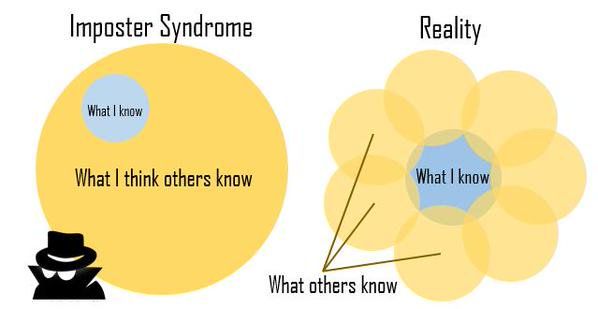
In reality, we're all specialists within the Rust project. We all have areas where we have deep expertise and other large areas where we only have the vaguest idea of how things work. Niko, one of the lang team co-leads, former compiler team lead and core team alumni, still comes to me to ask questions about error handling. I frequently need to tell my fellow contributors that I have no idea what the acronyms they're using mean3. But this doesn't mean we don't deserve our positions within the project. We don't expect every contributor to know everything, to be perfect, or to make no mistakes. The only thing we expect from our contributors is the ability to collaborate effectively with others and a willingness to learn and grow over time.
The thing that makes the Rust project as good as it is isn't a couple of prolific contributors lifting mountains by themselves, it's everyone working together that brought us to where we are today. We all make mistakes. The project has layer4 after layer5 of safeguards to make sure we have a chance to catch and fix them before they affect our users. These incidents are unavoidable, expected, and honestly fine! This is the most fundamental philosophy of both the Rust language and the Rust project: we don't think it's sufficient to build robust systems by only including people who don't make mistakes; we think it's better to provide tooling and process to catch and prevent mistakes. It isn't an accident that our motto is "A language empowering everyone to build reliable and efficient software." We want people to feel empowered to make changes they're not 100% confident in, to make mistakes, to learn, and to grow within the Rust project. This is how all of us got to where we are today!
So, if you look up to people within the Rust project, if the work we do here interests you, if you have always wanted to contribute, and especially if you already have contributed, I want you to know that you're one of the people we want to apply for Rust Foundation grants and fellowships. You're one of the people we want to eventually see join teams. If you're already on a team, I want you to know that you're there for a good reason, and we value your judgement. You're not an imposter, and I want you to know that I really look forward to seeing you around the project.
Edit: After I posted this it was brought to my attention that the image I used and tweet I cited are not from an original source, and they can actually be traced back to a series of blog posts by Alicia Liu. These original sources do a much more subtle exploration of what is and isn't imposter syndrome, and particularly focus on how imposter syndrome impacts members of marginalized communities, I highly recommend reading these posts.
To help reinforce and normalize this, I've gathered a list of times when current or past project members have struggled with imposter syndrome, have made mistakes, have had to ask "basic" questions, and similar experiences that will hopefully help set more reasonable expectations for new and old contributors across the project.
Pin until I read fasterthanlime's "Pin and
suffering" blog post and
I gave a talk in 2016 where my most important
point was that people
erroneously believe that you have to be an expert to write an RFC or change
Rust, but that I wasn't, and you don't need to be one either."dyn does, it still amazes me that I have something to
give as a team lead. I was immersed in Rust communities by writing weekly
blogs about Veloren (I took this on because I didn't know enough to contribute
code), which lead to helping with the Rust Gamedev newsletter, which led me to
helping to run the Cross Team Collaboration Fun Times meetup!"&T, I had someone from the
audience, a Rust expert, say "ah ah ah! but what about interior mutability";
and in my mind I thought "... oh no; what is that?", followed by "... what am
I doing, I'm not qualified to be up here...". All of us "imposters" must
strive to prevent such moments from becoming barriers to our own
participation. I've learned a lot about Rust (and group dynamics, and
organizational behavior) since then, but I'm still learning every day;
re-learning, in some cases."Quote from https://yaah.dev/getting-involved: "What happened at the Google meetup you ask? Manish, our wonderful meetup organizer, walked up to me, unprompted, and asked “Hey, you’re Jane right?”. I was shocked, how the heck did Manish know who I was? It didn’t feel as though I’d done anything worthy of notice, and yet here he was asking for me by name." ↩
https://twitter.com/ithinkwellHugh/status/1175900121097220096 ↩
https://github.com/rust-lang/project-error-handling/issues/34#issuecomment-1092269566 ↩
Any irreversible changes such as stabilizations require almost everyone on the relevant team to approve the change and zero people on the team to raise concerns. ↩
We double check all changes with crater before they ever land on stable and are careful to quickly revert changes that cause problems on crater or nightly. ↩
此内容由惯性聚合(RSS阅读器)自动聚合整理,仅供阅读参考。 原文来自 — 版权归原作者所有。