

惯性聚合 高效追踪和阅读你感兴趣的博客、新闻、科技资讯
阅读原文 在惯性聚合中打开

推荐订阅源

宝玉的分享
宝玉的分享
T
Threat Research - Cisco Blogs
H
Hacker News: Front Page
N
News and Events Feed by Topic
Know Your Adversary
Know Your Adversary
Cisco Talos Blog
Cisco Talos Blog
SecWiki News
SecWiki News
C
Cisco Blogs
D
Darknet – Hacking Tools, Hacker News & Cyber Security
T
Tor Project blog
K
Kaspersky official blog
Forbes - Security
Forbes - Security
Webroot Blog
Webroot Blog
Schneier on Security
P
Privacy & Cybersecurity Law Blog
H
Heimdal Security Blog
Y
Y Combinator Blog
The GitHub Blog
The GitHub Blog
S
SegmentFault 最新的问题
V
Vulnerabilities – Threatpost
T
Tenable Blog
T
Tailwind CSS Blog
P
Privacy International News Feed
WordPress大学
WordPress大学
大猫的无限游戏
大猫的无限游戏
小众软件
小众软件
博客园 - Franky
Hacker News: Ask HN
Hacker News: Ask HN
Jina AI
Jina AI
C
Cybersecurity and Infrastructure Security Agency CISA
CTFtime.org: upcoming CTF events
雷峰网
雷峰网
Vercel News
Vercel News
A
About on SuperTechFans
爱范儿
爱范儿
Simon Willison's Weblog
AWS News Blog
AWS News Blog
The Last Watchdog
The Last Watchdog
Engineering at Meta
Engineering at Meta
Spread Privacy
Spread Privacy
Security Archives - TechRepublic
博客园 - 司徒正美
量子位
博客园 - 三生石上(FineUI控件)
J
Java Code Geeks
Hacker News - Newest:
Hacker News - Newest: "LLM"
Recorded Future
Recorded Future
H
Hackread – Cybersecurity News, Data Breaches, AI and More
Martin Fowler
Martin Fowler
Project Zero
Project Zero

Rust Blog

Security Advisory for Cargo (CVE-2026-5223) | Rust Blog Security Advisory for Cargo (CVE-2026-5222) | Rust Blog Project goals update — April 2026 (end of 2025H2) | Rust Blog Rust is participating in Outreachy | Rust Blog Raising the baseline for the `nvptx64-nvidia-cuda` target | Rust Blog Announcing Google Summer of Code 2026 selected projects | Rust Blog Announcing Rust 1.95.0 | Rust Blog docs.rs: building fewer targets by default | Rust Blog Changes to WebAssembly targets and handling undefined symbols | Rust Blog Announcing Rust 1.94.1 | Rust Blog Security advisory for Cargo | Rust Blog What we heard about Rust's challenges | Rust Blog Call for Testing: Build Dir Layout v2 | Rust Blog Announcing rustup 1.29.0 | Rust Blog Announcing Rust 1.94.0 | Rust Blog 2025 State of Rust Survey Results | Rust Blog Rust debugging survey 2026 | Rust Blog Update on the October 15, 2018 incident on crates.io Announcing Rust 1.29.2 Announcing Rust 1.29 Launching the 2018 State of Rust Survey Announcing Rust 1.28 What is Rust 2018? Announcing Rust 1.27.2 Announcing Rust 1.27.1 Security Advisory for rustdoc Announcing Rust 1.27 Announcing Rust 1.26.2 Announcing Rust 1.26.1 Announcing Rust 1.26 The Rust Team All Hands in Berlin: a Recap Increasing Rust’s Reach 2018 Announcing Rust 1.25 Rust's 2018 roadmap Announcing Rust 1.24.1 Announcing Rust 1.24 The 2018 Rust Event Lineup Announcing Rust 1.23 New Year's Rust: A Call for Community Blogposts Rust in 2017: what we achieved Announcing Rust 1.22 (and 1.22.1) Fearless Concurrency in Firefox Quantum Announcing Rust 1.21 impl Future for Rust Rust 2017 Survey Results Announcing Rust 1.20 Announcing Rust 1.19 The 2017 Rust Conference Lineup Rust's 2017 roadmap, six months in Increasing Rust’s Reach Announcing Rust 1.18 Two years of Rust The Rust Libz Blitz Launching the 2017 State of Rust Survey Announcing Rust 1.17 Announcing Rust 1.16 Rust's language ergonomics initiative Announcing Rust 1.15.1 Rust's 2017 roadmap Announcing Rust 1.15 Announcing Rust 1.14 Announcing the First Underhanded Rust Contest Announcing Rust 1.13 Announcing Rust 1.12.1 Announcing Rust 1.12 Incremental Compilation Announcing Rust 1.11 Shape of errors to come The 2016 Rust Conference Lineup Announcing Rust 1.10 State of Rust Survey 2016 Announcing Rust 1.9 One year of Rust Taking Rust everywhere with rustup Launching the 2016 State of Rust Survey Cargo: predictable dependency management Introducing MIR Announcing Rust 1.8 Announcing Rust 1.7 Announcing Rust 1.6 Announcing Rust 1.5 Announcing Rust 1.4 Announcing Rust 1.3 Rust in 2016 Announcing Rust 1.2 Rust 1.1 stable, the Community Subteam, and RustCamp Announcing Rust 1.0 Abstraction without overhead: traits in Rust Rust Once, Run Everywhere Mixing matching, mutation, and moves in Rust Fearless Concurrency with Rust Announcing Rust 1.0 Beta Announcing Rust 1.0.0.alpha.2 Rust 1.0: status report and final timeline Announcing Rust 1.0 Alpha Rust 1.0: Scheduling the trains Yehuda Katz and Steve Klabnik are joining the Rust Core Team Cargo: Rust's community crate host Stability as a Deliverable Road to Rust 1.0
Rust turns three
Aaron Turon · 2018-05-15 · via Rust Blog

Three years ago today, the Rust community released Rust 1.0 to the world, with our initial vision of fearless systems programming. As per tradition, we’ll celebrate Rust’s birthday by taking stock of the people and the product, and especially of what’s happened in the last year.

The People

Rust is a people-centric, consensus-driven project. Some of the most exciting developments over the last year have to do with how the project itself has grown, and how its processes have scaled.

The official teams that oversee the project doubled in size in the last year; there are now over a hundred individuals associated with one or more of the teams. To accommodate this scale, the team structure itself has evolved. We have top-level teams covering the language, library ecosystem, developer tooling, documentation, community, and project operations. Nested within these are dozens of subteams and working groups focused on specific topics.

Rust is now used in a huge variety of companies, including both newcomers and big names like Google, Facebook, Twitter, Dropbox, Microsoft, Red Hat, npm and, of course, Mozilla; it’s also in the top 15 languages this year on GitHub. As a byproduct, more and more developers are being paid to contribute back to Rust, many of them full time. As of today, Mozilla employees make up only 11% of the official Rust teams, and just under half of the total number of people paid to work on Rust. (You can read detailed whitepapers about putting Rust into production here.)
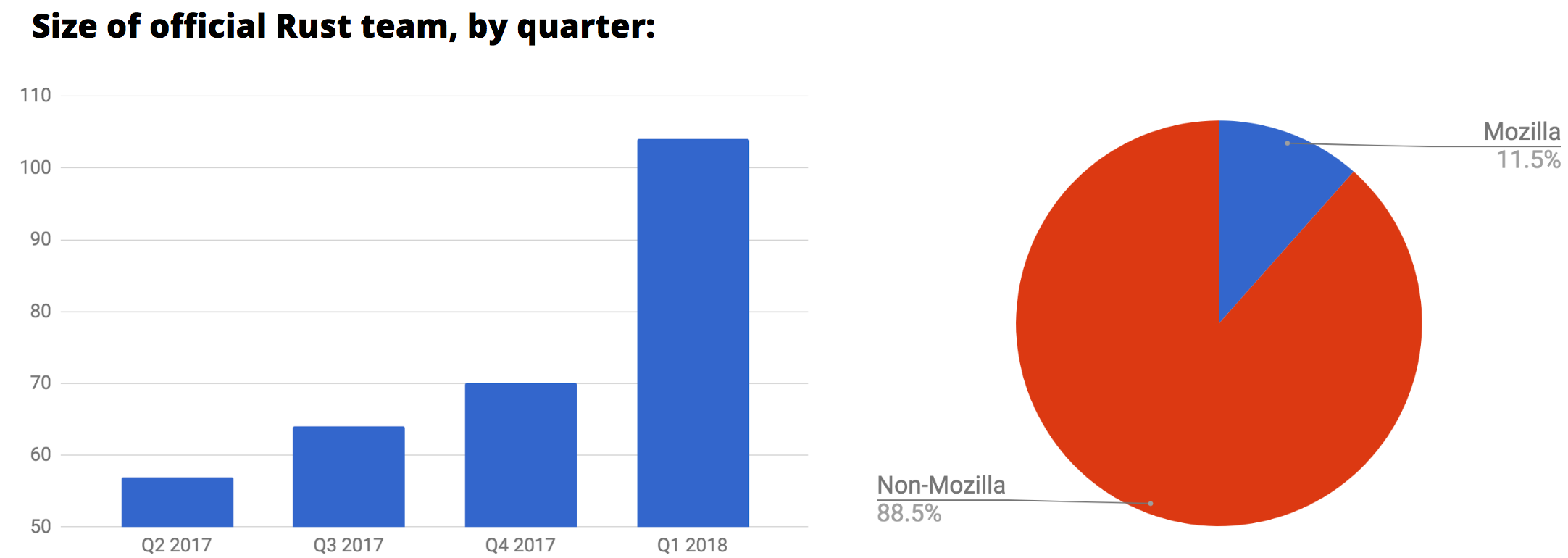
Graphs of Rust team growth

Finally, the Rust community continues to work on inclusivity, through outreach programs like Rust Reach and RustBridge, as well as structured mentoring and investments in documentation to ease contribution. For 2018, a major goal is to connect and empower Rust’s global community, which we’re doing both through conference launches in multiple new continents, as well as work toward internationalization throughout the project.

The Product

If you spend much time reading this blog, you’ll know that the major theme of our work over the past year has been productivity. As we said in last year’s roadmap:

From tooling to libraries to documentation to the core language, we want to make it easier to get things done with Rust.

This work will culminate in a major release later this year: Rust 2018 Edition. The release will bring together improvements in every area of the project, polished into a new “edition” that bundles the changes together with updated documentation and onboarding. The roadmap has some details about what to expect.

The components that make up Rust 2018 will be shipped as they become ready on the stable compiler. Recent releases include:

The next couple of releases will include stable SIMD support, procedural macros, custom allocators, and more. The final big features — lifetime system improvements and async/await — should both reach feature complete status on nightly within weeks. Vital tools like the RLS and rustfmt are also being polished for the new edition, including RFCs for finalizing the style and stability stories.

To help tie all this work to real-world use-cases, we’ve also targeted four domains for which Rust provides a compelling end-to-end story that we want to show the world as part of Rust 2018. Each domain has a dedicated working group and is very much open for new contributors:

As Rust 2018 comes into focus, we plan to provide a “preview” of the new edition for cutting-edge community members to try out. Over the past couple of weeks we kicked off a sprint to get the basics nailed down, but we need more help to get it ready for testing. If you’re interested, you can dive into:

The Postscript

Rust’s growth continues to accelerate at a staggering rate. It has been voted the Most Loved Language on StackOverflow for all three years since it shipped. Its community has never been healthier or more welcoming. If you’re curious about using or contributing to Rust, there’s never been a better time to get involved.

Happy 3rd birthday, Rust.