


The Cargo and Compiler team are delighted to announce that starting with Rust 1.80 (or nightly-2024-05-05) every reachable #[cfg] will be automatically checked that they match the expected config names and values.
This can help with verifying that the crate is correctly handling conditional compilation for different target platforms or features. It ensures that the cfg settings are consistent between what is intended and what is used, helping to catch potential bugs or errors early in the development process.
This addresses a common pitfall for new and advanced users.
This is another step to our commitment to provide user-focused tooling and we are eager and excited to finally see it fixed, after more than two years since the original RFC 30131.
Every time a Cargo feature is declared that feature is transformed into a config that is passed to rustc (the Rust compiler) so it can verify with it along with well known cfgs if any of the #[cfg], #![cfg_attr] and cfg! have unexpected configs and report a warning with the unexpected_cfgs lint.
Cargo.toml:
[package]
name = "foo"

[features]
lasers = []
zapping = []src/lib.rs:
#[cfg(feature = "lasers")]  // This condition is expected
                            // as "lasers" is an expected value
                            // of the `feature` cfg
fn shoot_lasers() {}

#[cfg(feature = "monkeys")] // This condition is UNEXPECTED
                            // as "monkeys" is NOT an expected
                            // value of the `feature` cfg
fn write_shakespeare() {}

#[cfg(windosw)]             // This condition is UNEXPECTED
                            // it's supposed to be `windows`
fn win() {}
cargo check:
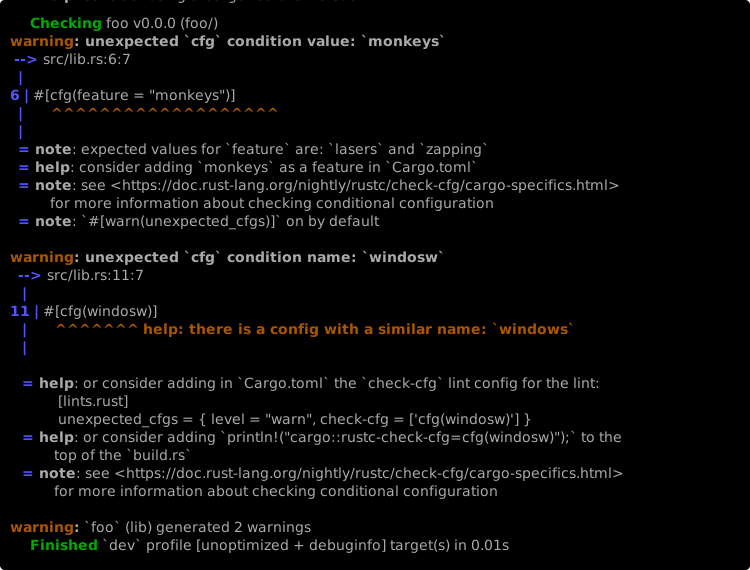
UPDATE: This section was added with the release of nightly-2024-05-19.
In Cargo point-of-view: a custom cfg is one that is neither defined by
rustcnor by a Cargo feature. Think oftokio_unstable,has_foo, ... but notfeature = "lasers",unixordebug_assertions
Some crates might use custom cfgs, like loom, fuzzing or tokio_unstable that they expected from the environment (RUSTFLAGS or other means) and which are always statically known at compile time. For those cases, Cargo provides via the [lints] table a way to statically declare those cfgs as expected.
Defining those custom cfgs as expected is done through the special check-cfg config under [lints.rust.unexpected_cfgs]:
Cargo.toml
[lints.rust]
unexpected_cfgs = { level = "warn", check-cfg = ['cfg(loom)', 'cfg(fuzzing)'] }On the other hand some crates use custom cfgs that are enabled by some logic in the crate build.rs. For those crates Cargo provides a new instruction: cargo::rustc-check-cfg2 (or cargo:rustc-check-cfg for older Cargo version).
The syntax to use is described in the rustc book section checking configuration, but in a nutshell the basic syntax of --check-cfg is:
cfg(name, values("value1", "value2", ..., "valueN"))Note that every custom cfgs must always be expected, regardless if the cfg is active or not!
build.rs examplebuild.rs:
fn main() {
    println!("cargo::rustc-check-cfg=cfg(has_foo)");
    //        ^^^^^^^^^^^^^^^^^^^^^^ new with Cargo 1.80
    if has_foo() {
        println!("cargo::rustc-cfg=has_foo");
    }
}
Each
cargo::rustc-cfgshould have an accompanying unconditionalcargo::rustc-check-cfgdirective to avoid warnings like this:unexpected cfg condition name: has_foo.
cargo::rustc-cfg | cargo::rustc-check-cfg |
|---|---|
foo | cfg(foo) or cfg(foo, values(none())) |
foo="" | cfg(foo, values("")) |
foo="bar" | cfg(foo, values("bar")) |
foo="1" and foo="2" | cfg(foo, values("1", "2")) |
foo="1" and bar="2" | cfg(foo, values("1")) and cfg(bar, values("2")) |
foo and foo="bar" | cfg(foo, values(none(), "bar")) |
More details can be found in the rustc book.
For Cargo users, the feature is always on and cannot be disabled, but like any other lints it can be controlled: #![warn(unexpected_cfgs)].
No, like most lints, unexpected_cfgs will only be reported for local packages thanks to cap-lints.
RUSTFLAGS env?You should be able to use the RUSTFLAGS environment variable like it was before.
Currently --cfg arguments are not checked, only usage in code are.
This means that doing RUSTFLAGS="--cfg tokio_unstable" cargo check will not report any warnings, unless tokio_unstable is used within your local crates, in which case crate author will need to make sure that that custom cfg is expected with cargo::rustc-check-cfg in the build.rs of that crate.
build.rs?UPDATE: Cargo with nightly-2024-05-19 now provides the [lints.rust.unexpected_cfgs.check-cfg] config to address the statically known custom cfgs.
There is currently no way to expect a custom cfg other than with cargo::rustc-check-cfg in a build.rs.
Crate authors that don't want to use a build.rs and cannot use [lints.rust.unexpected_cfgs.check-cfg], are encouraged to use Cargo features instead.
Non-Cargo based build systems are not affected by the lint by default. Build system authors that wish to have the same functionality should look at the rustc documentation for the --check-cfg flag for a detailed explanation of how to achieve the same functionality.
The stabilized implementation and RFC 3013 diverge significantly, in particular there is only one form for --check-cfg: cfg() (instead of values() and names() being incomplete and subtlety incompatible with each other). ↩
cargo::rustc-check-cfg will start working in Rust 1.80 (or nightly-2024-05-05). From Rust 1.77 to Rust 1.79 (inclusive) it is silently ignored. In Rust 1.76 and below a warning is emitted when used without the unstable Cargo flag -Zcheck-cfg. ↩
此内容由惯性聚合(RSS阅读器)自动聚合整理,仅供阅读参考。 原文来自 — 版权归原作者所有。