



惯性聚合 高效追踪和阅读你感兴趣的博客、新闻、科技资讯
阅读原文 在惯性聚合中打开

推荐订阅源

S
SegmentFault 最新的问题
Google Online Security Blog
L
LINUX DO - 最新话题
cs.CV updates on arXiv.org
AI
AI
K
KPMG report finds enterprise disconnect between AI and its ROI | CIO
N
News | PayPal Newsroom
G
GRAHAM CLULEY
V
Vulnerabilities – Threatpost
Cisco Talos Blog
Cisco Talos Blog
Hacker News - Newest:
Hacker News - Newest: "LLM"
P
Privacy & Cybersecurity Law Blog
Google DeepMind News
L
LangChain Blog
T
Tailwind CSS Blog
腾讯CDC
C
CXSECURITY Database RSS Feed - CXSecurity.com
The Cloudflare Blog
Spread Privacy
Spread Privacy
月光博客
月光博客
WordPress大学
WordPress大学
C
CERT Recently Published Vulnerability Notes
小众软件
小众软件
AWS News Blog
AWS News Blog
让小产品的独立变现更简单 - ezindie.com
博客园 - Franky
O
OpenAI News
W
WeLiveSecurity
H
Heimdal Security Blog
Application and Cybersecurity Blog
V
Visual Studio Blog
The Last Watchdog
The Last Watchdog
有赞技术团队
有赞技术团队
量子位
TaoSecurity Blog
TaoSecurity Blog
V
V2EX
罗磊的独立博客
雷峰网
雷峰网
Latest news
Latest news
Jina AI
Jina AI
Simon Willison's Weblog
博客园_首页
博客园 - 聂微东
L
Lohrmann on Cybersecurity
V2EX - 技术
V2EX - 技术
T
The Exploit Database - CXSecurity.com
www.infosecurity-magazine.com
freeCodeCamp Programming Tutorials: Python, JavaScript, Git & More
Security Latest
Security Latest
Help Net Security
Help Net Security

Rust Blog

Security Advisory for Cargo (CVE-2026-5223) | Rust Blog Security Advisory for Cargo (CVE-2026-5222) | Rust Blog Project goals update — April 2026 (end of 2025H2) | Rust Blog Rust is participating in Outreachy | Rust Blog Raising the baseline for the `nvptx64-nvidia-cuda` target | Rust Blog Announcing Google Summer of Code 2026 selected projects | Rust Blog Announcing Rust 1.95.0 | Rust Blog docs.rs: building fewer targets by default | Rust Blog Changes to WebAssembly targets and handling undefined symbols | Rust Blog Announcing Rust 1.94.1 | Rust Blog Security advisory for Cargo | Rust Blog What we heard about Rust's challenges | Rust Blog Call for Testing: Build Dir Layout v2 | Rust Blog Announcing rustup 1.29.0 | Rust Blog Announcing Rust 1.94.0 | Rust Blog 2025 State of Rust Survey Results | Rust Blog Rust debugging survey 2026 | Rust Blog Update on the October 15, 2018 incident on crates.io Announcing Rust 1.29.2 Announcing Rust 1.29 Announcing Rust 1.28 What is Rust 2018? Announcing Rust 1.27.2 Announcing Rust 1.27.1 Security Advisory for rustdoc Announcing Rust 1.27 Announcing Rust 1.26.2 Announcing Rust 1.26.1 Rust turns three Announcing Rust 1.26 The Rust Team All Hands in Berlin: a Recap Increasing Rust’s Reach 2018 Announcing Rust 1.25 Rust's 2018 roadmap Announcing Rust 1.24.1 Announcing Rust 1.24 The 2018 Rust Event Lineup Announcing Rust 1.23 New Year's Rust: A Call for Community Blogposts Rust in 2017: what we achieved Announcing Rust 1.22 (and 1.22.1) Fearless Concurrency in Firefox Quantum Announcing Rust 1.21 impl Future for Rust Rust 2017 Survey Results Announcing Rust 1.20 Announcing Rust 1.19 The 2017 Rust Conference Lineup Rust's 2017 roadmap, six months in Increasing Rust’s Reach Announcing Rust 1.18 Two years of Rust The Rust Libz Blitz Launching the 2017 State of Rust Survey Announcing Rust 1.17 Announcing Rust 1.16 Rust's language ergonomics initiative Announcing Rust 1.15.1 Rust's 2017 roadmap Announcing Rust 1.15 Announcing Rust 1.14 Announcing the First Underhanded Rust Contest Announcing Rust 1.13 Announcing Rust 1.12.1 Announcing Rust 1.12 Incremental Compilation Announcing Rust 1.11 Shape of errors to come The 2016 Rust Conference Lineup Announcing Rust 1.10 State of Rust Survey 2016 Announcing Rust 1.9 One year of Rust Taking Rust everywhere with rustup Launching the 2016 State of Rust Survey Cargo: predictable dependency management Introducing MIR Announcing Rust 1.8 Announcing Rust 1.7 Announcing Rust 1.6 Announcing Rust 1.5 Announcing Rust 1.4 Announcing Rust 1.3 Rust in 2016 Announcing Rust 1.2 Rust 1.1 stable, the Community Subteam, and RustCamp Announcing Rust 1.0 Abstraction without overhead: traits in Rust Rust Once, Run Everywhere Mixing matching, mutation, and moves in Rust Fearless Concurrency with Rust Announcing Rust 1.0 Beta Announcing Rust 1.0.0.alpha.2 Rust 1.0: status report and final timeline Announcing Rust 1.0 Alpha Rust 1.0: Scheduling the trains Yehuda Katz and Steve Klabnik are joining the Rust Core Team Cargo: Rust's community crate host Stability as a Deliverable Road to Rust 1.0
Keeping Rust projects secure with cargo-audit 0.9: dependency trees, core advisories, unmaintained crates | Inside Rust Blog
Tony Arcieri on behalf of the Secure Code WG · 2019-10-03 · via Rust Blog

cargo-audit is a command-line utility which inspects Cargo.lock files and compares them against the RustSec Advisory Database, a community database of security vulnerabilities maintained by the Rust Secure Code Working Group.

You can install cargo-audit and run it against your project with the following commands:

$ cargo install cargo-audit
$ cargo audit

The 0.9 release of cargo-audit includes a number of new features we hope make it more useful, including:

  • UI improvements for understanding how vulnerabilities apply to your project
  • Warnings for unmaintained crate dependencies (with an option to hard fail)
  • Tracking of vulnerabilities in the Rust language itself

UI improvements: dependency trees

Previously, when cargo-audit found a vulnerability in a project, it would display advisory information without any context as to how a particular vulnerable dependency is included in your project, making it difficult to determine what action needs to be taken to resolve the vulnerability.

The latest release prints an inverse dependency tree (ala the excellent cargo-tree crate) for each advisory showing how a vulnerable dependency is included in your project:
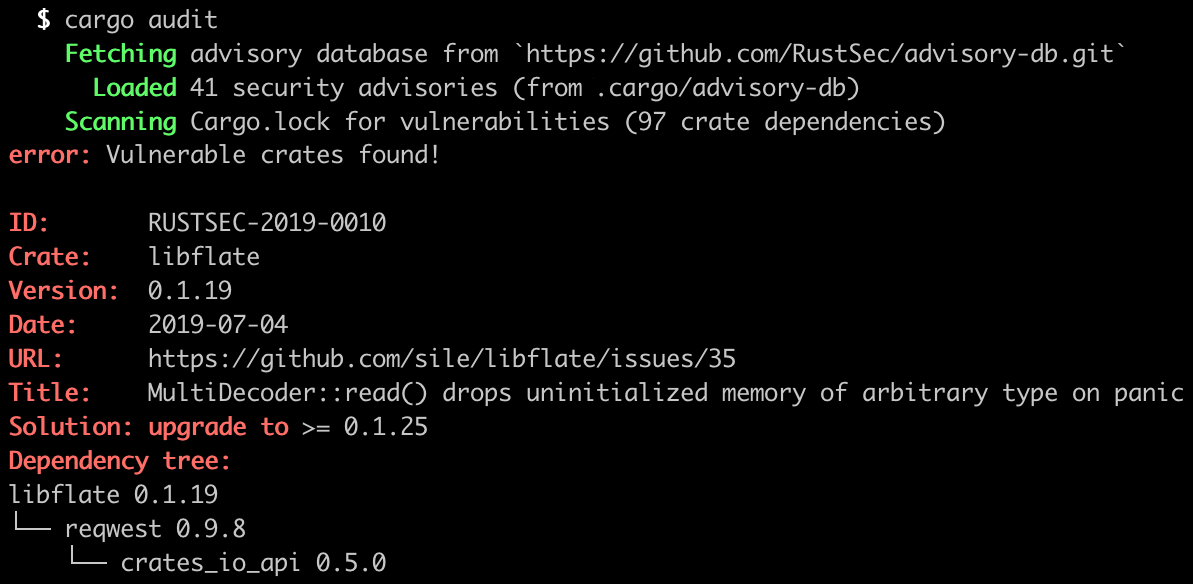
cargo audit with dependency tree

In future versions of cargo-audit we hope to add a cargo audit fix command ala npm audit fix which can either automatically update the necessary dependencies or provide instructions on how to do so. If that feature interests you and you'd like to contribute, we're looking for help!

New feature: unmaintained crate warnings

This release added the notion of informational advisories - advisories which don't directly represent a security vulnerability, but may contain potentially security-relevant information. The primary intended use for this feature is providing warnings for unmaintained crates.

A recent study, Small World with High Risks: A Study of Security Threats in the npm Ecosystem, showed that unmaintained npm packages pose a high risk to that ecosystem:

Our results provide evidence that npm suffers from single points of failure and that unmaintained packages threaten large code bases

Rust is in a similar boat with some high profile crates, such as the term crate (downloaded 8,000 times a day), are unmaintained. By tracking information about unmaintained crates in the RustSec Advisory Database, we hope to improve visibility on these crates, either by helping people discover "successor" crates they should switch to, or putting potential volunteer maintainers in touch with authors interested in handing crates off. When those handoffs happen, we can mark unmaintained crate advisories as obsolete (while still giving interested security researchers a list of crates to keep an eye on for potential software supply chain attacks).

If you have an unmaintained crate you'd like us to create an advisory for, or know of a third party unmaintained crate and would like to provide information about potential alternatives, please leave a comment in the RustSec/advisory-db#173 GitHub issue and we can file an advisory for it.

For now, unmaintained crates are surfaced as warnings, with some brief information available about each one and a link to click to read more. If you'd like for unmaintained crate advisories to be considered errors (so cargo-audit exits with a non-zero status for e.g. CI purposes), run:

$ cargo audit -D

or if you prefer to be more explicit:

$ cargo audit --deny-warnings

Tracking Rust language vulnerabilities

Previously the RustSec Advisory Database only tracked information about vulnerable crates published through crates.io. Starting with this release, however, we are also indexing advisories for vulnerabilities in the Rust language's core ecosystem components, including std, cargo, and rustdoc. We've now indexed the following vulnerabilities:

We are interested in potentially surfacing information about these advisories via cargo-audit, e.g. optionally detecting if the currently active Rust toolchain is vulnerable. If that interests you, we're also looking for help on this issue!

Thanks for reading, and we hope you enjoy cargo-audit 0.9!