


惯性聚合 高效追踪和阅读你感兴趣的博客、新闻、科技资讯
阅读原文 在惯性聚合中打开

推荐订阅源

Google DeepMind News
TaoSecurity Blog
TaoSecurity Blog
T
Threat Research - Cisco Blogs
Cisco Talos Blog
Cisco Talos Blog
cs.CL updates on arXiv.org
T
Tenable Blog
C
Cybersecurity and Infrastructure Security Agency CISA
GbyAI
GbyAI
Microsoft Security Blog
N
Netflix TechBlog - Medium
AWS News Blog
AWS News Blog
Security Latest
Security Latest
L
LINUX DO - 热门话题
Blog — PlanetScale
Blog — PlanetScale
T
Threatpost
Stack Overflow Blog
Stack Overflow Blog
Vercel News
Vercel News
S
Securelist
I
Intezer
D
Darknet – Hacking Tools, Hacker News & Cyber Security
H
Heimdal Security Blog
T
The Exploit Database - CXSecurity.com
Threat Intelligence Blog | Flashpoint
The Hacker News
The Hacker News
cs.CV updates on arXiv.org
H
Hackread – Cybersecurity News, Data Breaches, AI and More
U
Unit 42
The Register - Security
NISL@THU
NISL@THU
S
Schneier on Security
M
MIT News - Artificial intelligence
The Last Watchdog
The Last Watchdog
Cyber Security Advisories - MS-ISAC
Hugging Face - Blog
Hugging Face - Blog
cs.AI updates on arXiv.org
Hacker News - Newest:
Hacker News - Newest: "LLM"
Y
Y Combinator Blog
Know Your Adversary
Know Your Adversary
罗磊的独立博客
MongoDB | Blog
MongoDB | Blog
美团技术团队
W
WeLiveSecurity
P
Privacy International News Feed
Forbes - Security
Forbes - Security
H
Hacker News: Front Page
小众软件
小众软件
博客园 - 【当耐特】
P
Proofpoint News Feed
P
Privacy & Cybersecurity Law Blog
T
Tor Project blog

Rust Blog

Security Advisory for Cargo (CVE-2026-5223) | Rust Blog Security Advisory for Cargo (CVE-2026-5222) | Rust Blog Project goals update — April 2026 (end of 2025H2) | Rust Blog Rust is participating in Outreachy | Rust Blog Raising the baseline for the `nvptx64-nvidia-cuda` target | Rust Blog Announcing Google Summer of Code 2026 selected projects | Rust Blog Announcing Rust 1.95.0 | Rust Blog docs.rs: building fewer targets by default | Rust Blog Changes to WebAssembly targets and handling undefined symbols | Rust Blog Announcing Rust 1.94.1 | Rust Blog Security advisory for Cargo | Rust Blog What we heard about Rust's challenges | Rust Blog Call for Testing: Build Dir Layout v2 | Rust Blog Announcing rustup 1.29.0 | Rust Blog Announcing Rust 1.94.0 | Rust Blog 2025 State of Rust Survey Results | Rust Blog Rust debugging survey 2026 | Rust Blog Update on the October 15, 2018 incident on crates.io Announcing Rust 1.29.2 Announcing Rust 1.29 Announcing Rust 1.28 What is Rust 2018? Announcing Rust 1.27.2 Announcing Rust 1.27.1 Security Advisory for rustdoc Announcing Rust 1.27 Announcing Rust 1.26.2 Announcing Rust 1.26.1 Rust turns three Announcing Rust 1.26 The Rust Team All Hands in Berlin: a Recap Increasing Rust’s Reach 2018 Announcing Rust 1.25 Rust's 2018 roadmap Announcing Rust 1.24.1 Announcing Rust 1.24 The 2018 Rust Event Lineup Announcing Rust 1.23 New Year's Rust: A Call for Community Blogposts Rust in 2017: what we achieved Announcing Rust 1.22 (and 1.22.1) Fearless Concurrency in Firefox Quantum Announcing Rust 1.21 impl Future for Rust Rust 2017 Survey Results Announcing Rust 1.20 Announcing Rust 1.19 The 2017 Rust Conference Lineup Rust's 2017 roadmap, six months in Increasing Rust’s Reach Announcing Rust 1.18 Two years of Rust The Rust Libz Blitz Launching the 2017 State of Rust Survey Announcing Rust 1.17 Announcing Rust 1.16 Rust's language ergonomics initiative Announcing Rust 1.15.1 Rust's 2017 roadmap Announcing Rust 1.15 Announcing Rust 1.14 Announcing the First Underhanded Rust Contest Announcing Rust 1.13 Announcing Rust 1.12.1 Announcing Rust 1.12 Incremental Compilation Announcing Rust 1.11 Shape of errors to come The 2016 Rust Conference Lineup Announcing Rust 1.10 State of Rust Survey 2016 Announcing Rust 1.9 One year of Rust Taking Rust everywhere with rustup Launching the 2016 State of Rust Survey Cargo: predictable dependency management Introducing MIR Announcing Rust 1.8 Announcing Rust 1.7 Announcing Rust 1.6 Announcing Rust 1.5 Announcing Rust 1.4 Announcing Rust 1.3 Rust in 2016 Announcing Rust 1.2 Rust 1.1 stable, the Community Subteam, and RustCamp Announcing Rust 1.0 Abstraction without overhead: traits in Rust Rust Once, Run Everywhere Mixing matching, mutation, and moves in Rust Fearless Concurrency with Rust Announcing Rust 1.0 Beta Announcing Rust 1.0.0.alpha.2 Rust 1.0: status report and final timeline Announcing Rust 1.0 Alpha Rust 1.0: Scheduling the trains Yehuda Katz and Steve Klabnik are joining the Rust Core Team Cargo: Rust's community crate host Stability as a Deliverable Road to Rust 1.0
cargo-audit v0.11: Introducing the `fix` feature, yanked crate detection, and more | Inside Rust Blog
Tony Arcieri on behalf of the Secure Code WG · 2020-01-23 · via Rust Blog

cargo-audit is a command-line utility which inspects Cargo.lock files and compares them against the RustSec Advisory Database, a community database of security vulnerabilities maintained by the Rust Secure Code Working Group.

This post describes the new features in the 0.11 release of cargo-audit.

cargo audit fix: automatically update vulnerable dependencies

One of our most requested features (especially by fans of the similar npm audit fix command), the new cargo audit fix subcommand will attempt to automatically update version requirements for vulnerable dependencies to non-vulnerable versions.

Note that this is an experimental new feature which isn't enabled by default. To try it out, install cargo-audit with the following:

$ cargo install cargo-audit --features=fix

This will perform the same audit process as cargo audit initially, and then attempt to apply fixes to your Cargo.toml:
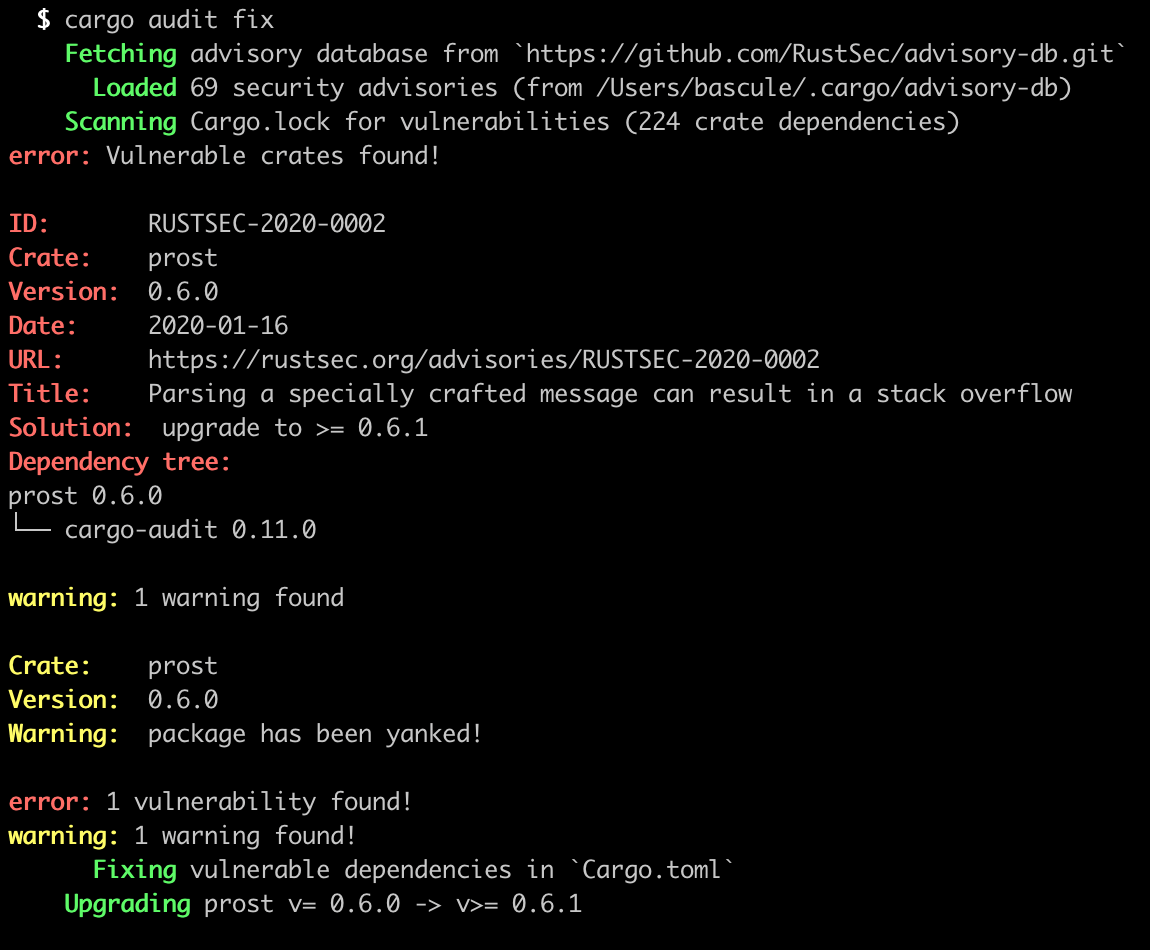
cargo audit fix screenshot

Under the hood, it uses cargo-edit (as a library) to perform modifications to your Cargo.toml file, using the fixed version requirements listed in the advisory to try to perform an automatic upgrade to a non-vulnerable version of a dependency for each advisory.

Note once more that this is a new, experimental feature and as such it's bound to have bugs. If you're worried, you can use cargo audit fix --dry-run to perform a dry run only. And if you do encounter bugs, please file a bug report.

We'd like to thank Reza Fatahi and Hanif Ariffin for their work in contributing this feature.

Warnings for yanked crates

As you can see in the screenshot above, cargo audit now checks each of the crates in your Cargo.lock file against the crates.io index to determine if any of them have been yanked. If they have, it will emit a warning as per above.

If you'd like for yanked crates to be a hard failure, you can run cargo audit with the -D command-line argument:

$ cargo audit -D

or if you prefer to be more explicit:

$ cargo audit --deny-warnings

Compatibility with the new "V2" format for Cargo.lock

Rust 1.39 shipped support for a new merge-friendly Cargo.lock format.

cargo audit consumes Cargo.lock directly, and while the V2 format change didn't break the core vulnerability-auditing functionality of cargo audit, several minor features regressed because of this, such as displaying dependency trees for vulnerable dependencies.

This release also upgrades to version 4.0 of the cargo-lock crate, which includes full support for the V2 Cargo.lock format and constructs a representation of a lockfile which is the same across the V1 and V2 formats.

If you noticed dependency trees failing to display after upgrading to the V2 Cargo.lock format, they should now be working again!

Thanks for reading, and we hope you enjoy cargo-audit 0.11!