








With all that's going on in the world you'd be forgiven for forgetting that as of today, it has been five years since we released 1.0! Rust has changed a lot these past five years, so we wanted to reflect back on all of our contributors' work since the stabilization of the language.
Rust is a general purpose programming language empowering everyone to build reliable and efficient software. Rust can be built to run anywhere in the stack, whether as the kernel for your operating system or your next web app. It is built entirely by an open and diverse community of individuals, primarily volunteers who generously donate their time and expertise to help make Rust what it is.
1.2 — Parallel Codegen: Compile time improvements are a large theme to every release of Rust, and it's hard to imagine that there was a short time where Rust had no parallel code generation at all.
1.3 — The Rustonomicon: Our first release of the fantastic "Rustonomicon", a book that explores Unsafe Rust and its surrounding topics and has become a great resource for anyone looking to learn and understand one of the hardest aspects of the language.
1.4 — Windows MSVC Tier 1 Support: The first tier 1 platform promotion was bringing native support for 64-bit Windows using the Microsoft Visual C++ toolchain (MSVC). Before 1.4 you needed to also have MinGW (a third party GNU environment) installed in order to use and compile your Rust programs. Rust's Windows support is one of the biggest improvements these past five years. Just recently Microsoft announced a public preview of their official Rust support for the WinRT API! Now it's easier than ever build top quality native and cross platform apps.
1.5 — Cargo Install: The addition of being able to build Rust binaries alongside cargo's pre-existing plugin support has given birth to an entire ecosystem of apps, utilities, and developer tools that the community has come to love and depend on. Quite a few of the commands cargo has today were first plugins that the community built and shared on crates.io!
1.6 — Libcore: libcore is a subset of the standard library that only
contains APIs that don't require allocation or operating system level features.
The stabilization of libcore brought the ability to compile Rust with no allocation
or operating system dependency was one of the first major steps towards Rust's
support for embedded systems development.
1.10 — C ABI Dynamic Libraries: The cdylib crate type allows Rust to be
compiled as a C dynamic library, enabling you to embed your Rust projects in
any system that supports the C ABI. Some of Rust's biggest success stories
among users is being able to write a small critical part of their system in
Rust and seamlessly integrate in the larger codebase, and it's now easier
than ever.
1.12 — Cargo Workspaces: Workspaces allow you to organise multiple rust projects and share the same lockfile. Workspaces have been invaluable in building large multi-crate level projects.
1.13 — The Try Operator: The first major syntax addition was the ? or
the "Try" operator. The operator allows you to easily propagate your error
through your call stack. Previously you had to use the try! macro, which
required you to wrap the entire expression each time you encountered a result,
now you can easily chain methods with ? instead.
try!(try!(expression).method()); // Old
expression?.method()?;           // New
1.14 — Rustup 1.0: Rustup is Rust's Toolchain manager, it allows you to seamlessly use any version of Rust or any of its tooling. What started as a humble shell script has become what the maintainers affectionately call a "chimera". Being able to provide first class compiler version management across Linux, macOS, Windows, and the dozens of target platforms would have been a myth just five years ago.
1.15 — Derive Procedural Macros: Derive Macros allow you to create powerful
and extensive strongly typed APIs without all the boilerplate. This was the
first version of Rust you could use libraries like serde or diesel's
derive macros on stable.
1.17 — Rustbuild: One of the biggest improvements for our contributors to
the language was moving our build system from the initial make based system
to using cargo. This has opened up rust-lang/rust to being a lot easier for
members and newcomers alike to build and contribute to the project.
1.20 — Associated Constants: Previously constants could only be associated with a module. In 1.20 we stabilised associating constants on struct, enums, and importantly traits. Making it easier to add rich sets of preset values for types in your API, such as common IP addresses or interesting numbers.
1.24 — Incremental Compilation: Before 1.24 when you made a change in your library rustc would have to re-compile all of the code. Now rustc is a lot smarter about caching as much as possible and only needing to re-generate what's needed.
1.26 — impl Trait: The addition of impl Trait gives you expressive
dynamic APIs with the benefits and performance of static dispatch.
1.28 — Global Allocators: Previously you were restricted to using the
allocator that rust provided. With the global allocator API you can now
customise your allocator to one that suits your needs. This was an important
step in enabling the creation of the alloc library, another subset of the
standard library containing only the parts of std that need an allocator like
Vec or String. Now it's easier than ever to use even more parts of the
standard library on a variety of systems.
1.31 — 2018 edition: The release of the 2018 edition was easily our biggest release since 1.0, adding a collection of syntax changes and improvements to writing Rust written in a completely backwards compatible fashion, allowing libraries built with different editions to seamlessly work together.
cargo fix away from being resolved.1.34 — Alternative Crate Registries: As Rust is used more and more in production, there is a greater need to be able to host and use your projects in non-public spaces, while cargo has always allowed remote git dependencies, with Alternative Registries your organisation can easily build and share your own registry of crates that can be used in your projects like they were on crates.io.
1.39 — Async/Await: The stabilisation of the async/await keywords for handling Futures was one of the major milestones to making async programming in Rust a first class citizen. Even just six months after its release async programming in Rust has blossomed into a diverse and performant ecosystem.
1.42 — Subslice patterns: While not the biggest change, the addition
of the .. (rest) pattern has been a long awaited quality of life
feature that greatly improves the expressivity of pattern matching
with slices.
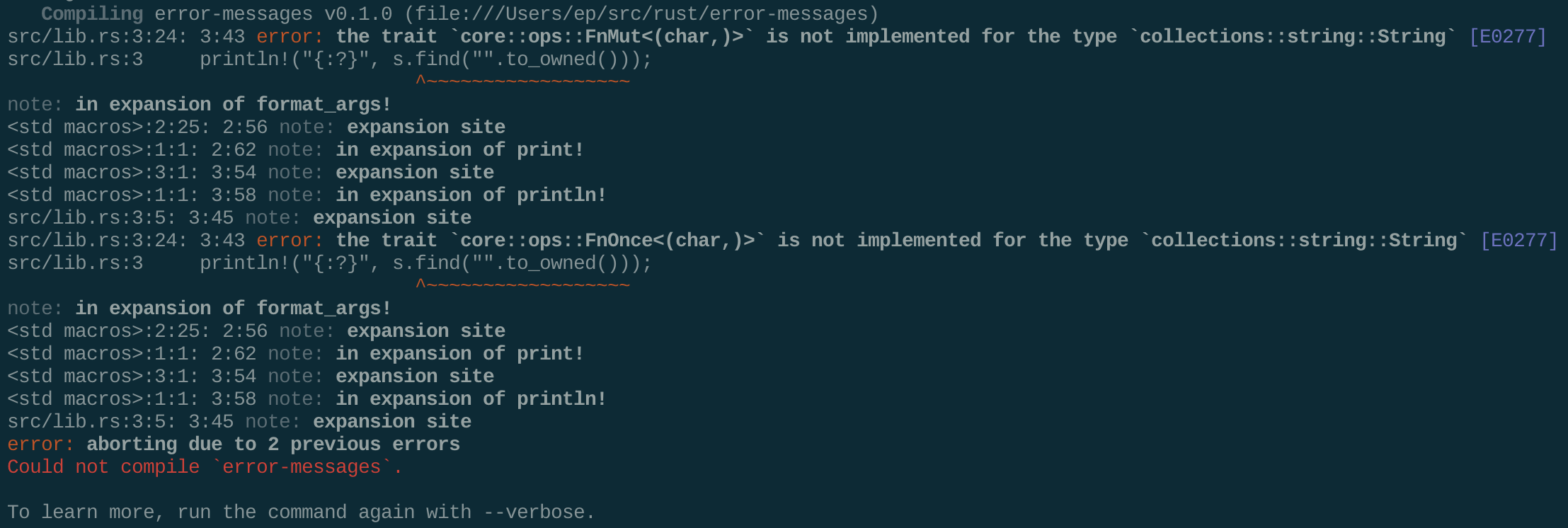
One thing that we haven't mentioned much is how much Rust's error messages and diagnostics have improved since 1.0. Looking at older error messages now feels like looking at a different language.
We’ve highlighted a couple of examples that best showcase just how much we’ve improved showing users where they made mistakes and importantly help them understand why it doesn’t work and teach them how they can fix it.
use std::io::Write;

fn trait_obj(w: &Write) {
    generic(w);
}

fn generic<W: Write>(_w: &W) {} Compiling error-messages v0.1.0 (file:///Users/usr/src/rust/error-messages)
src/lib.rs:6:5: 6:12 error: the trait `core::marker::Sized` is not implemented for the type `std::io::Write` [E0277]
src/lib.rs:6 generic(w);
^~~~~~~
src/lib.rs:6:5: 6:12 note: `std::io::Write` does not have a constant size known at compile-time
src/lib.rs:6 generic(w);
^~~~~~~
error: aborting due to previous error
Could not compile `error-messages`.
To learn more, run the command again with --verbose.
   Compiling error-messages v0.1.0 (/Users/ep/src/rust/error-messages)
error[E0277]: the size for values of type `dyn std::io::Write` cannot be known at compilation time
 --> src/lib.rs:6:13
  |
6 |     generic(w);
  |             ^ doesn't have a size known at compile-time
...
9 | fn generic<W: Write>(_w: &W) {}
  |    ------- -       - help: consider relaxing the implicit `Sized` restriction: `+  ?Sized`
  |            |
  |            required by this bound in `generic`
  |
  = help: the trait `std::marker::Sized` is not implemented for `dyn std::io::Write`
  = note: to learn more, visit <https://doc.rust-lang.org/book/ch19-04-advanced-types.html#dynamically-sized-types-and-the-sized-trait>

error: aborting due to previous error

For more information about this error, try `rustc --explain E0277`.
error: could not compile `error-messages`.

To learn more, run the command again with --verbose.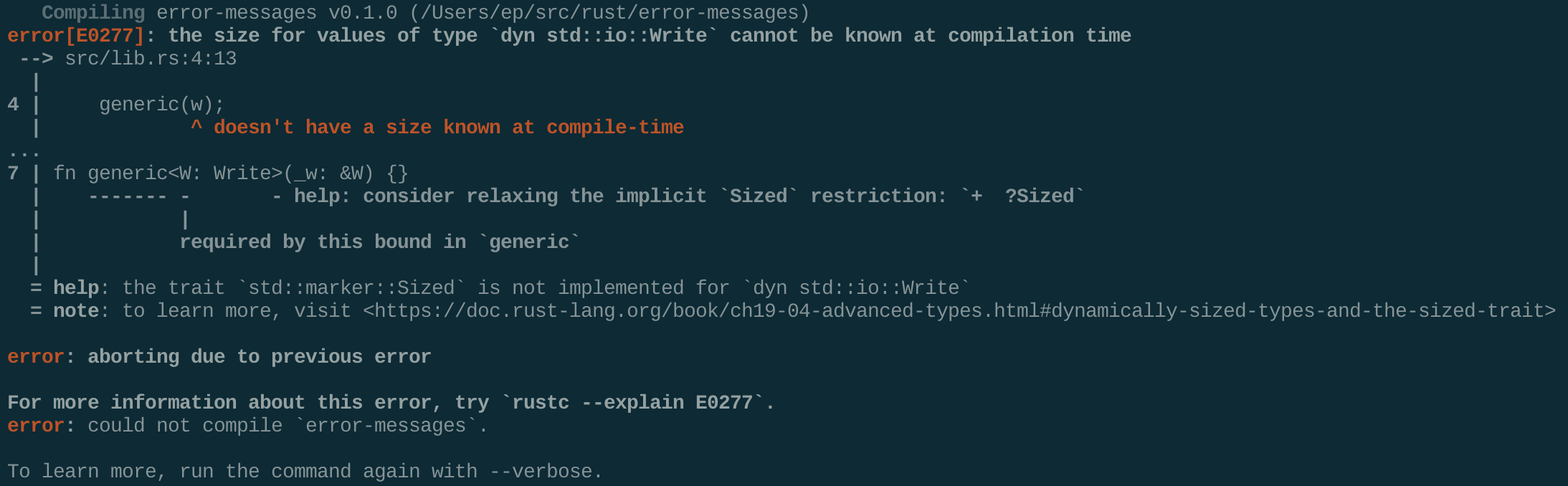
fn main() {
    let s = "".to_owned();
    println!("{:?}", s.find("".to_owned()));
} Compiling error-messages v0.1.0 (file:///Users/ep/src/rust/error-messages)
src/lib.rs:3:24: 3:43 error: the trait `core::ops::FnMut<(char,)>` is not implemented for the type `collections::string::String` [E0277]
src/lib.rs:3 println!("{:?}", s.find("".to_owned()));
^~~~~~~~~~~~~~~~~~~
note: in expansion of format_args!
<std macros>:2:25: 2:56 note: expansion site
<std macros>:1:1: 2:62 note: in expansion of print!
<std macros>:3:1: 3:54 note: expansion site
<std macros>:1:1: 3:58 note: in expansion of println!
src/lib.rs:3:5: 3:45 note: expansion site
src/lib.rs:3:24: 3:43 error: the trait `core::ops::FnOnce<(char,)>` is not implemented for the type `collections::string::String` [E0277]
src/lib.rs:3 println!("{:?}", s.find("".to_owned()));
^~~~~~~~~~~~~~~~~~~
note: in expansion of format_args!
<std macros>:2:25: 2:56 note: expansion site
<std macros>:1:1: 2:62 note: in expansion of print!
<std macros>:3:1: 3:54 note: expansion site
<std macros>:1:1: 3:58 note: in expansion of println!
src/lib.rs:3:5: 3:45 note: expansion site
error: aborting due to 2 previous errors
Could not compile `error-messages`.
To learn more, run the command again with --verbose.
   Compiling error-messages v0.1.0 (/Users/ep/src/rust/error-messages)
error[E0277]: expected a `std::ops::FnMut<(char,)>` closure, found `std::string::String`
 --> src/lib.rs:3:29
  |
3 |     println!("{:?}", s.find("".to_owned()));
  |                             ^^^^^^^^^^^^^
  |                             |
  |                             expected an implementor of trait `std::str::pattern::Pattern<'_>`
  |                             help: consider borrowing here: `&"".to_owned()`
  |
  = note: the trait bound `std::string::String: std::str::pattern::Pattern<'_>` is not satisfied
  = note: required because of the requirements on the impl of `std::str::pattern::Pattern<'_>` for `std::string::String`

error: aborting due to previous error

For more information about this error, try `rustc --explain E0277`.
error: could not compile `error-messages`.

To learn more, run the command again with --verbose.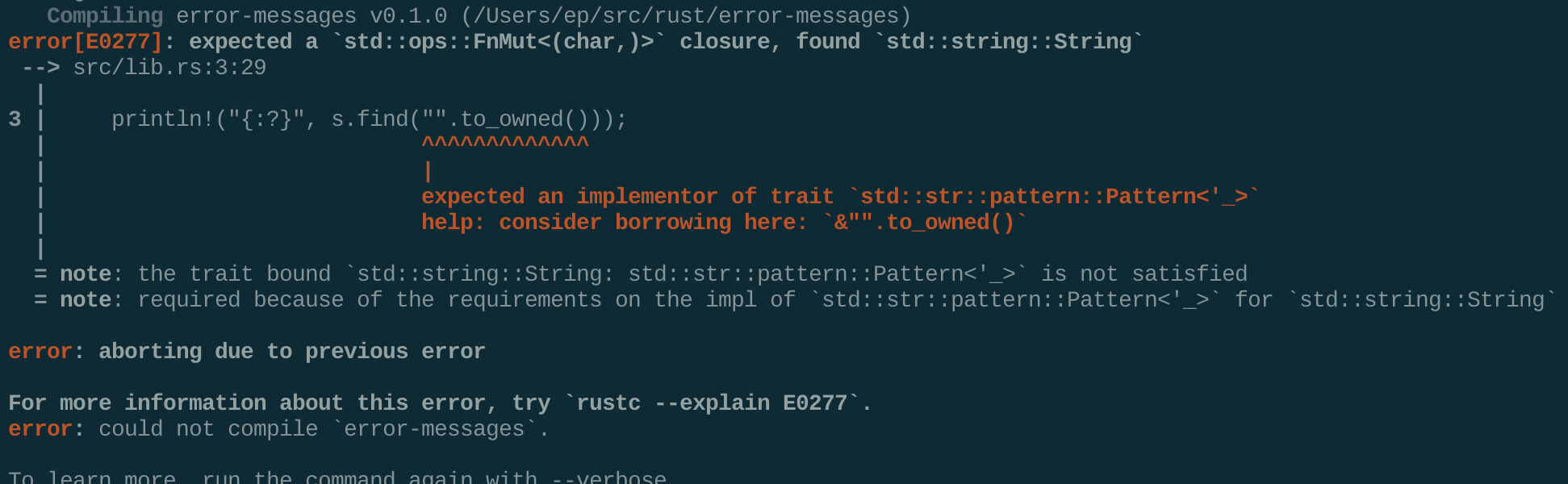
fn main() {
    let mut x = 7;
    let y = &mut x;

    println!("{} {}", x, y);
} Compiling error-messages v0.1.0 (file:///Users/ep/src/rust/error-messages)
src/lib.rs:5:23: 5:24 error: cannot borrow `x` as immutable because it is also borrowed as mutable
src/lib.rs:5 println!("{} {}", x, y);
^
note: in expansion of format_args!
<std macros>:2:25: 2:56 note: expansion site
<std macros>:1:1: 2:62 note: in expansion of print!
<std macros>:3:1: 3:54 note: expansion site
<std macros>:1:1: 3:58 note: in expansion of println!
src/lib.rs:5:5: 5:29 note: expansion site
src/lib.rs:3:18: 3:19 note: previous borrow of `x` occurs here; the mutable borrow prevents subsequent moves, borrows, or modification of `x` until the borrow ends
src/lib.rs:3 let y = &mut x;
^
src/lib.rs:6:2: 6:2 note: previous borrow ends here
src/lib.rs:1 fn main() {
src/lib.rs:2 let mut x = 7;
src/lib.rs:3 let y = &mut x;
src/lib.rs:4
src/lib.rs:5 println!("{} {}", x, y);
src/lib.rs:6 }
^
error: aborting due to previous error
Could not compile `error-messages`.
To learn more, run the command again with --verbose.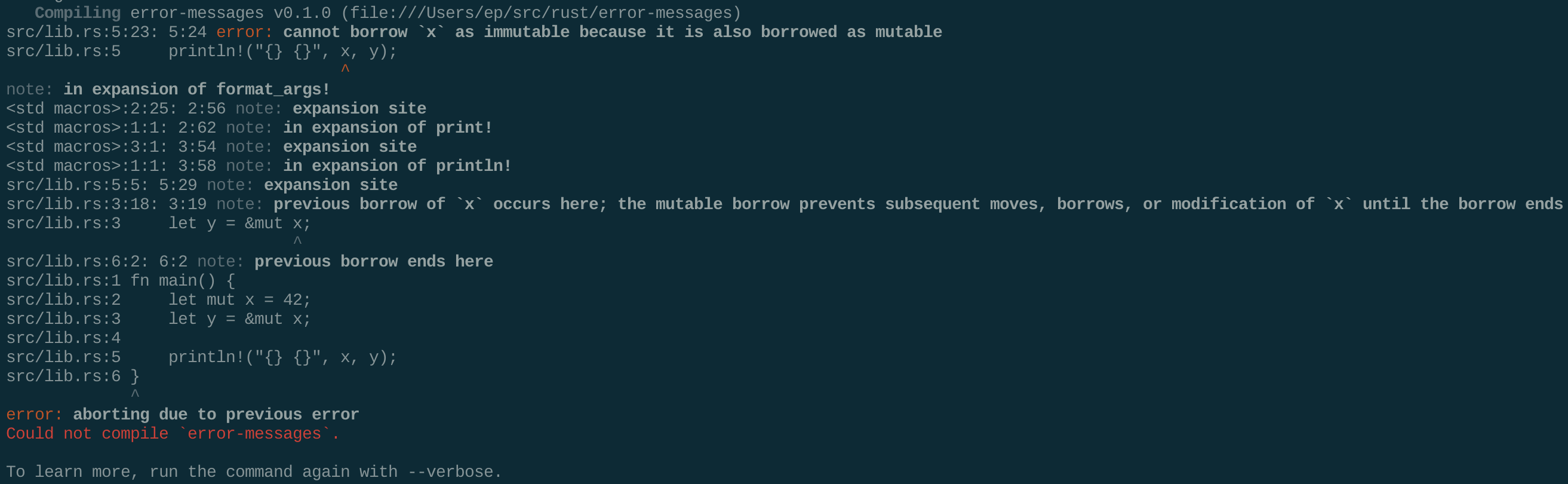
   Compiling error-messages v0.1.0 (/Users/ep/src/rust/error-messages)
error[E0502]: cannot borrow `x` as immutable because it is also borrowed as mutable
 --> src/lib.rs:5:23
  |
3 |     let y = &mut x;
  |             ------ mutable borrow occurs here
4 |
5 |     println!("{} {}", x, y);
  |                       ^  - mutable borrow later used here
  |                       |
  |                       immutable borrow occurs here

error: aborting due to previous error

For more information about this error, try `rustc --explain E0502`.
error: could not compile `error-messages`.

To learn more, run the command again with --verbose.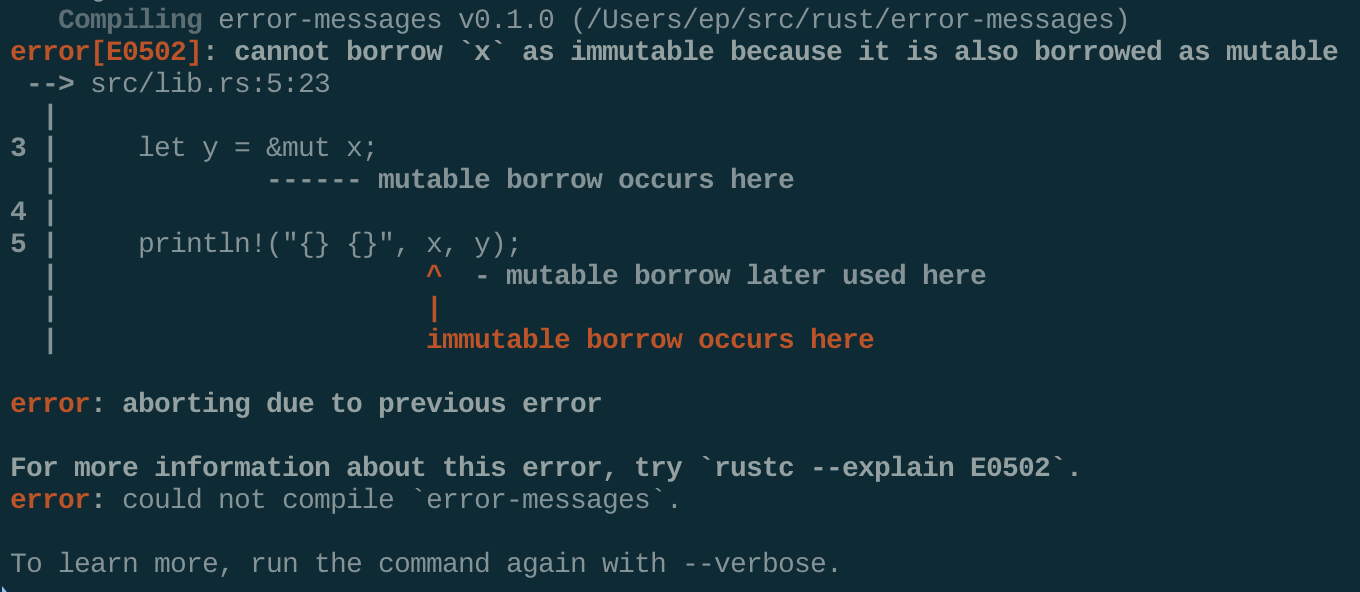
Of course we can't cover every change that has happened. So we reached out and asked some of our teams what changes they are most proud of:
For rustdoc, the big things were:
- The automatically generated documentation for blanket implementations
- The search itself and its optimizations (last one being to convert it into JSON)
- The possibility to test more accurately doc code blocks "compile_fail, should_panic, allow_fail"
- Doc tests are now generated as their own separate binaries.
— Guillaume Gomez (rustdoc)
Rust now has baseline IDE support! Between IntelliJ Rust, RLS and rust-analyzer, I feel that most users should be able to find "not horrible" experience for their editor of choice. Five years ago, "writing Rust" meant using old school Vim/Emacs setup.
— Aleksey Kladov (IDEs and editors)
For me that would be: Adding first class support for popular embedded architectures and achieving a striving ecosystem to make micro controller development with Rust an easy and safe, yet fun experience.
— Daniel Egger (Embedded WG)
The release team has only been around since (roughly) early 2018, but even in that time, we've landed ~40000 commits just in rust-lang/rust without any significant regressions in stable.
Considering how quickly we're improving the compiler and standard libraries, I think that's really impressive (though of course the release team is not the sole contributor here). Overall, I've found that the release team has done an excellent job of managing to scale to the increasing traffic on issue trackers, PRs being filed, etc.
— Mark Rousskov (Release)
Within the last 3 years we managed to turn Miri from an experimental interpreter into a practical tool for exploring language design and finding bugs in real code—a great combination of PL theory and practice. On the theoretical side we have Stacked Borrows, the most concrete proposal for a Rust aliasing model so far. On the practical side, while initially only a few key libraries were checked in Miri by us, recently we saw a great uptake of people using Miri to find and fix bugs in their own crates and dependencies, and a similar uptake in contributors improving Miri e.g. by adding support for file system access, unwinding, and concurrency.
— Ralf Jung (Miri)
If I had to pick one thing I'm most proud of, it was the work on non-lexical lifetimes (NLL). It's not only because I think it made a big difference in the usability of Rust, but also because of the way that we implemented it by forming the NLL working group. This working group brought in a lot of great contributors, many of whom are still working on the compiler today. Open source at its best!
— Niko Matsakis (Language)
As the language has changed and grown a lot in these past five years so has its community. There's been so many great projects written in Rust, and Rust's presence in production has grown exponentially. We wanted to share some statistics on just how much Rust has grown.
When Rust turned 1.0 you could count the number of companies that were using it in production on one hand. Today, it is being used by hundreds of tech companies with some of the largest tech companies such as Apple, Amazon, Dropbox, Facebook, Google, and Microsoft choosing to use Rust for its performance, reliability, and productivity in their projects.
Obviously we couldn't cover every change or improvement to Rust that's happened since 2015. What have been your favourite changes or new favourite Rust projects? Feel free to post your answer and discussion on our Discourse forum.
Lastly, we wanted to thank everyone who has to contributed to the Rust, whether you contributed a new feature or fixed a typo, your work has made Rust the amazing project it is today. We can't wait to see how Rust and its community will continue to grow and change, and see what you all will build with Rust in the coming decade!
此内容由惯性聚合(RSS阅读器)自动聚合整理,仅供阅读参考。 原文来自 — 版权归原作者所有。